Why Yogendra Yadav believes the ADR verdict has implications beyond Bihar’s SIR
The political activist says the judgment sets a precedent for voter roll revisions nationwide and raises troubling questions about judicial safeguards and electoral democracy

As concerns grow over voter list revisions, exclusions, and the future of electoral democracy, The Federal spoke to Yogendra Yadav about the Supreme Court’s verdict, the implications of SIR, allegations of voter roll manipulation, delimitation, and what he sees as emerging challenges to India’s democratic framework.
You compared the ADR judgment to the ADM Jabalpur judgment. Why do you draw such a strong parallel? Could you also explain ADM Jabalpur for readers unfamiliar with it?
Thanks for starting with that because I think that is the essence of what we are going to discuss today.
ADM Jabalpur is spoken about by everyone and taught to every student of law, but very few people outside legal circles know what it was about. The judgment was delivered in 1976, in the middle of the Emergency.
Also read: SIR verdict: Operation successful, patient under observation
During the Emergency, the government had suspended citizens’ rights. The question before the Supreme Court was whether even the most basic right, the right to life, stood suspended. Put very simply, if a police officer killed someone on the street, could you go to court and challenge it?
The case came before a five-judge bench. Some of the finest legal minds of that era heard it. The Supreme Court ruled, by a 4–1 majority, that during the Emergency, citizens had no right to habeas corpus. If the police took someone away, you could not approach the court and ask where that person had been taken.
The lone dissent came from Justice HR Khanna.
ADM Jabalpur was critical not only because it extinguished the right to life and habeas corpus. It was important because it signalled that during the Emergency there was little point in approaching the Supreme Court. It told citizens that the judiciary would not stand in the way of executive excesses. That is why I draw the parallel with the ADR case.
Do people understand the implications of the ADR judgment? What, in your view, are its consequences?
I would not call it a premonition. You look at how a case progresses and sometimes the outcome becomes evident.
The case began on July 10, 2025, before a vacation bench of Justice Sudhanshu Dhulia and Justice Joymalya Bagchi. The judges immediately pointed to three apparent problems with SIR.
First, they questioned the timing and asked why it was being conducted just before the Bihar election. Second, they asked why documents such as Aadhaar, ration cards and EPIC cards were being excluded. Third, they questioned why the Election Commission was entering the domain of citizenship verification.
These were the three core issues we had raised. The judges were very critical of the Election Commission. However, their order was couched in restrained language, merely suggesting that the Commission should consider allowing additional documents.
The matter later went before Justice Surya Kant’s bench. By August 14, most arguments had been completed and the Election Commission was to present its response.
At that point, instead of deciding the constitutional questions, the court increasingly became a forum for addressing individual grievances from Bihar. The larger question, whether the entire exercise was constitutional and legal, was not addressed.
The Bihar election came and went. Then SIR was extended to 12 more states. Once that happened, it became clear to me that the process would ultimately be upheld. When more than half the country was allowed to come under SIR, it became evident that the court viewed the exercise as constitutional.
Further signals came during hearings related to West Bengal. Justice Surya Kant remarked that no one should obstruct SIR. Justice Bagchi, while hearing concerns regarding the deletion of 27 lakh names in Bengal, observed that if people could not vote this time, they could vote next time. At that stage, the broad direction of the judgment was clear.
Why do you believe the ADR judgment is so consequential?
Technically, the judgment concerns SIR in Bihar. But court judgments become precedents. The ruling leaves no doubt that the Election Commission is now free to conduct SIR in other states as well.
Second, the clean chit given to the Election Commission effectively signals that not only this SIR process, but future interventions in voter rolls, can proceed without meaningful judicial constraints.
Also read: 'Blank cheque given to EC': SC verdict on SIR sparks sharp reactions
The third point is my interpretation. Just as ADM Jabalpur signalled that citizens should not expect relief from the Supreme Court during the Emergency, the ADR judgment creates a perception that on politically sensitive matters there may be little point in approaching the court.
For matters involving the regime’s core interests, people may now wonder whether the doors of the Supreme Court remain open. That is a deeply troubling signal.
When you say people may stop approaching the Supreme Court on political matters, are you suggesting a complete co-option of the judiciary by the executive?
That would probably be an overstatement. I am certainly not suggesting that every judge is part of what has been described by legal scholar Gautam Bhatia as an “executive judiciary” — a judiciary that is more executive-minded than the executive itself.
However, we have this peculiar institution called the “master of the roster”. One person decides which judge hears which case.
Even if many judges do not share a particular mindset, it may not matter if sensitive cases never reach them. This is not about one case. It is part of a broader pattern.
There are numerous examples. The Ayodhya case remains controversial. The bail proceedings involving Omar Khalid have dragged on for years. These developments, taken together, form a troubling pattern in modern Indian judicial history.
You have argued that SIR could result in large-scale disenfranchisement. Why?
What is at stake here is disenfranchisement. About 60 per cent of the country has already undergone SIR. Across those states and Union Territories, roughly six crore names have been removed from voter rolls on a net basis.
If that trend continues, another 3.5 to 4 crore names could disappear when the remaining 40 per cent of the country is covered. That means roughly 10 crore voters may ultimately be excluded.
More importantly, SIR overturns two foundational principles of India’s electoral system.
For 75 years, responsibility for placing a citizen on the voter roll rested with the state. Now the burden has shifted to citizens. You may have voted for decades, but unless you submit an enumeration form within a short window, your voting rights can effectively disappear.
The second principle concerns citizenship. Until now, citizenship was presumed unless challenged. If I opened my door and applied to vote, the assumption was that I was an Indian citizen.
Also read: Deciphering BJP’s landmark victories in Bengal, Assam | AI With Sanket
Now the burden has shifted. Citizens are being asked to prove historical family links and produce documents dating back decades.
These are fundamental changes.
We are looking at mass exclusions, a reversal of universal adult franchise principles, and evidence that women, migrants and minorities have been disproportionately affected.
For the first time, the Supreme Court had before it a case involving voter-list curation on a massive scale. If the court approves that, then, in my view, it is comparable to ADM Jabalpur.
Once your right to vote can be taken away, every other democratic right becomes vulnerable.
Are these exclusions targeted? Is India moving towards a situation where the BJP becomes electorally unbeatable?
I describe this through the framework of “Desh, Kaal, Patra”. These are the three dimensions of democracy.
After the shock of the 2024 election, I suspect someone within the BJP asked three questions.
First, are there regions that do not vote for the BJP? Can their political weight be reduced? The answer here is delimitation.
Second, can elections be held less frequently so that governments face voters less often? That leads to One Nation, One Election.
Third, are there social groups that do not consistently support the BJP? Can their numerical weight in voter rolls be reduced? That is where SIR comes in.
Not all exclusions under SIR are targeted. There is structural exclusion. Citizens who fail to submit forms are automatically removed. This disproportionately affects women, migrants and the poor.
Women are especially affected because many must trace documentation through parental households located elsewhere. The result has been a decline in the proportion of women voters across multiple states.
In Uttar Pradesh, for example, the ratio of women voters fell dramatically. Then there is targeted exclusion.
West Bengal is the clearest example. There were around 56 lakh structural exclusions. Beyond that, there were 33 lakh additional exclusions, of which around 27 lakh people had submitted forms, attended hearings and provided documents, yet still had their names deleted.
Approximately 65 per cent of those excluded were Muslims, despite Muslims constituting around 27 per cent of Bengal’s population. That suggests targeted exclusion. Both forms of exclusion violate the spirit of universal adult franchise.
Are specific categories of Muslims being targeted?
In Assam, there is a clear distinction between Assamese-speaking Muslims and Bengali-speaking Muslims. The two groups receive very different treatment from the state.
In West Bengal, I do not have evidence to make such a distinction. My sense is that areas where the Trinamool Congress performed strongly experienced higher levels of exclusion affecting Muslim voters. Beyond that, I would not want to speculate.
Also read: Yogendra Yadav flags ‘curated’ elections in Bengal verdict | AI With Sanket
To what extent did SIR influence the West Bengal election result?
Whenever an election result surprises us, the first question should be whether we misunderstood public sentiment. Perhaps we underestimated anti-incumbency against the Trinamool Congress. That must be considered.
But another question is whether the result would have been the same without voter exclusions. If the 27 lakh allegedly curated deletions had not occurred, and if those voters had voted largely for the TMC, then around 26 or 27 seats could have changed hands.
Then there is the question of women voters. Women in West Bengal traditionally support the TMC more strongly than men do. If women had not been disproportionately excluded, additional seats might also have shifted.
Together, those factors could potentially affect 40 to 50 seats. Would that have changed the overall verdict? Possibly.
Beyond SIR, there are also questions about campaign conduct, communal rhetoric, election administration and counting processes.
I am not claiming we have conclusive proof that the TMC would have won. But I do believe the outcome would not have looked the way it does now. For that reason, I would place this election in what I call India’s “red flag” category.
Historically, I would place the West Bengal election alongside the 1972 West Bengal election, the 1983 Assam election and the 1992 Punjab election — contests where serious questions were raised about whether outcomes truly reflected popular mandates.
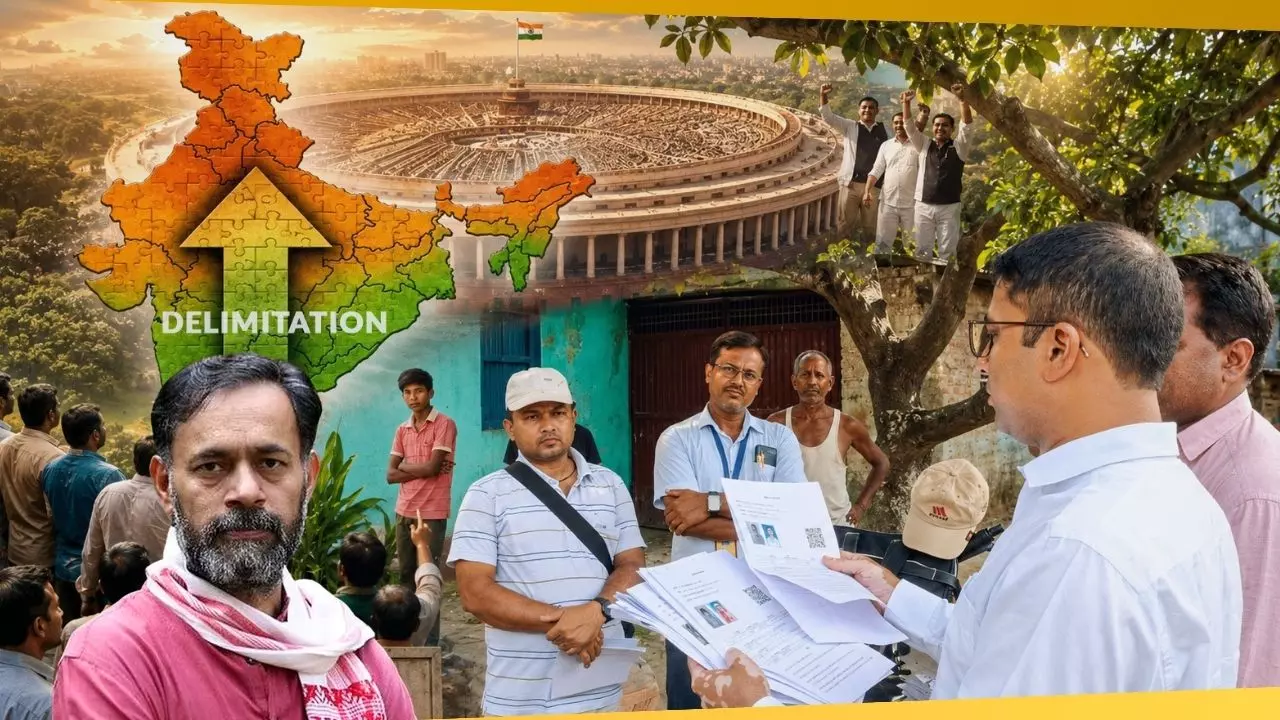
You have linked SIR with delimitation. What happened in Assam and Jammu and Kashmir that worries you?
If Bengal-style SIR spreads across the country and Assam-style delimitation becomes the norm, then electoral democracy will face a serious crisis.
Delimitation involves three things. First, reallocating seats. Second, redrawing constituency boundaries. Third, deciding which constituencies are reserved. In Assam, all three were manipulated.
Before the exercise even began, Chief Minister Himanta Biswa Sarma publicly stated that he wanted delimitation to reduce the political strength of what he called “Miyas”, a reference to Bengali-speaking Muslims. He said he wanted indigenous communities to dominate 106 constituencies while limiting Miyas to around 20.
Also read: SIR effect: Bengal, Bihar to bar deleted names from welfare schemes
After delimitation, he publicly thanked the Election Commission and said the objective had largely been achieved.
Three things happened. Districts where the BJP was uncertain of victory lost seats. Areas where it was stronger gained seats. Constituency boundaries were redrawn in highly unusual ways, concentrating Muslim voters into fewer seats while reducing their influence elsewhere.
The number of constituencies where Muslims had significant electoral influence reportedly fell from around 36 to about 22. At the same time, the influence of Hindu Bengali and Bodo communities increased. Reserved constituencies were also reorganised in ways that altered political outcomes.
The result was an electoral map that gave the BJP a substantial structural advantage before voting even began. I am not saying the BJP won Assam only because of delimitation. I believe the Congress would have lost anyway.
But the process significantly altered the electoral landscape. If similar delimitation occurs nationwide, opposition parties may eventually conclude that participating in elections no longer serves a meaningful purpose. That is how serious I believe the issue is.
The content above has been transcribed from video using a fine-tuned AI model. To ensure accuracy, quality, and editorial integrity, we employ a Human-In-The-Loop (HITL) process. While AI assists in creating the initial draft, our experienced editorial team carefully reviews, edits, and refines the content before publication. At The Federal, we combine the efficiency of AI with the expertise of human editors to deliver reliable and insightful journalism.