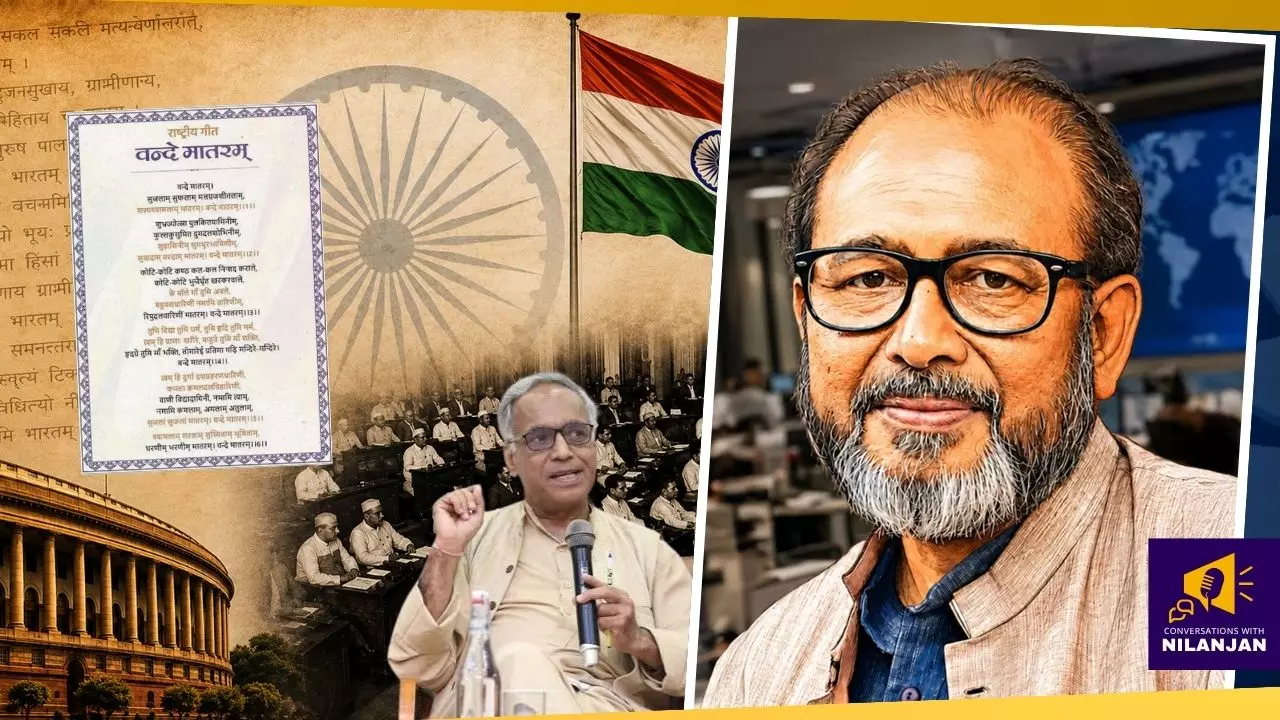
Historian Salil Misra speaks on the history and controversy surrounding the mandatory singing of all six stanzas of Vande Mataram.
Interview | Vande Mataram law needless at best, harmful at worst: Historian Salil Misra
Enforcing all six stanzas of Vande Mataram undermines India's pluralistic ethos and breaks baseline consensus, warns historian Salil Misra

As the nation marks the 150th anniversary of Vande Mataram alongside new legal amendments penalising any perceived insult to it, the move reopens historical debates regarding its origins, its evolution during the Swadeshi movement, and why nationalist leaders ultimately chose to restrict its official rendering to the first two stanzas.
The Federal spoke to Salil Misra, professor and historian, to analyse the complex journey of Vande Mataram, its parallel lives as an anti-colonial rallying cry and a communal flashpoint, and why mandating its full text undermines the pluralist foundation of Indian nationhood. Edited excerpts from the interview:
How did the original literary context of Vande Mataram in Bankim Chandra Chattopadhyay’s Anandamath—which depicted a rebellion against British and Muslim rule by Hindu ascetics—shape the song’s initial imagery, and how did it transition into a broader anti-colonial chant during the Swadeshi movement?
The song Vande Mataram has had two parallel lives. First, there is the background of the novel Anandamath, which is set around the Sanyasi Rebellion during the second half of the 18th century. In the novel, the Sanyasis or Santans were fighting simultaneously against the British and against Muslim rulers, giving it an explicit Hindu-Muslim dimension.
The poem was incorporated into the book, and from then on, its first major public breakthrough occurred during the Swadeshi movement in Bengal following the 1905 partition. At that time, Vande Mataram became the premier symbol and slogan of the anti-imperialist struggle.
Also read: Silence stays legal, obstruction doesn't: What New Vande Mataram Bill actually means
It was banned by the British, and people could be arrested simply for singing it in public. It was sung from Indian National Congress platforms, Rabindranath Tagore set it to tune and sang it, and it was translated into major Indian languages, including Urdu, becoming a pan-Indian anti-colonial anthem.
When Tagore sang the song at the 1896 Kolkata session of the Indian National Congress, it was received as an all-encompassing anti-colonial statement rather than a sectarian one. What did the song mean in Bengal during the 1890s for Tagore to bring it to national prominence?
There was an inherent ambivalence that characterized both the Swadeshi movement and Vande Mataram. While Swadeshi was our first mass anti-imperialist struggle, the British, particularly Lord Curzon, deliberately projected the partition of Bengal as something that would benefit Muslims by creating a Muslim-majority province, appealing to them to stay away from the movement.
To an extent, that tactic worked. Much of the active participation in the Swadeshi movement came from Hindus, while the Muslim elite in Bengal remained largely neutral or opposed.
For Hindus, looking at the motherland as a mother figure came naturally. However, for Muslims and followers of other monotheistic faiths, deifying a nation as a mother goddess fell outside their religious framework. To reach the masses, early nationalist leadership had to incorporate popular cultural and religious symbols.
Why did Tagore decide to sing only the first stanza of Vande Mataram at the 1896 Congress session rather than the complete poem?
The first stanza is easily the most evocative and universal part of the song. It sacralises natural spaces — “Sujalam, suphalam, malayaja sheetalam.” If you look at other national songs, like Muhammad Iqbal’s Tarana-e-Hind or Tagore’s Jana Gana Mana, they all sacralise the natural boundaries and landscape of the country—the Himalayas, the Ganga, and the land itself.
Also read: Vande Mataram: What you can face for insulting the National Song if new law takes effect
Tagore focused on that first stanza because it sacralises the physical territory of the nation without incorporating explicit religious iconography. That spatial sacralisation was precisely what was in his mind, and it is the same approach he used when he composed Jana Gana Mana years later.
During the 1920s and 1930s, as communal tensions grew and the Muslim League gained prominence, how did Mahatma Gandhi and other leaders view Vande Mataram?
Following the 1937 provincial elections, Congress formed governments in seven out of 11 provinces, while the Muslim League sat in the Opposition. The League subsequently launched a major campaign against the Congress, alleging its rule represented a “Hindu Raj”. They pointed to the Congress flag, the push for Hindi, the Vidya Mandir scheme, and prominently, what Muhammad Ali Jinnah termed the “idolatrous” song Vande Mataram.
While Congress clarified that it had not declared Vande Mataram as the official national anthem, the song was being sung in provincial assemblies and municipal schools run by Congress administrations. The League’s primary objection was not just its presence in Anandamath, but that its later stanzas deified the nation as a mother goddess, which Jinnah argued was contrary to Islamic principles.
In 1937, the Congress leadership decided to restrict the official singing of Vande Mataram to only its first two stanzas after consulting Tagore, Nehru, and Gandhi. What drove that specific compromise?
Subhash Chandra Bose was very keen on retaining the song because of its sacred history in Bengal. However, the period between 1937 and 1939 saw a sharp rise in communal riots. As Mahatma Gandhi lamented, two sacred slogans — “Allahu Akbar” and “Vande Mataram” — were weaponized and reduced to war cries during communal violence.
Also read: Vande Mataram Bill 2026: DMK opposes, calls it 'joke, fraud and foul play'
This was the tragic second life of Vande Mataram. The shift was so pronounced that when Bose later selected a national anthem for the Indian National Army, he did not choose Vande Mataram. Instead, he chose a Hindustani adaptation of Jana Gana Mana (Subh Sukh Chain).
Why did the phrase “Vande Mataram” transform from an all-unifying anti-colonial slogan in 1905 into a contentious political phrase by the late 1930s?
This happened due to the intense communalization within Indian society during that period. The phrase effectively lived two parallel lives.
Critics have long targeted the 1937 Congress decision to limit the song to two stanzas, calling it appeasement. From a historical perspective, how crucial was that decision for preserving the secular framework of the freedom movement?
It was crucial. Indian nationalism developed as a territorial concept—the principle that anyone who inhabits this territory is an equal member of the nation, irrespective of religion, culture, or language. A national symbol or song must reflect that territorial DNA.
The first two stanzas capture that territorial spirit completely by praising the rivers, lands, and natural beauty. The remaining stanzas invoke specific Hindu religious imagery, such as “Sapta Koti” referring to Goddess Durga. Restricting the official song to the first two stanzas preserved the core DNA of Indian nationhood. It was not a matter of placating any community.
Also read: Will Vande Mataram order for madrasas deepen communal fault lines in Bengal? | Capital Beat
On January 24, 1950, Dr Rajendra Prasad announced in the Constituent Assembly that Jana Gana Mana would be the national anthem and Vande Mataram the national song, with equal status, without holding a formal vote. What was the background to that decision?
The Constituent Assembly had seen extensive debate on various issues, and both songs had been subjected to misunderstandings and controversies. Jana Gana Mana faced an absurd myth that it had been composed for King George V—a claim Tagore personally refuted with outrage—while Vande Mataram carried the baggage of communal debate.
Neither Jawaharlal Nehru nor Dr Rajendra Prasad wanted these national symbols subjected to further divisive debate or a formal vote on the floor of the Assembly. They took a unanimous, official decision to grant both songs equal reverence and official status.
In March 2026, the government mandated that all six stanzas of Vande Mataram must be sung at official functions, backed by penal provisions under the amended Prevention of Insults to National Honour Act. How does this alter the 1937 and 1950 historical consensus?
It alters the consensus fundamentally. Respect generated out of fear of legal penalty dilutes the genuine sanctity of a symbol. We saw a similar outcome when playing the national anthem in cinema halls was enforced; it was eventually discontinued because it led to friction rather than genuine respect. A charitable view is that this decision is needless; at its worst, it is harmful because it disrupts national consensus.
Also read: Vande Mataram debate in Parliament: Historian questions Modi govt | Capital Beat
Does this revival of the full text mark a significant departure from the pluralist ethos of the Indian national movement?
It is a very significant departure. It disregards the basic pluralist spirit that was central to the DNA of the Indian freedom struggle. Vande Mataram was adopted in its two-stanza form precisely to uphold that pluralist ethos. Mandating the full text violates that foundational spirit.