



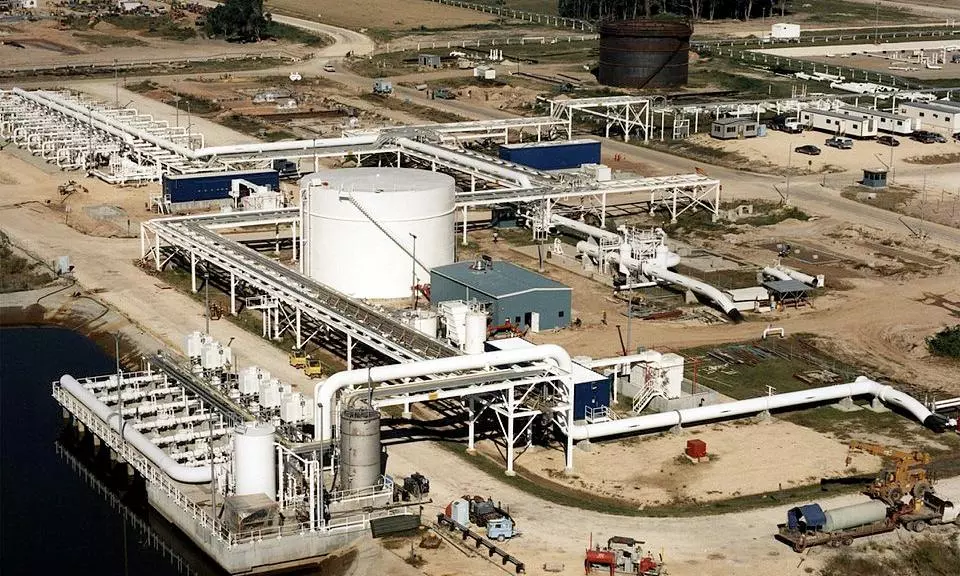
UAE to store 30 mn barrels of crude in India’s strategic reserves; where is this oil kept?
The deal gives India access to a major emergency crude buffer without bearing the cost of purchasing the oil

The United Arab Emirates' (UAE) decision to store 30 million barrels of crude oil in India’s Strategic Petroleum Reserves (SPR) system has emerged as a major step in strengthening India’s energy security at a time of growing geopolitical uncertainty and volatile global oil markets.
The agreement gives India access to a large emergency crude stockpile without having to spend billions of dollars buying and storing the oil itself.
Also read: India, UAE ink key energy, defence pacts; Abu Dhabi pledges USD 5 bn investment
The deal also carries strategic importance because the oil can be routed from the UAE’s eastern coast directly to Indian refineries.
But what exactly are Strategic Petroleum Reserves, and why are they important for India?
Why India needs SPRs
Strategic Petroleum Reserves (SPR) are government-maintained emergency stockpiles of crude oil created to protect countries from supply shocks. They function as a national backup system that can be used when global crude supplies are disrupted due to wars, geopolitical tensions, natural disasters or severe market volatility.
For India, which imports nearly 85 to 88 per cent of its crude oil requirements, maintaining adequate strategic reserves is an economic necessity. Any major disruption in global supply chains can directly affect fuel availability, industrial production, transportation and overall economic stability, like the crisis in the Strait of Hormuz during the Iran war has shown.
But where does India store such massive reserves of crude oil?
It stores its strategic reserves in giant underground rock caverns carved deep beneath the earth near coastal areas, following the principle of hydrostatic containment. These caverns are considered among the safest storage systems because they are naturally protected from surface attacks, natural disasters and evaporation losses. The reserves are managed by Indian Strategic Petroleum Reserves Limited (ISPRL), a public sector entity under the Ministry of Petroleum and Natural Gas.
India stores its strategic reserves in giant underground rock caverns carved deep beneath the earth near coastal areas. AI generated image
India’s SPR facilities
India’s Phase I SPR facilities are located at Visakhapatnam in Andhra Pradesh, and Mangaluru and Padur in Karnataka. Together, these sites can store around 5.33 million metric tonnes of crude oil, equivalent to nearly 39 million barrels. This provides roughly 9.5 days of India’s crude oil requirement during emergencies.
The government is now expanding the network under Phase II with new facilities planned at Chandikhol in Odisha and an expansion at Padur. Once completed, the additional reserves are expected to provide nearly 12 more days of emergency coverage.
Also read: India's oil reserves: How long can the country sustain a supply shock?
Apart from these dedicated SPR facilities, India’s oil marketing companies also maintain commercial fuel inventories. Combined together, the country currently has an overall emergency fuel cushion of nearly 74 days.
Yet, at the global level, India’s strategic reserves remain much smaller compared to major economies such as the United States of America (409 million barrels and a capacity of 714 million barrels) and China (1.4 billion barrels, the world's largest).
Significance of Abu Dhabi’s agreement
Against this backdrop, the UAE’s decision to store 30 million barrels in India assumes major strategic significance. The arrangement strengthens India’s emergency preparedness while also deepening bilateral energy cooperation.
Importantly, India does not bear the cost of purchasing this crude. The UAE retains ownership of the oil and funds the storage, giving India access to a substantial emergency buffer without immediate capital expenditure.
Also read: Strait of Hormuz closure: India's 100 mn barrel crude stocks could cover 40-45 days
From a supply-chain perspective, the agreement also offers strategic flexibility. Crude can be transported directly from the UAE’s eastern coast to Indian refineries, reducing dependence on routes passing through the Strait of Hormuz, one of the world’s most sensitive maritime chokepoints and a region vulnerable to geopolitical tensions.
The agreement further reflects the growing depth of the India-UAE strategic partnership at a time when energy security has become as geopolitically significant as military and trade alliances.