What Trump’s 25 pc Iran tariff means for India’s foreign policy and trade
Trump’s Iran-linked tariff threat raises fresh questions for global trade and India’s strategic balancing.

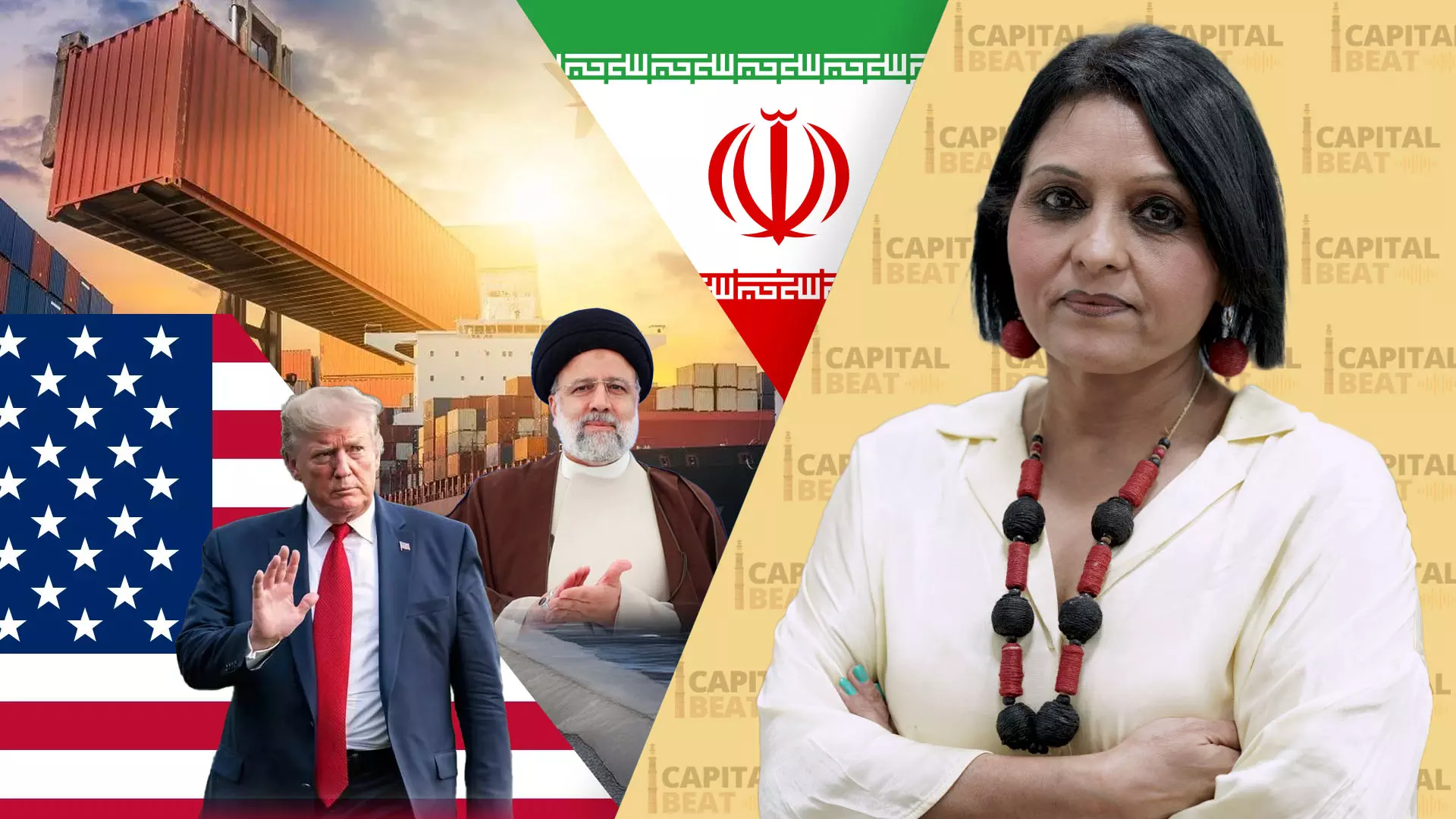
The latest episode of Capital Beat had Sanjay Kapoor, international affairs expert, and Prof Aftab Kamal Pasha, international affairs expert and former diplomat, examining the implications of US President Donald Trump’s announcement of a 25 per cent tariff on countries trading with Iran, and the potential economic and geopolitical impact on India.
The discussion centred on Trump’s declaration that the tariff would be “effective immediately” to any country maintaining commercial ties with Iran, and extend to all business conducted with the United States. The announcement was placed against the backdrop of protests in Iran and reports of a violent crackdown that, as stated in the programme, left nearly 600 people dead.
The panellists discussed how the tariff could affect India’s trade, energy security, regional strategy, and broader foreign policy positioning amid shifting global alignments.
Tariff announcement
The programme cited Trump’s post on Truth Social, which stated: “Effective immediately, any country doing business with the Islamic Republic of Iran will pay a tariff of 25 per cent on any business being done with the United States of America. This order is final and inclusive.”
Also read: 'Iran wants to negotiate, they are tired of getting beaten up by US': Trump
The episode also referenced remarks attributed to White House Press Secretary Karoline Leavitt, who said that airstrikes were “one of the many options on the table”, raising questions about possible military escalation alongside economic pressure.
The host framed the central question as whether this move would materially affect India, given its trade with Iran and its broader strategic interests in the region.
US tariff strategy
Prof. Pasha described the Iran-linked tariff as part of a wider US tariff policy aimed at increasing revenue and pressuring trading partners. “This is a continuation of President Trump’s tariff policy to ramp up revenues for the United States,” he said, citing US debt levels and interest obligations mentioned in the discussion.
He noted that several countries had negotiated reduced tariffs through bilateral agreements, naming South Korea, Japan, the European Union, Indonesia, and Malaysia as examples mentioned in the transcript. India, he said, was still negotiating, with talks described as stalled.
Also read: Iran open to negotiations but ready for war as Trump weighs military action
Prof. Pasha stated that India was already facing “25 plus 25 per cent tariff” pressures in other contexts, including energy-related trade, and argued that the additional Iran-linked tariff would not dramatically alter India’s overall trade exposure.
India–Iran trade
Prof. Pasha characterised India’s trade with Iran as limited. “We are not a major trading partner with Iran,” he said, estimating exports at a little over $1 billion, largely comprising basmati rice, chemicals, and tea.
He stated that these commodities could be sourced by Iran from alternative markets in the Gulf region, reducing the immediate leverage of the tariff. He also questioned why similar pressure had not been applied uniformly, pointing out that Turkiye continued trading with Russia and Iran without facing comparable penalties.
Also read: Explained: Russian oil, American tariffs, and the Indian economy
He added that China had resisted tariff pressure in the past, leading to US withdrawals, and argued that Washington targeted countries it believed were less likely to push back.
Pressure on Iran
Prof. Pasha framed the tariff primarily as an instrument to increase pressure on Iran rather than its trading partners. “What America is doing is to put more pressure on Iran,” he said, adding that decades of sanctions had not weakened Iran’s leadership or led to regime collapse.
He stated that Iran had increased its military and technological capabilities despite sanctions and cited the regime’s ability to control protests, including through blocking satellite internet services such as Starlink.
According to Prof. Pasha, the additional tariff was “not going to hurt so much Iran or India,” and would not fundamentally alter the strategic balance.
Strategic ambivalence
Sanjay Kapoor approached the issue from India’s strategic perspective, describing New Delhi as a “reluctant player” in its engagement with Iran. He noted that India reduced oil and gas imports following US sanctions during Trump’s first term.
Also read: US tariffs on India may rise up to 500% as Trump backs Russia sanctions bill
Kapoor referenced the Chabahar port project, stating that it had earlier received US concessions due to American military logistics needs in Afghanistan. He said those concessions had since been withdrawn or narrowed.
“I don’t think there is a great amount of love for Iran at the moment,” Kapoor said, while also describing this distance as “a tragedy” given civilisational and historical links between India and Iran.
Limited economic impact
Kapoor characterised the 25 per cent tariff as marginal in economic terms. “The 25 per cent tariff is a very small amount on a trade which is 1.68 billion,” he said, describing the volume as easily adjustable if required.
He argued that India’s deeper concerns lay elsewhere, particularly in evolving US relations with China and Pakistan, and the broader regional security implications of those alignments.
Kapoor stated that India had made significant efforts to strengthen ties with Washington but continued to face pressure, creating uncertainty about long-term strategic outcomes.
US–India frictions
Prof. Pasha outlined what he described as a deterioration in US-India relations since Trump’s return to office. He referred to expectations around bilateral trade expansion and said negotiations had failed to meet US expectations.
Also read: Why Mexico's 50 pc import duty to placate US hurts India's car exports
“Since February, Trump has been putting enormous pressure on India,” Prof. Pasha said, citing demands related to trade agreements, Russian oil imports, defence purchases, and India’s engagement with BRICS.
He also stated that Washington was uncomfortable with any improvement in India–China relations, adding that India’s emphasis on strategic autonomy was being viewed with suspicion.
Diplomatic strain
Prof. Pasha described what he called a “communication gap and ego problem” between the two leaders, asserting that personal chemistry had deteriorated. He said this had complicated India’s ability to navigate competing pressures from the US, China, and Russia.
He argued that India was facing constraints in accepting US trade demands, particularly in agriculture and dairy, which he said could undermine domestic food security.
“We are caught between the devil and the deep blue sea,” Prof. Pasha said, describing India’s position in the evolving geopolitical environment.
Military escalation risk
The discussion then turned to the possibility of US military action against Iran. Kapoor expressed scepticism, citing past US experiences with Iran since 1979 and describing them as largely unsuccessful.
He referred to Iran’s ability to withstand military pressure and to actions by Iran-aligned groups such as the Houthis, portraying them as evidence that smaller actors could resist major powers.
Also read: India drops to 3rd spot in Russian fossil fuel imports in December
Kapoor stated that while military action was possible, its outcomes were unpredictable and could further destabilise the region.
Energy vulnerability
Prof. Pasha addressed the consequences of a direct military confrontation for India. He said the US had the capability to carry out airstrikes against Iran and was under pressure from Israeli leadership and domestic lobbies.
He warned that Iran could retaliate by targeting US bases in the Gulf, which could trigger collateral damage affecting energy infrastructure, desalination plants, and shipping lanes.
“India is not going to remain immune,” Prof. Pasha said, highlighting India’s dependence on oil and gas from the Gulf, the presence of nearly 10 million Indian workers in the region, and the volume of air traffic transiting Gulf hubs.
Regional fallout
Prof. Pasha said any escalation could disrupt global supply chains and energy markets, with direct consequences for India’s economy and citizens. He stressed the scale of India’s exposure through energy imports, trade, and the Indian diaspora.
Also read: Modi 'not happy with me' over steep tariffs, says Trump
He added that India would need to remain proactive and realistic, rather than assuming that regional conflict would not affect its interests.
The episode concluded by emphasising that developments around Iran, US policy, and regional security would require close monitoring as India navigates a complex and volatile geopolitical landscape.