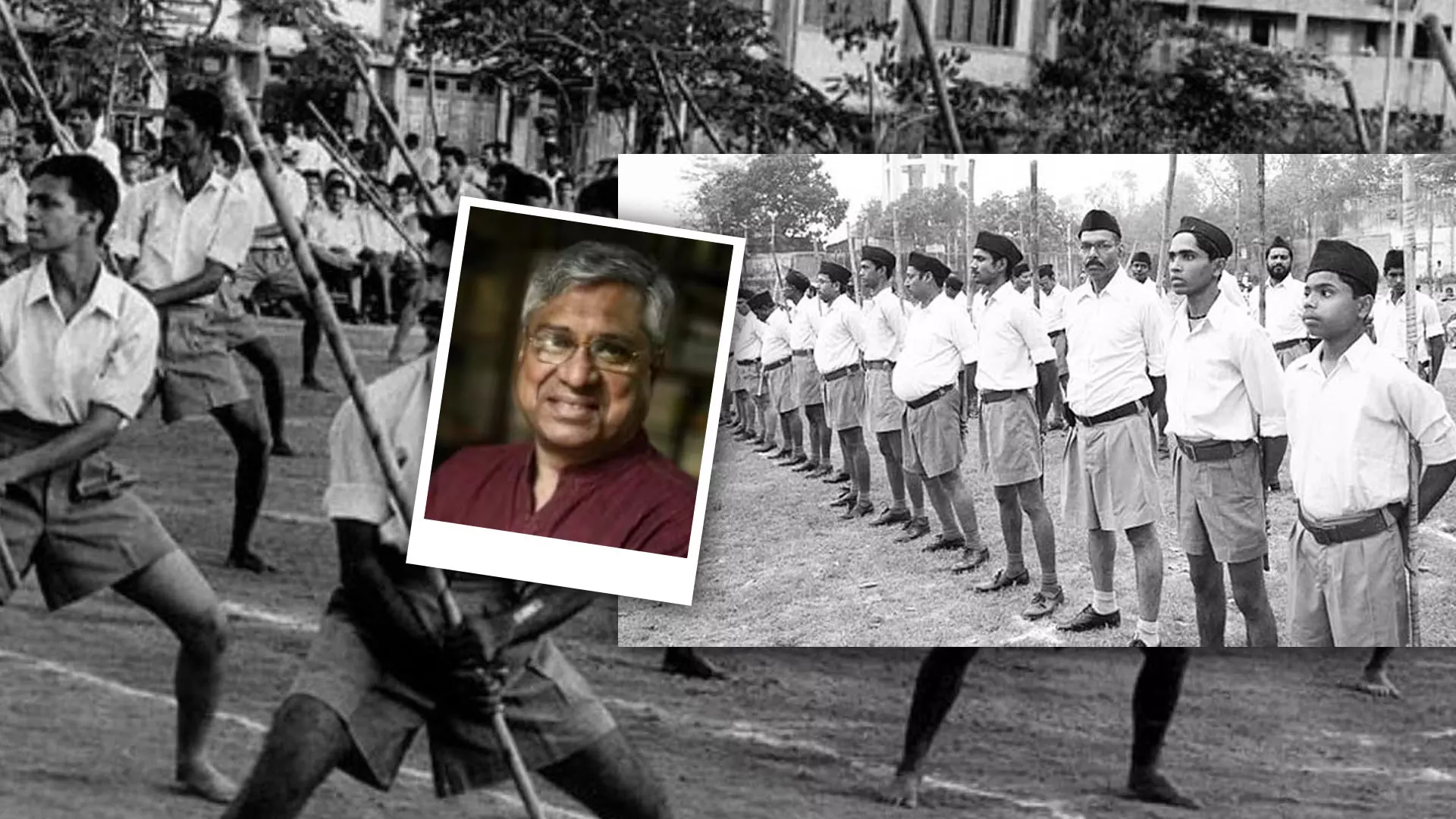
RSS centenary: Historian explains why distorting the past is deeply problematic
In a searing critique of Hindutva politics, historian Aditya Mukherjee warns of the dangers of distorting India’s past into a tool of revenge and polarization

How are the RSS and the broader Sangh Parivar interpreting Indian history, and how are these interpretations shaping contemporary politics? To examine these, The Federal spoke to eminent historian Professor Aditya Mukherjee.
In a wide-ranging conversation, he unpacked claims about “avenging history”, the Somnath temple, medieval India, and the systematic rewriting of textbooks, warning of the deep dangers such narratives pose to India’s plural and democratic foundations.
You have argued that calls to “avenge history”, such as the one made by the National Security Advisor Ajit Doval, are deeply problematic. Why?
Two things are fundamentally wrong here. First, history is the business of historians, not politicians. Increasingly, politicians do not bother to read or listen to what historians have said for decades. Instead, they announce their own versions of history. Second, for a National Security Advisor to say that the right thing to do is to avenge history is disastrous. It pushes the country towards further fragmentation.
Who exactly is supposed to be avenged against? Given their understanding of history, it is not the imperialists or the British. It is the Muslims—nearly 200 million people in India. Are we going to take revenge on them?
This is precisely the basis on which Gregory Stanton, who founded Genocide Watch and anticipated the Rwandan genocide, warned that India is moving in a direction that could result in one of the worst civil wars or genocides in history. When the National Security Advisor speaks of revenge, what message goes down to the street? What we see today: people jumping on Muslims, forcing them to chant “Jai Shri Ram,” or humiliating pastors and making them say the same slogan—is this national security? It is astonishing.
Also read: Why Felix Pal thinks RSS is an 'aloof parent' of the Sangh Parivar
How do you view the Prime Minister’s participation in the Somnath Swabhiman Parv marking 1,000 years of the temple’s destruction?
It belongs to the same ideological stream. Let me explain what historians actually understand about Somnath, and contrast it with what the prime minister tells people.
Romila Thapar, who wrote a full-length scholarly study on Somnath, showed that the idea that Mahmud of Ghazni’s destruction of the temple permanently scarred the Hindu psyche did not exist until the 19th century. It first emerged in the British Parliament. That narrative was then repeated in the 1950s by KM Munshi.
Thapar demonstrates, using multiple sources in different languages, that 150 years after the destruction, the temple was rebuilt. No mention was made of Mahmud of Ghazni. More importantly, 250 years later, a Muslim trader received permission to build a mosque within the temple precincts—with the consent of the local ruler, priests, and people. Where, then, is this supposedly eternal Hindu trauma?
The language used today by the prime minister, the NSA, and the RSS was invented by the British in the late 19th century. It framed Hindus and Muslims as two contending civilizations that could never coexist. VD Savarkar later picked up this idea, and so did the Muslim League.
The use of Somnath today is meant to create a false memory, deepen Hindu-Muslim division, and shape the present and future around a fabricated past. The political goal is polarization for electoral benefit.
The prime minister has suggested that (Jawaharlal) Nehru and (MK) Gandhi opposed the reconstruction of Somnath. How accurate is that?
It is a misrepresentation. Nobody opposed its reconstruction. The issue was whether a secular state should fund or officially sponsor the construction of a temple, mosque, or church. Gandhi clearly said no state funds should be used. Nehru advised President Rajendra Prasad not to attend the inauguration in an official capacity.
Also read: 100 years of Left, Right, Centre: What next for Indian politics? | Talking Sense With Srini
That is now being twisted to portray secular leaders as anti-Hindu. Secular people are being branded as pro-Muslim and anti-Hindu. Gandhi, Nehru, (Vallabhbhai) Patel—where exactly were they anti-Hindu?
Those who incite lynching and violence in the name of Hinduism are the ones farthest from any genuine religious ethic. Political misuse of religion lies at the heart of this narrative.
How do you respond to claims that India suffered “1,000 or 1,200 years of slavery” under Muslim rule?
Only someone with no connection with history would casually oscillate between 1,000 and 1,200 years as if 200 years make no difference.
This argument conflates two very different kinds of empires. Pre-modern empires—Maurya, Mughal, Egyptian—were not colonial in the modern sense. Colonial empires extracted surplus from colonies. That did not happen in pre-British India.
If migration or conquest alone defines colonialism, then India experienced 5,000 years of colonial rule. Aryan migrations, movements from Central Asia, Iran, and Africa—genetic history proves constant migration. Are we going to call all of that colonialism?
Many so-called invaders settled here and contributed enormously—economically, culturally, architecturally. Islam came to India when the Prophet was still alive. Christianity arrived with the earliest disciples. Both predate the word “Hindu.” How can they be called foreign?
This obsession with indigenous versus foreign is racism. It leads to genocides. It creates the idea that “we” are the real occupants and “they” are outsiders who must be expelled.
Why do you reject labelling medieval India as a “Muslim period”?
Historians do not classify eras by the religion of rulers. They classify them as ancient, medieval, early modern—based on social structures.
A Muslim ruler can be good or bad, just like a Hindu ruler. The religion of the ruler does not make the society Muslim.
Also read: 'The Sangh Parivar plan is to present a sanitised, RSS-compatible Gandhi'
India’s medieval economy outperformed every other region. By the end of the Mughal period, India produced nearly a quarter of global GDP and eight times Britain’s output. That requires stability, not chaos.
India was the world’s largest textile manufacturer. Architecturally, culturally, musically, and intellectually, the Mughal period produced extraordinary achievements. The Bhakti and Sufi movements flourished then.
Demonizing this period is historically absurd.
Savarkar wrote that “Hindutva is not a word but a history in full.” What does that mean to you?
It means the over-determination of religion. Religion becomes the basis of politics, economics, culture, and language. Everything is subordinated to religious identity.
That is precisely what we contest. Religion is only one aspect of society.
MS Golwalkar and others claimed Muslims were never assimilated into Indian society. How do you respond?
This is an authoritarian idea of assimilation—one religion, one language, one culture. It is closer to Hitler or Mussolini than to India.
Indian nationalism was unique. While Europe built nation-states around single religions and languages, India imagined a nation celebrating diversity.
India never tried to homogenize. Mutual cultural exchange occurred naturally. That is what enriched both Hinduism and Islam in India.
Holding today’s Muslims responsible for medieval events is grotesque. By that logic, Native Americans should destroy the United States.
This language of revenge belongs to the dark ages.
What dangers do you see in rewriting textbooks and history curricula?
The RSS began shaping education through Saraswati Shishu Mandirs from 1951. NCERT studies found their textbooks described Muslims as brutal, destructive invaders and Christians as conspirators behind Partition.
Children were taught that Qutub Minar was built by Samudragupta and that Muslims and Christians threaten India’s unity.
Also read: From Char Dham to deodar trees, RSS turns focus on crumbling Himalayas
NCERT concluded that these books aimed to turn children into “bigoted morons” under the guise of patriotism.
Whenever the RSS came near power—1977, 1999–2004, and after 2014—they attacked secular textbooks. Now entire centuries of Mughal history are being removed.
This is the Pakistanization of Indian textbooks.
If “history is written by the winners,” will this distorted version prevail?
In medieval times, rulers could write their own histories. Today, that is impossible.
The whole world has studied the Taj Mahal. You cannot turn it into “Tejo Mahalaya.” Evidence exists globally.
You can only make your own children ignorant. Other countries will still study real history.
Indian history will not change. This attempt is dangerous and ludicrous.
(The content above has been transcribed using a fine-tuned AI model. To ensure accuracy, quality, and editorial integrity, we employ a Human-In-The-Loop (HITL) process. While AI assists in creating the initial draft, our experienced editorial team carefully reviews, edits, and refines the content before publication. At The Federal, we combine the efficiency of AI with the expertise of human editors to deliver reliable and insightful journalism.)