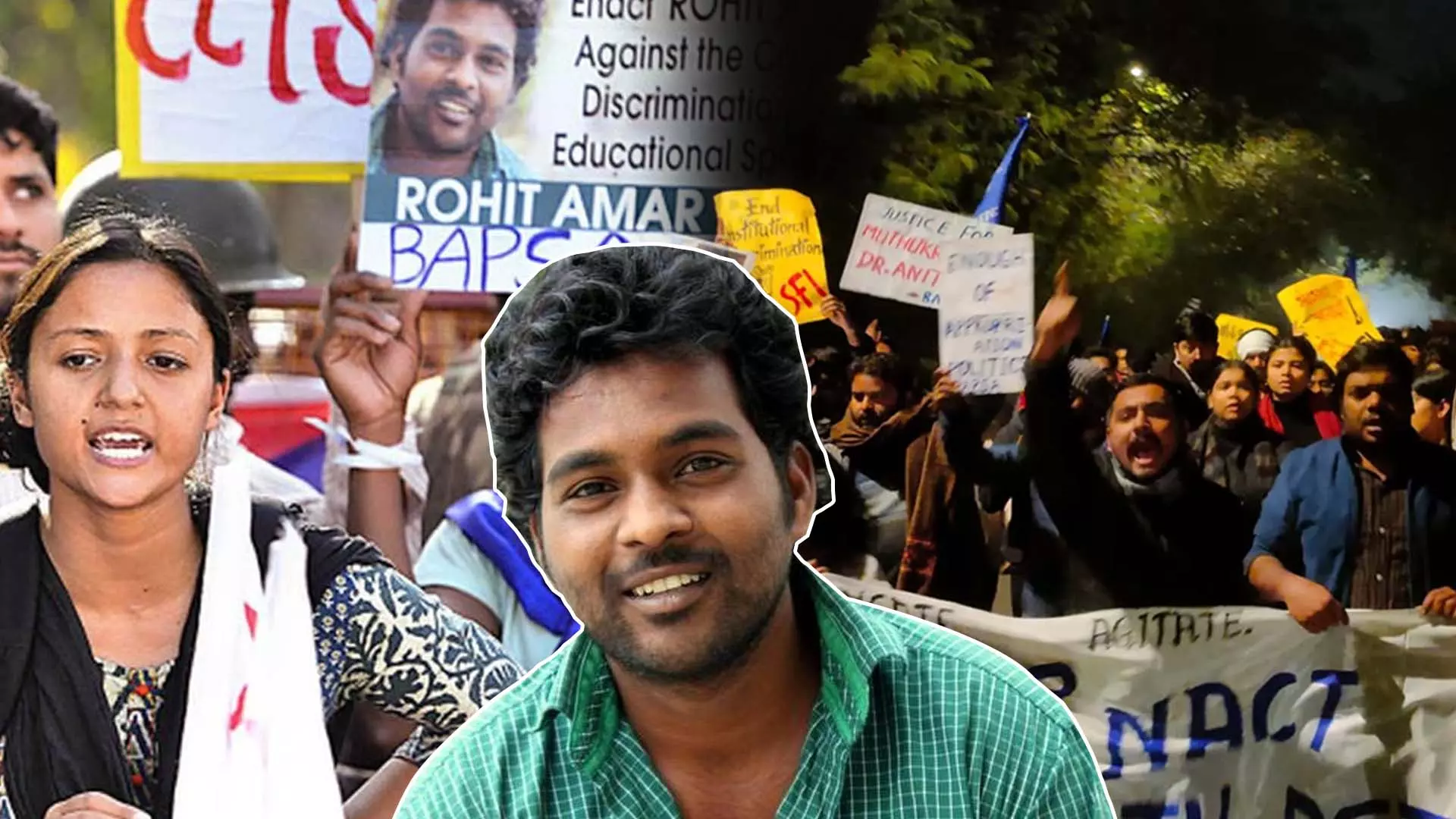
Rohith Act demand persists 10 years after Rohith Vemula’s death
A decade after a Dalit scholar’s death shook Indian campuses, students say caste discrimination remains institutionalised. Why has justice still not translated into law?

“My birth is my fatal accident.”
Ten years ago, these poignant words from Rohith Vemula’s final letter forced India to confront a reality that universities often deny — caste does not vanish in higher education. It adapts, embeds itself within institutions, and frequently escapes accountability.
A decade later, students across the country continue to demand a Rohith Act, not merely to commemorate the late scholar's life, but to ensure that caste-based discrimination in universities is formally recognised, prevented, and addressed through law. The demand refuses to fade because the conditions that led to Rohith’s death remain largely unchanged.
A death that exposed the system
Rohith Vemula was a 26-year-old PhD scholar from Guntur, Andhra Pradesh, at the University of Hyderabad and an active member of the Ambedkar Students’ Association. In January 2016, after prolonged institutional harassment, social boycott, and suspension by the university administration, he died by suicide.
Also read: Kerala PhD scholar’s plight rekindles Rohith Vemula memories
His death laid bare the deep-rooted caste bias within India’s higher education system and triggered nationwide protests. It also forced institutions to confront questions they had long avoided — about power, exclusion, and responsibility.
Since then, other similar cases have emerged — from Payal Tadvi to Darshan Solanki — reinforcing student claims that Rohith’s death was not an exception but part of a recurring pattern.
For student groups, these are not isolated tragedies. They point to a system where marginalised lives repeatedly fail to trigger institutional urgency.
How exclusion takes shape on campus
Students argue that discrimination in universities rarely appears in overt forms. Instead, it operates subtly — through classroom interactions, grading practices, access to research supervisors, fellowships, hostel facilities, and mental health support.
Also read: Karnataka's Rohith Vemula bill proposes jail, fines for caste discrimination in higher education
Universities do have Equal Opportunity Cells (EOcs) and internal committees, but students say these bodies are often ineffective, underpowered, and unaccountable to those they are meant to protect.
When grievance mechanisms fail, the burden of survival shifts entirely onto marginalised students. This structural imbalance, students assert, is why legal intervention is necessary.
Karnataka’s unfinished experiment
In 2025, Karnataka attempted to address this gap by proposing a Rohith Vemula Act to tackle caste-based discrimination in higher education. A draft Bill was also prepared to cover public, private, and deemed universities across the state.
The proposed law included stringent provisions — jail terms, fines, compensation for victims, and withdrawal of government funding from non-compliant institutions. For many, it marked a historic moment: the first time a state formally acknowledged institutional discrimination in universities as a punishable offence.
Also read: ‘B R Ambedkar: Now and Then’ underscores the need to reimagine Bahujan stories
However, the Bill never became law. It has neither been tabled nor cleared by the Karnataka legislature.
Political opposition dismissed the proposal as excessive, while rights groups pointed out critical flaws in the draft. Trapped between resistance and unresolved concerns, the Bill remains stalled.
Global scrutiny and legal gaps
In June 2025, two United Nations special rapporteurs wrote to the Indian government, describing the Rohith Act as timely and necessary while welcoming its intent.
At the same time, they warned that the draft law was incomplete. It prohibited discrimination but failed to clearly define direct and indirect discrimination. It also did not adequately address the disproportionate exclusion faced by Dalit and Adivasi students in fellowships, housing, mental health care, and protection from harassment and violence.
The UN experts cautioned against an approach focused only on criminal punishment. They stressed the need for preventive frameworks, effective grievance redressal systems, whistleblower protection, and institutional accountability.
Also read: Ground Report: Why were roads to UP's Kapsad village blocked after Dalit murder, abduction?
They also highlighted the absence of meaningful consultation with Dalit and Adivasi students and scholars during the drafting process.
Why students want a national law
For student unions, the stalled Karnataka Bill underscores why the struggle must go beyond individual states. Ten years after Rohith Vemula’s death, India still lacks a comprehensive legal framework to address institutional discrimination in higher education.
Students argue that inclusion cannot be achieved through punishment alone. It requires accessible classrooms, remedial academic support, and shared institutional responsibility — rather than expecting marginalised students to display resilience in hostile environments.
This is why unions such as the Jawaharlal Nehru University Students’ Union are demanding a pan-India Rohith Act.
They want the law to formally recognise institutional discrimination, making caste, religious, and social exclusion punishable offences. They are calling for grievance-redressal mechanisms with student representation, time-bound inquiries, and real powers to act against faculty or administrators.
Also read: Ghosts of Laxmanpur Bathe massacre in Bihar still haunt villagers as justice remains elusive
They also demand preventive measures — sensitisation programmes, stronger EOcs accountable to students, and structural reforms that stop discrimination before it turns fatal.
At its core, the Rohith Act demand is about shifting responsibility — from students who endure discrimination to institutions that enable it.
The content above has been transcribed from video using a fine-tuned AI model. To ensure accuracy, quality, and editorial integrity, we employ a Human-In-The-Loop (HITL) process. While AI assists in creating the initial draft, our experienced editorial team carefully reviews, edits, and refines the content before publication. At The Federal, we combine the efficiency of AI with the expertise of human editors to deliver reliable and insightful journalism.