‘Not just CRPF, Home Minister should also answer for brutalities on CJP protesters’
Senior advocate Colin Gonsalves discusses CRPF’s internal report admitting use of excessive force against protesters in Delhi on July 20, role of courts, and what genuine accountability looks like

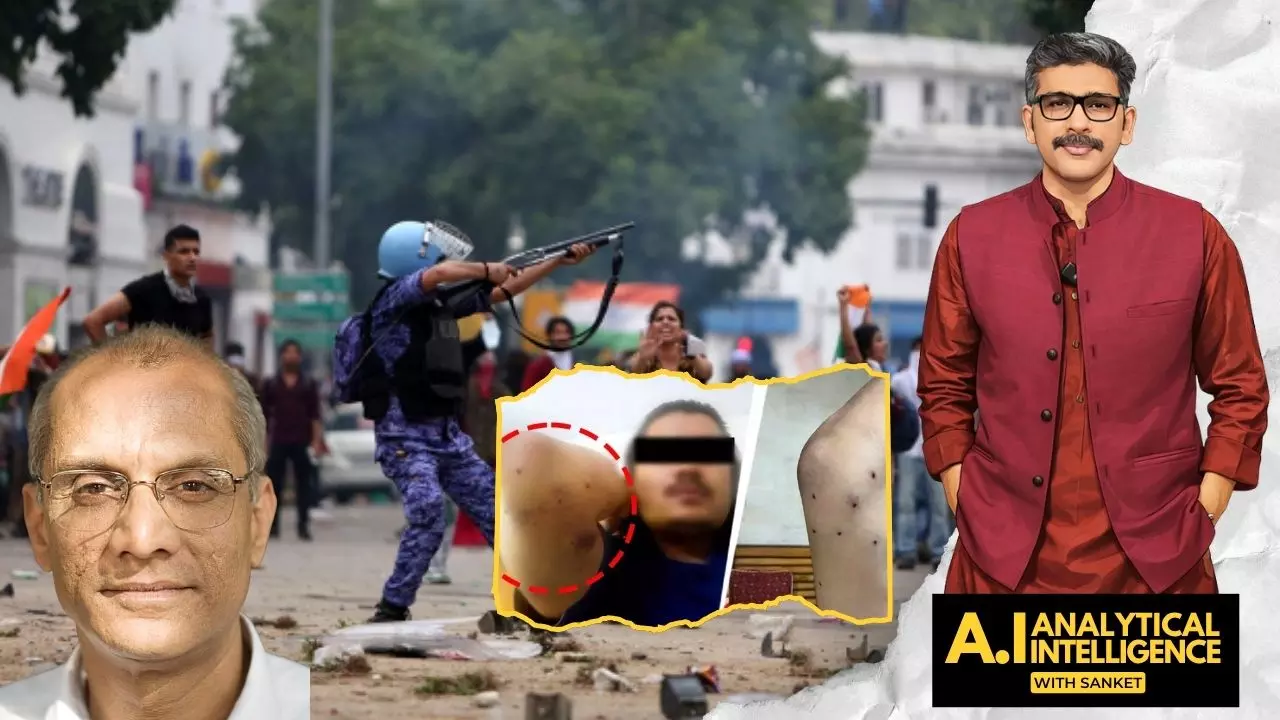
Accountability for police brutalities against protesters at the July 20 march organised by the Cockroach Janta Party (CJP) in Delhi should extend all the way to the top – to Union Home Minister Amit Shah, to whom the Central Reserve Police Force (CRPF) reports, says senior advocate Colin Gonsalves. Calling the CRPF’s internal report admitting to the use of excessive force against protesters by Rapid Action Force (RAF) personnel at the protest unprecedented, Gonsalves, in an interview with The Federal, analyses if the admission itself is enough, whether the courts have responded adequately to the issue, and what genuine accountability would look like.
The movement began with a demand for accountability in the education sector. With the RAF’s admission, has the focus now shifted to accountability within the policing system?
I've witnessed police attacking unarmed people time and again. It happens across the country. If you look at the photographs from this incident, you can see the police charging at people with anger and force, almost as though they intended to break skulls, arms and legs.
But this is the first time I've seen the head of the CRPF publicly acknowledge, "We made a mistake."
What struck me wasn't merely the admission. The report reportedly explained how those mistakes happened. The first mistake, according to the report, was deploying personnel from Chhattisgarh and Jammu and Kashmir, where policing conditions are very different.
Also read: Several RAF jawans issued pellet guns for July 20 CJP protest, finds internal inquiry: Report
That itself raises an uncomfortable question. Why are they different? Because force is routinely used there as well. Skulls are broken, bones are broken. The implication appeared to be that Delhi was treated almost like a conflict zone. That is undoubtedly an important admission. But I don't attach too much significance to it because we've seen these acknowledgements before. Meetings will be held, reports will be written, and then everything will continue as before.
The fundamental issue is that we never hold accountable the person who ultimately allows these beatings to happen.
Unless responsibility reaches the very top, nothing is going to change—neither in Delhi nor anywhere else in the country.
Are you saying political accountability should extend all the way to the Union home minister?
Absolutely. In any democratic country in Europe, if pellet guns were fired at protesters, if people were blinded or schoolchildren attacked, the home minister would be expected to resign immediately.
Will a European home minister survive politically after something like this? I don't believe so.
In India, unfortunately, our moral and ethical standards have become extremely low. People can be beaten, seriously injured or even killed, and the very next day those responsible continue in office as though nothing has happened.
The Union home minister is almost never held accountable. In my opinion, the public debate should not have stopped with Dharmendra Pradhan. He wasn't the principal person responsible for policing. We should have demanded accountability from the home minister.
Also read: RAF identifies personnel linked to alleged pellet gun firing in Delhi protest: Report
But we don't even dare to imagine such accountability.
The security force itself has admitted that excesses took place, yet no one appears willing to accept political responsibility.
To me, the police force today has become one of the largest organised instruments of violence in the country.
Who creates that culture?
Politicians do. They treat the police force as though it exists to serve political interests, and far too many senior officers are willing to oblige those political masters.
How do you assess the judiciary's response? The initial reaction appeared dismissive, but the chief justice has now said peaceful protest is constitutionally protected and police excesses cannot be justified.
With great respect to the chief justice, I believe this is an attempt to retreat from the earlier position. He was seen making remarks that reflected a deeply troubling attitude towards ordinary citizens and protesters. Now he finds himself having to explain those remarks.
I've practised before the Supreme Court for nearly 35 years and have never seen a chief justice respond in this manner.
When I entered the profession, had an incident like this occurred, I believe the chief justice would have immediately taken suo motu cognisance, summoned the commissioner of police and everyone concerned, and ensured decisive action.
Also read: From slaps, social media ridicule to threats: Police brutality under fire amid CJP protests
Instead, the focus shifted to criticising the person who had written to the court. That surprised me because letter petitions are an established part of Indian public interest litigation (PIL). They are recognised under what we call epistolary jurisdiction.
A person who cannot afford legal representation is entitled to write directly to the court.
I saw that letter. It was a detailed one with annexures, photographs and supporting material. Yet the response was that it was "only a letter."
I later spoke to the petitioner. He told me he had cited 10 Supreme Court judgments explaining epistolary jurisdiction. Ordinarily, such a letter should be placed before the chief justice, converted into a PIL and supported by the appointment of an amicus curiae to assist the court.
But none of that happened. In my view, the judiciary has increasingly become unable to confront excesses by the central government. Many judges appear reluctant to act against the government because they fear the consequences, which in turn are real.
After the RAF’s admission, should an independent inquiry be initiated?
I don't believe that is going to happen. Those who promise inquiries generally have no intention of conducting a genuinely independent investigation.
Also read: Bihar cop seen with AK-47 in Siwan protest suspended; probe launched
What usually happens is that the police are asked to investigate their own officers, which is inherently impossible. Alternatively, another agency that remains under government control is asked to conduct the inquiry.
Could a probe be carried out by people who are genuinely independent of the central government?
Yes, it is possible.
Will the government allow that?
I don't believe it will. We've seen this before. Take the Jamia Milia protests, for instance. Nearly a hundred students were brutally assaulted. One student lost an eye. Bones were broken, heads were cracked open. The matter reached the Delhi High Court. Years have passed, but the court has still not moved decisively to punish those responsible.
If the Delhi High Court itself cannot summon the courage to act, who will? Ultimately, I believe only sustained, peaceful public movements can create accountability. We've seen such movements emerge in different parts of the world. Without that public pressure, I don't think India will ever change.
Also read: No justification for AK-47 on students, says ex-BSF officer
Today, I believe the world's largest democracy is steadily becoming one of its least democratic societies.
Police also used tear gas and water cannons on protesters demanding justice for Nirbhaya following the 2012 gang-rape-murder case. Police officers often argue that force is always their last resort after every other option has failed. Was that the case here?
No, I don't believe force should have been used in the first place. Violence has become deeply embedded within policing in this country. It has also become embedded within our politics.
During the UPA years too, there were instances of force against protesters. Isn't this a broader institutional problem rather than one confined to a single government?
Let me give you an example. Look at the riots in London. Those disturbances continued for several days. People were throwing Molotov cocktails at the police. Yet you did not see individual police officers retaliating out of anger or revenge.
They stood their ground, held their shields and maintained formation. When an officer was injured, the ranks opened, the injured officer was taken away in an ambulance, and the line closed again. The policing remained disciplined.
After many days of rioting, very few people had suffered injuries and there were no retaliatory killings by the police. Property was certainly damaged.
Also read: ‘CJP protests may have ended, but youth movement is far from over’ | Interview
But the response remained professional. That is policing.
What we increasingly witness here is something very different. In my view, our police force has become excessively violent.
Let me give you a recent example. A young lawyer from my office, Manik Gupta, went to a police station. He merely argued with a police officer.
For that, he was grabbed by the collar, taken into a room without CCTV cameras, and beaten. This happened only a few days ago.
That tells you something about the policing culture we have today.
The Supreme Court has now observed that police excesses cannot be justified merely because protests turn disruptive. Even though these are oral observations, do you believe the court may now step in more decisively if the police fail to act against their own personnel?
No. I don't expect that to happen. I don't believe the judiciary will do anything substantial. There may be cosmetic measures and observations.
But will senior police officers be held accountable? Will the court summon the courage to question the home minister? Will it even hold the commissioner of police accountable? I don't believe so.
Also read: CJP protests expose Modi's Achilles' heel: A government unused to listening
I have lost confidence in the judiciary's willingness to carry out basic institutional reforms.
Perhaps we should revisit this issue three, four or six months from now. Then we can see whether my assessment was right or wrong.
I sincerely hope I am proved wrong. I genuinely hope something positive emerges from all of this.