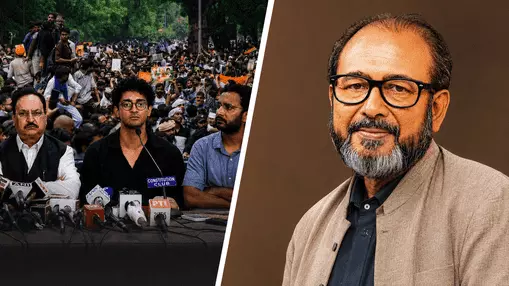
‘CJP protests may have ended, but youth movement is far from over’ | Interview
Author and senior journalist Nilanjan Mukhopadhyay says CJP protests have revived youth-led dissent, reshaped political discourse and exposed systemic failures

The resignation of Dharmendra Pradhan as Union Education Minister may have ended the immediate phase of the Cockroach Janta Party (CJP)-led agitation, but it is "not the end" of the youth movement, says author and senior journalist Nilanjan Mukhopadhyay.
He argues that the protests have demonstrated that sustained public mobilisation can still force political accountability and that young Indians are unlikely to remain silent after securing what they see as their first major victory.
In an interview with The Federal, Mukhopadhyay analyses whether the movement has truly ended, what Pradhan’s resignation means for the Modi government, the Opposition's next steps, and the growing influence of social media in Indian politics. Edited excerpts:
Has the CJP’s decision to call off the protest put an end to the movement as well as the outfit?
I do not think it is appropriate for us to say this is the end of the outfit. Immediately after the announcement that Dharmendra Pradhan was resigning, CJP’s founder Abhijeet Dipke, while speaking at Jantar Mantar in New Delhi, said, "This is the first wicket, many more to come."
That clearly means the various issues raised over the last few days while the protesters were at Jantar Mantar—and reportedly in around 100 cities across the country—have generated enormous traction.
Also read: The unmaking of Brand Modi: How ‘56-inch chested’ PM bowed to youth power
I think we will hear more of the CJP, perhaps not under the same name but in another avatar. More importantly, the sentiment that has emerged among youngsters in the 15-30 age group, who formed the bulk of the protesters, is not going to disappear.
After achieving what they see as their first victory, these young people are not going to remain silent forever. They will continue raising their voices on different issues.
Do you see Pradhan's resignation as a course correction by the Modi government?
First of all, I do not think anybody except Mr. Modi takes decisions in this government, especially on a matter as significant as the resignation of a Union minister.
Such a resignation is bound to be interpreted as the prime minister taking a step back. Therefore, I believe this was a carefully thought-out decision.
Over the last two days, Mr. Modi tried to reach out to the protesters through two videos, but they did not have the desired effect. In fact, he was ridiculed even more than before.
After realising there was no other option, he must have asked Pradhan to submit his resignation.
Will the resignation have a larger political impact on Prime Minister Modi, especially with elections approaching?
The CJP protests show us that protests still work.
One of the most remarkable aspects of this movement was that the idea of protest as something inspiring and transformative is not dead.
I use the word "romantic" in a broader sense—not interpersonal romance, but the belief that change is possible.
Across the world, wherever young people have come together to protest, it has been driven by the desire to make a mark and bring about change.
Also read: How songs of resistance have bound protestors at Jantar Mantar with generations of past dissenters
There is a saying that even the sky can be pierced if someone keeps throwing stones at it. Someday, one of those stones may create an opening.
That spirit has returned.
If it continues to grow in our country, then the BJP's narrative that anyone who disagrees with it is anti-national or an anti-social element—as Pradhan's resignation letter also suggests—will find fewer supporters.
Increasingly, more people will simply say, "I disagree with you," and launch fresh protests on other issues.
How should the Opposition take this issue forward after the protests have ended?
I think the first question should actually be asked to the BJP. How is the government going to take this issue forward? Parliament did not function for an entire week. What will the government do to ensure Parliament functions properly? Which issues does it want to bring before the House? When the government calls an all-party meeting to discuss parliamentary business, the Opposition should demand a discussion on the protests and what led to Pradhan's resignation.
Also read: From JP to CJP: How Delhi remains the epicentre of India’s power-shifting protests
More importantly, it should seek answers on what the government plans to do about the broader issues highlighted by the movement. This is no longer just about an alleged NEET paper leak. The protesters repeatedly said this was about systemic failure and accountability. These are core political issues and should be debated extensively in both Houses of Parliament. Adequate time should be given for such a discussion.
If that does not happen, disagreements between the Opposition and the government will continue, and we do not know what the consequences will be. Of course, the government may argue that despite its efforts, the Opposition still wants to disrupt Parliament because it does not want the House to function.
Has this protest marked the mainstreaming of social media in Indian politics?
Social media has played an increasingly important role in every election since 2009, when platforms like X (earlier Twitter) were emerging.
Even then, political parties used it extensively.
LK Advani, who was the BJP's prime ministerial candidate in the 2009 Lok Sabha election, had a significant social media team supporting his campaign. Its influence has steadily expanded.
However, I would say that until now, social media had not directly shaped a social and political protest of this scale. Even during the India Against Corruption movement led by Anna Hazare in 2011, social media was used to circulate information, mobilise supporters and communicate messages.
Also read: ‘After Pradhan’s exit, protecting students from retaliation next big challenge’
But the reach was nowhere close to what it is today because far fewer Indians were using these platforms.
In 2026, social media has a vastly larger audience than it did 15 years ago. That makes it an extremely significant political force.
Ironically, although Modi and the BJP were among the pioneers in effectively using social media during the late 2000s and early 2010s, today anyone can use these platforms to their advantage. In this round of protests, social media was used in a way that politically damaged Modi and the BJP. The government will now have to think about how it can effectively communicate its own message while responding to narratives created by others.
Internet shutdowns are no longer an effective solution. People can simply record a video, walk half a kilometre to another location and upload it.