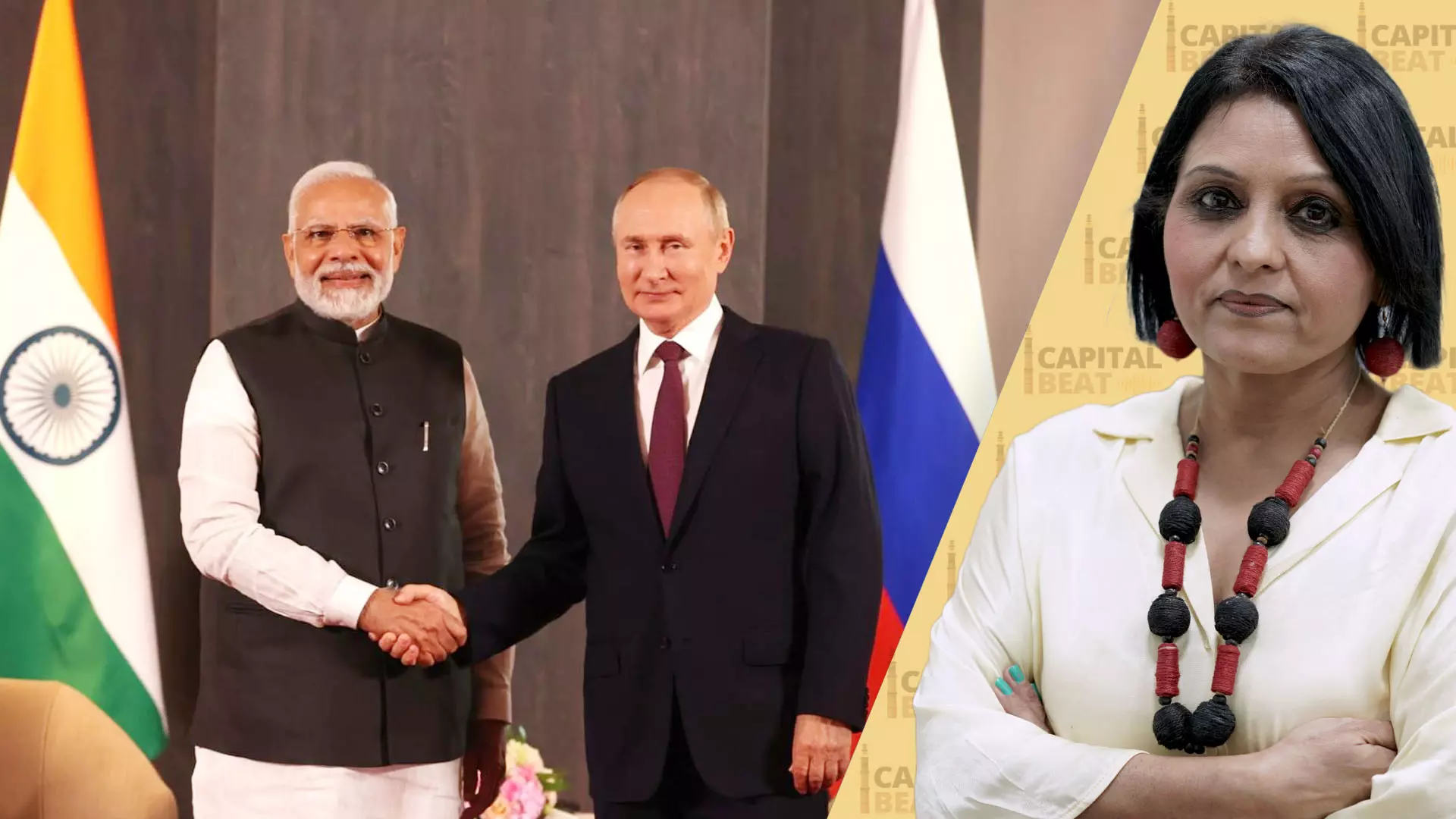
Putin's India visit: What’s at stake for India and Russia? | Capital Beat
Putin returns to India after four years, signalling a reset in bilateral ties as Delhi navigates strategic pressure from Washington. What India hopes to gain and how the US will react?

Russian President Vladimir Putin’s arrival in New Delhi at 6:30 p.m. today formed the central focus of this Capital Beat episode featuring international affairs experts Dr. Aftab Kamal Pasha and Sanjay Kapoor. The discussion examined the significance of the visit, the agreements expected at the 23rd India–Russia summit, and the broader context of India’s strained ties with the United States.
Putin will be in India for his first visit since the onset of the Russia-Ukraine war nearly four years ago. He last travelled to New Delhi in 2021 and has met Prime Minister Narendra Modi several times in 2025, including at the Shanghai Cooperation Organisation (SCO) meeting in Tianjin, China and through a series of bilateral calls. Multiple agreements across trade, defence, healthcare, academia, culture and media are expected during the visit.
Context of the visit
Dr. Pasha noted that the summit is taking place after extensive engagement between the two governments at multiple levels in recent months.
Also read: Putin’s India visit: MEA objects to 3 envoys’ article, calls it ‘unusual’
“The visit is the pinnacle of the several agreements which have been discussed in detail and they will be in tomorrow formally in the summit,” he stated. He observed that the Ukraine conflict had “bedevilled the bilateral relations which has led to pressure on both countries.”
He highlighted that Russia had endured strong economic sanctions from the European Union (EU), the United States and their allies, but added that Russia “has not only withheld this severe sanctions but it has managed to improve its economic standing and also improve its military position.” Dr. Pasha noted that India had simultaneously faced pressure from the United States over its continued import of Russian oil.
In his view, both Russia and India have experienced strains due to the sanctions architecture, the war’s geopolitical fallout and the challenges these pose to maintaining defence and energy cooperation. He said the summit offers an opportunity to reinforce long-standing ties at a moment when India faces criticism from Washington for its relationship with Moscow.
India under US pressure
Kapoor addressed how Washington may view the visit, noting that the United States had raised tariffs on Indian goods to 50 per cent, citing India’s large-scale imports of Russian oil. “At the face of it US will be upset with India primarily because it said that they were raising the tariff on India because of India's buying oil from Russia,” he observed.
Also read: S-400 and Su-57 on agenda for Putin’s India visit, says Kremlin
He pointed out that American political dynamics also influence Moscow–Washington interactions, with discussions underway between Russian and US interlocutors over possible approaches to Ukraine. Kapoor remarked that the visit comes at a time when Russia remains a central partner for India within groupings such as BRICS, an arrangement he noted the US administration views critically due to its dedollarisation initiatives.
Kapoor explained that India’s challenge is to manage ties with both Washington and Moscow without alienating either. He added that Russia’s role in India’s energy security and defence supplies cannot be easily substituted, though recent American sanctions on Russian oil companies have affected Indian refiners. He noted that one major Indian private refinery had significantly reduced purchases from Russia, reflecting the pressures involved.
Strains within global diplomatic alignments
Returning to the energy question, Dr. Pasha observed that the outcome of the Ukraine conflict remains central to stabilising Russian oil supplies to India. He stated, “The key to the oil front is resolution of the Ukraine conflict.” He referred to ongoing diplomatic efforts and described how divisions within NATO, American domestic considerations and the positions of European states continue to shape the conflict’s trajectory.
Dr. Pasha argued that prolonged conflict would intensify pressure on India’s foreign policy, stressing that “the longer the Ukraine war goes on, the greater the damage it will do to not only bilateral relations between India and Russia but also to America and India and also to India and Europe.”
He added that India’s foreign policy is navigating sensitivities involving the United States, European allies, Russia and China. In his view, the summit offers a moment to restore clarity and confidence within the India-Russia partnership at a time of shifting alignments.
Cold War comparisons and geopolitical positioning
The discussion turned to perceptions that Putin’s visit evokes Cold War dynamics. Dr. Pasha rejected this view, noting that Russia today is fundamentally different from the Soviet Union. “It is very different Russia now… more open for debate, discussion and relationship not based on ideology,” he stated. He observed that Russia is willing to engage with India, China, the Global South and BRICS in a pragmatic manner.
He further argued that Russia’s current geopolitical posture has strengthened during the war. He stated that “Russia's economy military… has come back with vengeance”, adding that earlier assumptions about Russia’s decline have proven incorrect. He also noted that China has played a key role in supporting Russia through this period.
Dr. Pasha cautioned that prolonged rhetoric around escalation, including statements about readiness for conflict with Europe, does not contribute to resolution. He emphasised that Russia and Europe both require restored energy and market linkages, and argued that renewed equilibrium in Eurasia would positively influence India’s relations with multiple partners.
Domestic political concerns around protocol
The panel examined comments by Opposition leader Rahul Gandhi, who stated that he had not been permitted to meet Putin despite established diplomatic protocol. Kapoor said, “I think it's very, very unfortunate that the government of India is not allowing the leader of the Opposition.” He noted that earlier governments facilitated such meetings and argued that “this used to be the practice earlier”.
He stated that on issues relating to Russia, there is broad alignment between the government and Opposition, making the restriction unusual. Kapoor reflected that this decision stems from heightened political tensions between the ruling and opposition parties. He described it as “very bad for our democracy” and said it excludes a long-standing element of India’s diplomatic engagement.
What is at stake for India and Russia
In closing observations, the panel discussed what both countries seek from the summit. Dr. Pasha emphasised that misunderstandings stemming from the Ukraine conflict, BRICS debates and American pressure should not erode India–Russia ties. He stated that Russia and China favour rapid expansion of BRICS, whereas India supports a more gradual approach due to sensitivities involving the United States.
He added that India must carefully manage relations with both Washington and Moscow, noting that “we cannot afford to antagonise the United States at any level.” At the same time, he argued that India must reassure Russia that its partnership remains based on continuity and strategic trust.
Dr. Pasha also noted that India’s proximity to either the United States or China often triggers reactions from the other major powers, affecting India’s security environment. He stressed that “these small issues should not be allowed to undermine or affect bilateral relations.”
The episode concluded by noting that multiple diplomatic and business-level meetings are scheduled for Friday, with both countries preparing for a full day of engagements following Putin’s arrival.
(The content above has been transcribed from video using a fine-tuned AI model. To ensure accuracy, quality, and editorial integrity, we employ a Human-In-The-Loop (HITL) process. While AI assists in creating the initial draft, our experienced editorial team carefully reviews, edits, and refines the content before publication. At The Federal, we combine the efficiency of AI with the expertise of human editors to deliver reliable and insightful journalism.)