



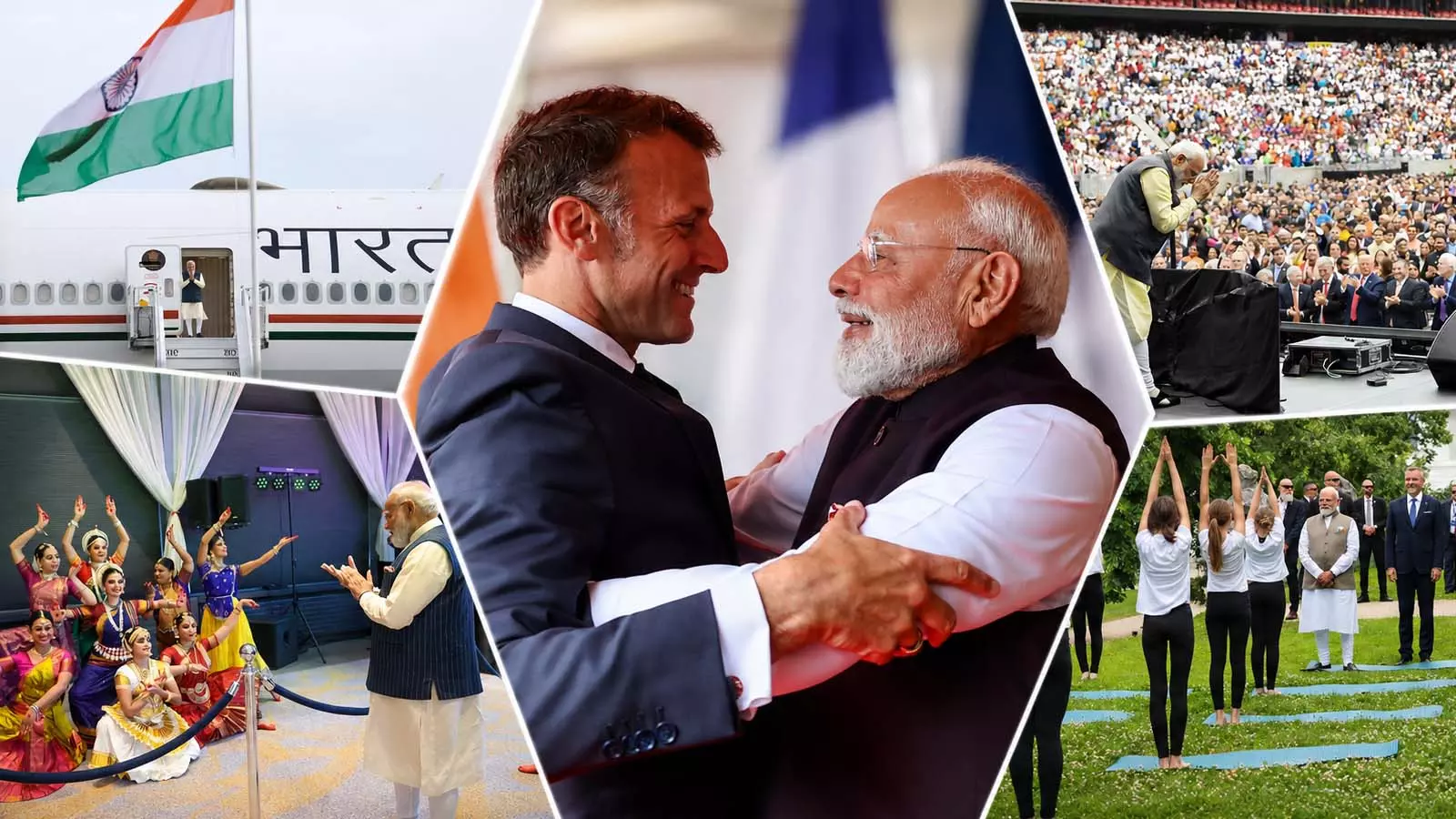
Prime Minister Narendra Modi's visits have often combined diplomatic engagements with outreach to the Indian diaspora, producing high-profile moments.
From Bhutan to Slovakia: Tracking PM Modi’s record 100 overseas visits
The prime minister's diplomatic footprint has extended across regions that had seen little engagement from Indian leaders for decades

Prime Minister Narendra Modi returned to New Delhi after a two-nation diplomatic tour of France and Slovakia, marking his 100th foreign trip since taking office in 2014.
Over the past 12 years, Modi has emerged as one of India's most travelled prime ministers, using diplomacy, diaspora outreach and strategic engagement as key pillars of his foreign policy. In fact, he is India's most-travelled Prime Minister, having undertaken over 70 trips earlier.
Overseas visits
According to the Prime Minister's Office (PMO), Modi's first overseas visit as prime minister was to Bhutan in June 2014, followed by a trip to Brazil for the BRICS Summit the following month. Since then, he has travelled to 78 countries and undertaken 100 foreign visits across three consecutive terms in office.
Also read: An Indian PM hasn't been to Norway in 43 years; so why now?
Modi completed 49 foreign tours during his first term between 2014 and 2019 and 27 during his second term. Since returning to power for a third consecutive term in 2024, he has already undertaken 24 overseas visits. His current tour, which began on June 13 and concludes on June 18, includes participation in the G7 Summit in France and bilateral engagements in Slovakia.
Many historic firsts
The prime minister's diplomatic footprint has extended across regions that had seen little engagement from Indian leaders for decades. He became the first Indian prime minister in 45 years to visit Poland in 2024 and the first in 41 years to travel to Austria. His visit to Norway ended a 43-year gap, while his trip to Argentina in 2025 was the first by an Indian prime minister in 57 years.
His ongoing visit to Slovakia is the first ever by an Indian prime minister since the country became independent in 1993.
Modi has also recorded several historic firsts. He became the first Indian prime minister to visit Israel in 2017, Mongolia in 2015, Ukraine in 2024 and Slovakia in 2026. He remains the only Indian prime minister to have visited Palestine, undertaking the trip in 2018. He was also the first Indian prime minister to visit Rwanda.
Breaking protocols
Modi's foreign visits have also been marked by several unusual diplomatic gestures and protocol exceptions from world leaders. During his visit to Papua New Guinea in 2023, Prime Minister James Marape personally received him at the airport despite local convention discouraging official welcomes after sunset.
Also read: Modi’s ‘Melody moment': Is foreign policy being reduced to viral moments?
In the United States, former President Barack Obama accompanied Modi to the Martin Luther King Jr. Memorial in a gesture rarely extended to foreign leaders. During Modi's visit to Nice, the city's mayor ordered the Indian Tricolour to be flown at City Hall, an uncommon honour for a visiting foreign dignitary.
Beyond diplomacy
Some of Modi's most frequently visited destinations reflect India's strategic priorities. He has travelled to France and the United States 10 times each during his tenure, while Japan and the United Arab Emirates have hosted him eight times.
His visits have often combined diplomatic engagements with outreach to the Indian diaspora, producing high-profile moments such as the "Howdy Modi" event in Houston in 2019 and the record-breaking International Day of Yoga celebration at the United Nations headquarters in New York in 2023.
Countries not visited by PM
Despite becoming one of India's most travelled prime ministers and breaking several long-standing diplomatic droughts, several prominent countries remain absent from Modi's travel itinerary.
Also read: Modi and the NRI: How BJP has tapped the diaspora for electoral gains
Among major economies and strategically significant nations, he has not yet visited Mexico, Ireland, Finland, Czech Republic and Hungary. In Latin America, countries such as Chile, Peru and Colombia have also not featured in his foreign engagements so far.
Among India's more sensitive diplomatic relationships, Modi has never visited North Korea. The list is notable because several of these countries are important trade, technology, and investment partners, suggesting that even after 100 foreign visits, India's diplomatic outreach still has significant room for expansion.
When Modi was barred
Modi's diplomatic journey is particularly notable given that before becoming prime minister, he faced international isolation following the 2002 Gujarat riots. In 2005, the United States revoked his visa and denied him entry, a restriction that remained in place until he became prime minister in 2014.
Several European nations and the United Kingdom had also limited official engagement with him before gradually restoring ties in 2012.
Expenses and criticism
According to figures presented by the Ministry of External Affairs in Parliament, India spent approximately Rs 762 crore on the prime minister's foreign visits between 2015 and 2025. Travel to the United States accounted for the highest expenditure, followed by France and Japan.
Also read: India seen as trusted trade partner: PM Modi in Malaysia after US, EU deals
Modi's extensive overseas engagements have also attracted criticism from opposition parties, particularly the Congress, which has frequently questioned his diplomatic outreach. Congress leaders have argued that despite more than 100 foreign visits, India has often struggled to secure explicit international backing during periods of heightened security tensions with its neighbours.
Critics have also questioned the costs associated with high-profile overseas tours and diaspora events, arguing that frequent travel has sometimes been prioritised over pressing domestic concerns.
More recently, opposition leaders highlighted what they described as a contradiction when Modi urged Indians to avoid non-essential foreign travel in 2026 to conserve foreign exchange reserves amid global economic uncertainty, despite being among the country's most travelled prime ministers.
The government, however, has consistently defended the visits, maintaining that they have strengthened India's global standing, expanded strategic partnerships, attracted investment, boosted defence cooperation and enhanced India's influence in multilateral forums.