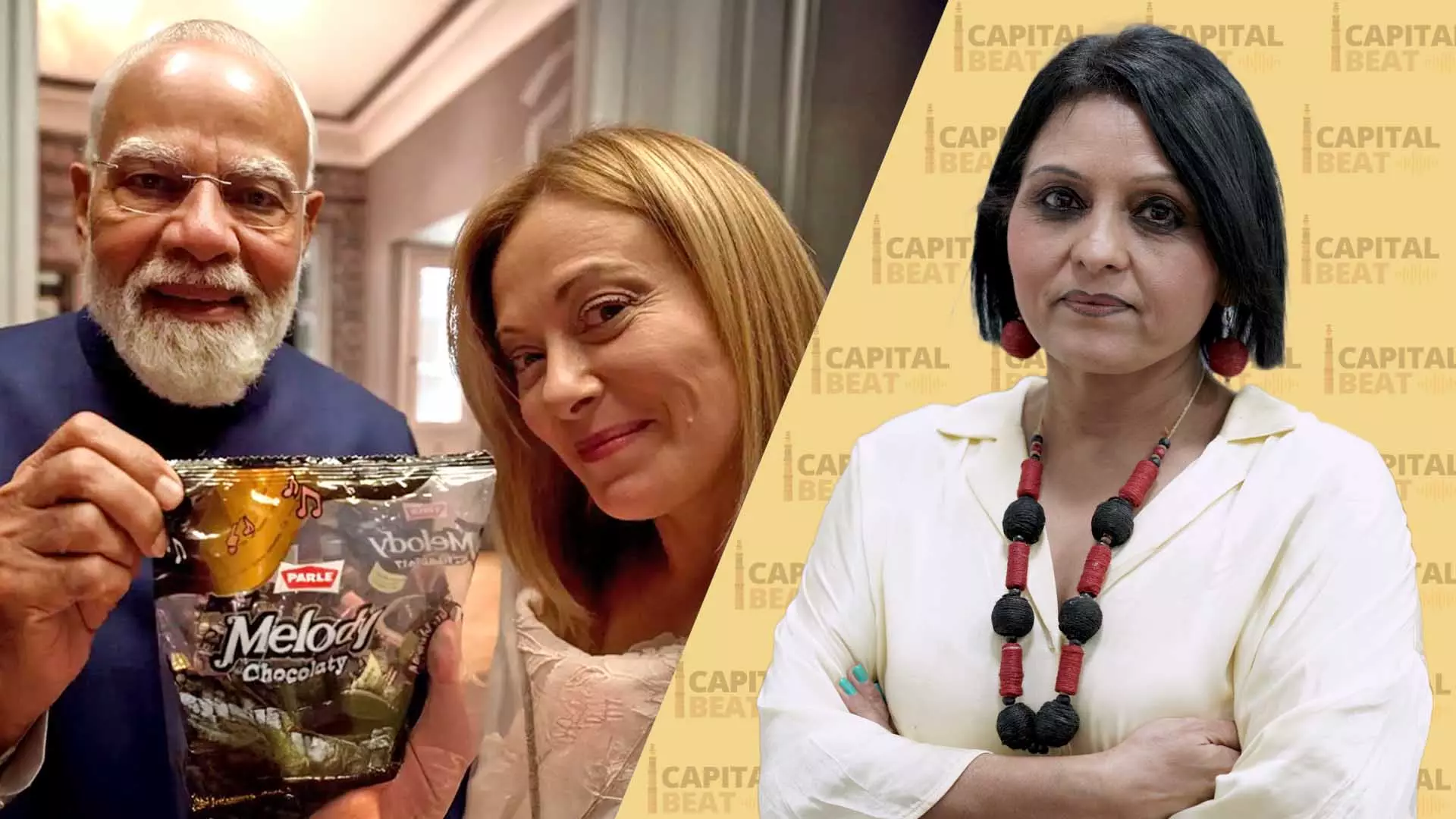
Modi’s ‘Melody moment': Is foreign policy being reduced to viral moments?
Panellists questioned the lack of focus on strategic outcomes, with one remarking that the trip’s biggest takeaway seemed to be merely raising a packet of candies

Prime Minister Narendra Modi’s viral “Melody diplomacy” moment with Italian Prime Minister Giorgia Meloni has triggered a sharp political debate, with critics questioning whether foreign policy is increasingly being reduced to social media optics and viral moments.
In this episode of Capital Beat, The Federal spoke to senior journalist Sanjay Kapoor and Congress leader Anshul Trivedi on whether PM Modi’s now-viral gesture of gifting a packet of Melody toffees to Meloni during his Italy visit reflected changing diplomatic styles or an attempt at image management amid growing economic concerns.
The discussion came after videos shared by Meloni on social media showed Modi handing over a packet of Parle’s Melody candies, reviving the popular “Melodi” meme trend that frequently surfaces online whenever the two leaders meet publicly.
Viral moment
The viral clip quickly spread across social media platforms, drawing both amusement and criticism. The interaction also triggered an unexpected surge in the shares of Parle Industries, a listed company that investors mistakenly linked to Parle Products, the manufacturer of Melody toffees.
Host Neelu Vyas noted how the moment had “taken the internet by storm”, while also sparking political reactions from Opposition leaders.
Also Read: Rahul Gandhi attacks PM Modi over ‘Melody toffee’ moment with Italy PM Giorgia Meloni
Congress MP Rahul Gandhi criticised the Prime Minister, saying, “An economic storm is raging over our heads, and our prime minister is busy handing out candies in Italy.”
Congress president Mallikarjun Kharge also attacked the government over inflation, unemployment, and rising debt, accusing the BJP government of focusing on public relations rather than governance.
'Internet driving narrative'
Kapoor argued that viral moments and internet culture are increasingly influencing diplomatic engagements between world leaders.
“It’s very clear that Mr Modi wants to feed the demands of the internet,” Kapoor said. “The internet is driving the narrative around the conversation between two leaders.”
According to him, the visuals from Modi and Meloni’s meetings — including car rides, visits to the Colosseum, and informal interactions — were being projected as the highlight of the visit rather than substantive diplomatic outcomes.
Also Read: India, Italy elevate bilateral ties to special strategic partnership: PM Modi
He said major issues such as trade expansion and discussions around the India-Middle East-Europe Economic Corridor were overshadowed by the viral toffee moment.
“The way the entire thing is choreographed is shown to be the end itself,” Kapoor remarked. “Nobody talks about the trade issues or the more compelling strategic matters.”
Kapoor also referred to a satirical social media post by Rajya Sabha MP Manoj Jha, who described the episode as “caramel diplomacy”.
'More about image building than diplomacy'
Anshul Trivedi claimed the “Melody moment” reflected an attempt by Modi to repackage his political image through social media virality.
“This is a concerted move from Mr Modi to show the informal side of himself,” Trivedi said. “He is trying to reshape the narrative because people are no longer willing to buy into his speeches the way they used to.”
According to Trivedi, Modi’s carefully cultivated image as a larger-than-life leader was now facing challenges due to economic difficulties and public dissatisfaction.
“He is going in for virality to compensate for the lack of vitality in policy,” he alleged.
Trivedi further argued that the Prime Minister’s international visits increasingly resembled campaign exercises aimed at projecting popularity rather than achieving diplomatic breakthroughs.
“All these things that he does outside are an extension of his campaign mode,” he said. “This is more about image-building than diplomacy.”
'Diverting attention from economic challenges'
Both panellists repeatedly linked the viral episode to concerns over the Indian economy.
Kapoor pointed to rising prices and economic stress among middle-class households, saying such optics appeared disconnected from public realities.
“People are struggling and things are looking grim,” Kapoor said. “On top of that, you are serenading a leader at the Colosseum. It appears insensitive.”
Also Read: Beyond ‘Melodi’ selfie, dinner, Colosseum: What Modi-Meloni meet focuses on
Trivedi too claimed the government was attempting to divert attention from economic challenges by focusing on social media narratives.
“The country needs serious policy discussions,” he said. “Instead, we are seeing attempts at creating viral moments.”
He criticised Modi for not engaging regularly with the press, saying the Prime Minister was seeking relevance on platforms like X and Instagram rather than through parliamentary accountability.
'Trivialising diplomacy'
The panel also discussed how diplomacy itself has evolved in the age of social media.
Kapoor noted that leaders across the world increasingly seek viral moments that resonate online, even if there are no major diplomatic outcomes attached to them.
“Many times leaders meet and there are no tangible outcomes,” he said. “But these viral moments help project the visit as successful.”
Also Read: Meloni goes viral after Trump’s ‘beautiful’ remark, Erdogan’s smoking advice
However, he questioned whether such moments trivialised diplomacy.
“It gives some kind of kick to followers, but that is not the real thing,” Kapoor added.
Trivedi argued that the Prime Minister’s social media strategy was designed to maintain control over political narratives.
“Controlling information and constructing images is central to Modi’s politics,” he said. “Now that the older messaging is not resonating, these informal viral moments are being used.”
'Pressure on MEA officers'
Kapoor also spoke about what he described as growing pressure within the Ministry of External Affairs during Modi’s foreign visits.
He claimed officials were increasingly anxious about avoiding uncomfortable media moments after recent incidents involving tough questions from foreign journalists during the Prime Minister’s overseas engagements.
“The MEA officers are scared,” Kapoor alleged. “They do not want anything to go wrong during the Prime Minister’s visits.”
He suggested that carefully choreographed lighter moments such as the Melody toffee exchange were part of efforts to ensure positive headlines and social media traction.
Focus not on strategic outcomes
Despite the criticism, the viral “Melodi” trend continued to dominate online conversations, with many supporters celebrating the chemistry between Modi and Meloni.
The debate ultimately centred on whether diplomacy in the social media era is increasingly driven by optics and internet engagement rather than traditional strategic outcomes.
Also Read: PM Modi praises Italy's Giorgia Meloni as ‘patriot’ in book foreword
While critics described the moment as an example of “caramel diplomacy”, supporters saw it as a soft-power gesture that helped popularise an Indian brand globally.
Kapoor, however, remained sceptical about its larger significance.
“The tragedy is that the entire outcome of the trip ends up being just raising a packet of Melody,” he said.
(The content above has been transcribed from video using a fine-tuned AI model. To ensure accuracy, quality, and editorial integrity, we employ a Human-In-The-Loop (HITL) process. While AI assists in creating the initial draft, our experienced editorial team carefully reviews, edits, and refines the content before publication. At The Federal, we combine the efficiency of AI with the expertise of human editors to deliver reliable and insightful journalism.)