Why use State machinery to celebrate PM’s birthday? And who’s footing the bill?
PM Modi’s 76th birthday celebrations involve schools, officials and public programmes. But who is paying, and where does the state’s role end?

The BJP is marking Prime Minister Narendra Modi’s 76th birthday today (September 17)—as well as his 25 years in public life—with a month-long Seva Sankalp Abhiyan, featuring public-service activities, blood donation drives, cleanliness programmes, and a lamp-lighting initiative called “Aashirwad ka Diya” (the lamp of blessings).
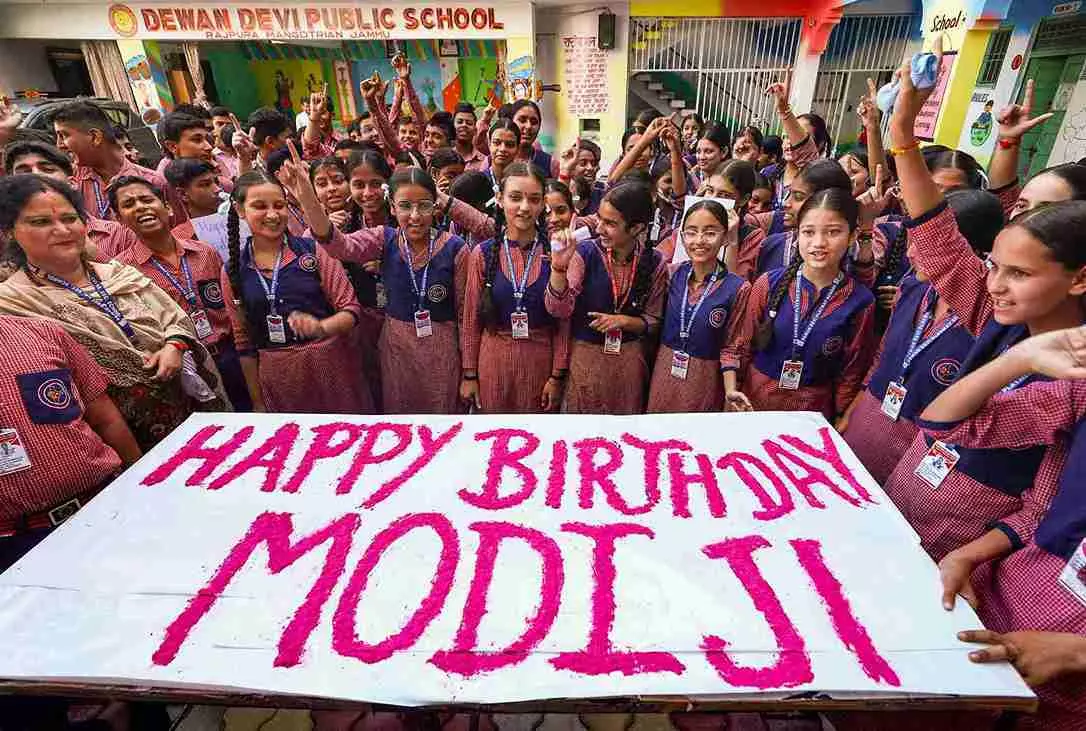
While the party is free to celebrate any event it chooses to, what has raised questions is the reported diktats to government schools to participate in these events and the organisation of programmes likely involving State expenditure.
Schools follow BJP diktat
For instance, a circular at a Jehanabad (Bihar) school reportedly asked teachers to remain on the campus from 6 pm to 7 pm to light lamps, record videos, and circulate the reels through WhatsApp groups. This was seemingly a direct impact of BJP president Nitin Nabin’s appeal for people to light an “Aashirwad ka Diya” specifically between 6 pm and 7 pm on September 17.
Also read: 75 is just a number: Modi's birthday and BJP's flexi-retirement policy
Another case in point was the large-scale lamp-lighting programme along the Shipra river and at Mahakal Lok in Madhya Pradesh’s Ujjain. More than 25 lakh lamps were reportedly lit, with Nabin himself participating in the event.
Public money, State machinery for PM’s birthday
But the million-dollar question is, who pays for such celebrations? Speaking on The Federal’s Capital Beat programme, Congress spokesperson Salman Anees Soz argued that Modi’s birthday could certainly be celebrated, but questioned whether public money or government machinery should be used for such activities.
He referred to a 2024 report concerning expenditure incurred by the Gujarat government on programmes commemorating Modi’s years in public life. Soz contrasted this with other national leaders and argued that public resources should instead address issues facing citizens.
Who pays and why?
Another jarring note was Delhi Chief Minister Rekha Gupta performing a havan as part of the birthday celebrations, raising a question over how far state institutions and political leaders should participate in such events. Is the line between party activity and government activity gradually getting eroded?
Also read: 75-year age rule: Bhagwat clarifies, reignites RSS-BJP power dynamics | Capital Beat
Senior journalist and political commentator TK Rajalakshmi said political parties and private individuals could organise celebrations using their own resources. But when government departments, employees, or public funds become involved, the expenditure and administrative decisions should be capable of being accounted for, she argued.
Celebrations forced on government staff?
She added if state governments were indeed spending public money on such events, there should be an identifiable administrative process, including budgetary allocation or a specific government head from which the expenditure was met.
Rajalakshmi also questioned the involvement of government employees such as school teachers and Anganwadi workers in birthday-related programmes. She argued that government employees are appointed to perform specific public functions and diverting them to celebratory programmes raises questions about the use of their working time and public resources.
Moreover, it is unlikely that government employees could refuse to participate in such activities, fearing the possible consequences. Soz pointed out that institutional pressure could make such refusal difficult, particularly when political and administrative structures overlap.
A hidden agenda?
But is there a hidden function of this gala birthday campaign? Is it serving as an image-building exercise for the BJP?
Soz argued that the scale of the celebrations appears disconnected from other issues that require greater attention, including education, public infrastructure, economic concerns, and India’s relations with the United States.
Also read: Bhagwat’s pitch on GenZ protests exposes RSS-Modi fault line over dissent
Author and policy expert Pushparaj Deshpande went further, describing the celebration as an exercise in personality-centric politics. He compared it with historical examples of rulers projecting themselves beyond the institutions they lead and argued that the present campaign reflects excessive personalisation of political power.
“The state is now becoming the individual, and the individual is being projected as a God-like figure,” author and policy expert Pushparaj Deshpande said, questioning the scale of the events and the involvement of government machinery.
Image-building and political mobilisation?
He questioned whether the campaign was partly designed to assess the strength of support for Modi and the BJP ecosystem given the recent setbacks with Gen Z.
Political analyst Ayushman Pandey similarly pointed to the involvement of party workers and government-linked programmes, asking whether the campaign could simultaneously serve image-building and political mobilisation purposes.
Visuals from across the country on Thursday showed children wearing masks of Modi or dressed as Modi, and celebrations featuring his images. Deshpande described the imagery as part of a wider personality cult, while Pandey argued that leaders and supporters should exercise restraint when celebrations begin to centre heavily on the individual rather than the office.