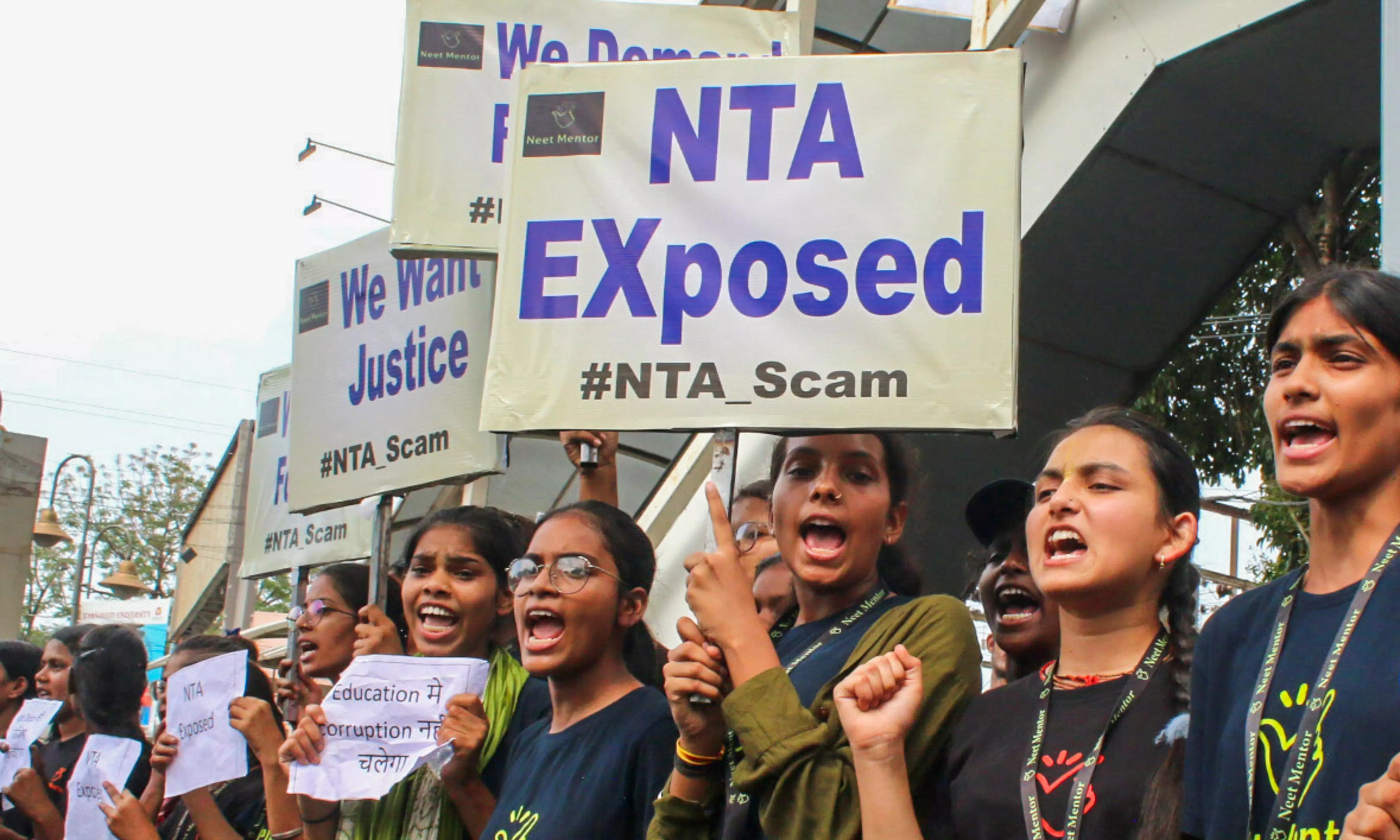
Parliamentary panel slams NTA's performance, suggests corrective measures
The report, laid on the table of Lok Sabha on Monday (December 8), also highlighted bureaucratic hurdles and a bribery investigation in NAAC’s accreditation system, pressing for a binary accreditation system

A Parliamentary committee has sharply criticised the functioning of the National Testing Agency (NTA), warning that a series of exam-related failures in 2024 and early 2025 have eroded public trust and require urgent corrective measures.
Alongside the NTA’s repeated lapses, the committee, in a report, has expressed strong concern over the higher education regulatory framework, particularly the UGC’s (University Grants Commission) failure to adequately address caste and disability-based discrimination in its draft 2025 regulations.
Also read: Top score in NEET UG-2025 stands at 686, lowest in exam's history
The report, laid on the table of Lok Sabha on Monday (December 8), also highlighted bureaucratic hurdles and a bribery investigation in NAAC’s (National Assessment and Accreditation Council) accreditation system – pressing for a binary accreditation system, and warned that funding restrictions may undermine infrastructure and faculty expansion goals necessary for the implementation of the National Education Policy (NEP).
Strong remarks on NTA’s performance
In its 371st report on ‘Review of Autonomous Bodies and Institutions – NTA, NAAC, Draft UGC Regulations, ICHR, ICPR, ICSSR, IIAS (Shimla) and Auroville Foundation’, the Parliamentary Standing Committee on Education, Women, Children, Youth and Sports, headed by Congress MP Digvijaya Singh, issued some of its strongest remarks on the NTA, stating that “the NTA’s performance in the last year has not inspired much confidence”.
In its two-part report on the woes of the NTA in June, The Federal had pointed out how the body stood accused of the very things it was meant to eliminate when it was formed in 2017: opacity, lack of accountability and numerous.
“It is a very small outfit with no intellectual base or resources of its own. It has been given the responsibility to organise examinations of a very different nature. It also has no accountability. It is like a private body not responsible to the public,” Delhi University Professor Apoorvanand had then told The Federal.
Also read: VIT Sehore students riot over ‘poor’ food, water; campus set on fire
The report also raises similar concerns. “In the year 2024 alone, of the 14 competitive examinations conducted by the NTA, at least five faced major issues and as result, three examinations viz. UGC-NET, CSIR-NET and NEET-PG had to be postponed, one examination viz. NEET-UG saw instances of paper leaks, and one examination i.e. CUET (UG/PG) saw its results postponed,” it said.
Concerns over vendors barred by govt
Further, the committee noted that in the JEE Main 2025 held in January, “at least 12 questions had to be withdrawn due to errors noted in the final answer key of the engineering entrance exam”.
The committee concluded that “such instances do not inspire confidence of the examinees in the system” and recommended that the NTA “quickly get their act together so that such instances, which otherwise are fully avoidable, do not occur in future”.
It raised alarm over the continued use of vendors barred by one government body but hired elsewhere, noting that “several firms involved in paper setting, administration, and correction have been blacklisted… but this however, is not impeding their securing of contracts”. It recommended compiling “a nationwide list of blacklisted firms… to prevent such firms/persons/entities from securing future contracts”.
Also read: What has Centre changed in Panjab University's governance and why the political uproar?
The panel noted that the NTA collected Rs 3,512.98 crore and spent Rs 3,064.77 crore in the last six years, “thereby creating a surplus of Rs. 448 Crores”. It said this corpus should be used to strengthen the agency’s internal capabilities and monitoring of vendors. Reiterating its 364th Report, it said the NTA must produce “not just an audited statement but also an Annual Report… and submit the same to the Parliament annually”.
‘No faith left in CUET or NTA’
In particular, the panel flagged delays in the Common University Entrance Test (CUET) results, saying, “Such a delay is a cause of major concern… which ultimately puts unnecessary pressure on the students”.
Delhi University Associate Professor Abha Dev Habib said she had “no faith left in CUET or the NTA”.
“Even if results come on time, the system itself is not working for students. The digital divide is very real. CUET’s structure disadvantages students, especially women, who cannot keep paying for coaching or handling repeated exam pressure… If the last leg of admission (in DU) can rely on Class 12 marks, why can’t we simply strengthen that?” she said.
The committee expressed concern at the expansion of coaching centres and recommended that exam papers “more closely reinforce the curriculum of school examinations”. It called for a high-level committee to “address the proliferation of coaching centres and suggest methods to regulate the same”.
On exam formats, the panel backed “a greater focus on pen-and-paper examinations” and asked the NTA to study exam models of the CBSE (Central Board of Secondary Examinations) and UPSC (Union Public Service Commission) and said CBTs (computer-based tests) must be conducted “only in government or government-controlled centers and never in private centers”.
Draft UGC Regulations 2025
Flagging that the UGC chairperson’s post has been vacant since April 2025, it recommended that “a new Chairperson should be appointed… as soon as possible”.
It noted that the Draft UGC Regulations 2025 are still under review and that at least 10 states have raised concerns.
“The Committee was informed that at least 10 state governments have written to the UGC raising concerns and giving suggestions about the draft regulations. In this context, the Committee reiterates its recommendation from Report 364 that the UGC should discuss the draft regulations with 13 the CABE (Central Advisory Board of Education) to ensure all stakeholders are involved in the consultation process,” it said.
The committee insisted that the draft regulations “must explicitly include the harassment of students… from the Other Backward Classes (OBCs)” as caste-based discrimination and “must explicitly include disability as an axis of discrimination”. It said Equity Committees must draw “more than half of its composition from the SC, ST, and OBC communities” and mandated “annual public disclosure of caste-based discrimination cases… sensitization programs… mental health support and legal aid”.
It also warned that “the UGC and the Department’s recent measures to restrict funding for capital projects in HEIs poses a challenge to achieving the goals of the NEP”.
On NAAC, the committee said the accreditation process was “long and bureaucratic” and reiterated the need to streamline it. It also took note of “a recent case of bribery in the NAAC” and sought a “through (sic) internal investigation”.
“If the government itself fudges data, whether on AQI or anything else, why would it surprise anyone that NAAC would have bribery or data manipulation? All these ranking and point systems create incentives for fudging,” said Habib.
The report also argued that with NIRF (National Institutional Ranking Framework) in place, NAAC’s grading is redundant and pushed for a binary accreditation system (accredited or not accredited) as recommended by the Radhakrishnan Committee.
The committee also stressed that “NAAC should allow flexibility for institutes in tribal and rural areas which cannot be considered on the same scale as institutes in metropolitan cities, etc”.
Acting UGC Chairperson and Secretary, Higher Education, Vineet Joshi, did not respond to calls or messages from The Federal. NTA Director-General Rajesh Lakhani could not be reached for a comment.