Explained: Politics behind Pakistan's boycott of India T20 WC game | AI With Sanket
The “Gentleman’s Game” has turned into a theatre of the absurd. In this episode of AI with Sanket, we dive deep into the unprecedented crisis surrounding the ICC Men’s T20 World Cup 2026

“Mark my words, India will not get it. You do your best. You will not get it.” That blunt declaration from senior sports journalist Rakesh Rao set the tone for a heated discussion on why Pakistan has chosen not to play India in the upcoming ICC Men’s T20 World Cup — and how cricket in South Asia is increasingly being shaped by politics rather than sport.
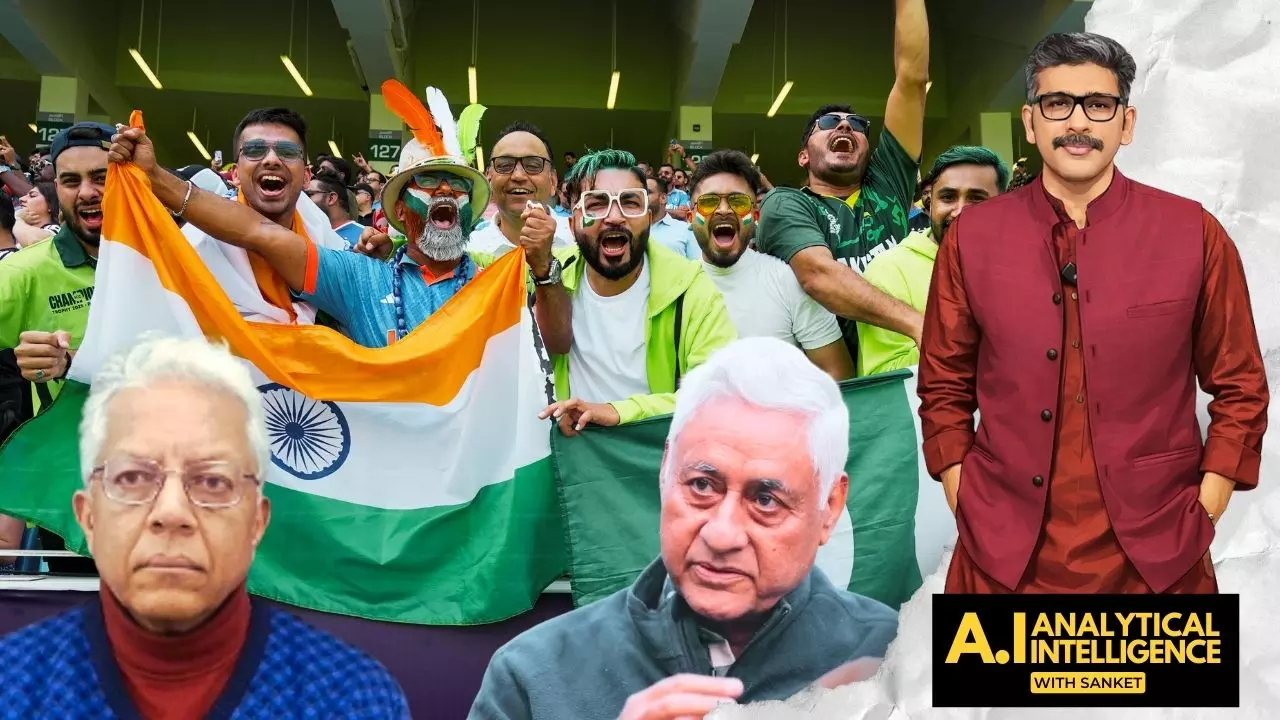
As Pakistan’s refusal triggered warnings of severe sanctions from the International Cricket Council (ICC), questions arose about selective boycotts, revenue loss, and whether cricket is now merely a theatre for geopolitical signalling. The Federal spoke to Pradeep Magazine, senior sports journalist, and Rao, on AI With Sanket, hosted by Sanket Upadhyay, to unpack the motivations and consequences behind Pakistan’s decision.
A match that vanished
The immediate controversy centres on an India–Pakistan group-stage match that now looks unlikely to happen after Pakistan declared it would participate in the tournament but refused to play India.
Also read: ICC warns Pakistan of 'serious implications' over India game boycott
Upadhyay framed the issue sharply: either teams play, or they do not. What confuses viewers, he said, is the growing culture of selective engagement — playing matches but refusing handshakes, declining trophies, or now, opting out of a specific opponent altogether.
Magazine described the situation as deeply disorienting for fans. “Either play or don’t play,” he said, noting that the repeated theatrics around Indo-Pak cricket were eroding the integrity of the sport.
South Asian politics on the pitch
Both panellists agreed the issue went far beyond cricket. Magazine argued that South Asian neighbourly politics were being played out through the game, with each country appealing to domestic audiences.
“Pakistan is playing to its own people,” he said, adding that the strained relationships between India, Pakistan and Bangladesh had now spilled fully into international cricket.
Rao echoed this view, calling Pakistan’s move a deliberate attempt to embarrass India rather than resolve a sporting dispute. He stressed that there was no immediate conflict between the Pakistan Cricket Board (PCB) and either the Board of Control for Cricket in India (BCCI) or the ICC before the announcement.
The Bangladesh trigger
A key turning point discussed was the controversy surrounding Bangladeshi cricketer Mustafizur Rahman being barred from participating in the Indian Premier League (IPL), which later escalated into Bangladesh withdrawing from the tournament altogether.
Magazine argued that this decision politicised the sport early on. He questioned how India could bar one Bangladeshi player citing security concerns while expecting the entire Bangladesh team to play in India.
Rao, however, pointed out that Bangladesh accepted its replacement by Scotland quietly. “Where was the need for Pakistan to step in?” he asked, calling Pakistan’s sudden solidarity with Bangladesh unnecessary and opportunistic.
Embarrassing India
According to Rao, Pakistan’s refusal to play India was carefully calculated. “The whole idea is to embarrass India,” he said, stressing that India was not even central to the initial Bangladesh issue.
He argued that Pakistan underestimated the implications of targeting the ICC itself. By refusing to play India, Pakistan risked damaging broadcast contracts and ICC revenues — revenues in which Pakistan itself is a stakeholder.
“No ICC tournament since 2012 has happened without India and Pakistan meeting at least once,” Rao noted, underlining how integral the fixture is to the global cricket economy.
ICC’s warning shot
The ICC’s response was swift and unusually firm. Rao highlighted how the ICC issued a carefully worded statement late on a Sunday night (February 1), signalling seriousness.
“This is not just a warning, it’s a threat,” he said, adding that the ICC could impose long-term sanctions that Pakistan would struggle to absorb.
Rao also rejected the narrative that the ICC is merely an extension of India’s will. While acknowledging India’s financial dominance, he stressed that ICC decisions are taken collectively by member boards.
Is Pakistan miscalculating?
Magazine questioned whether Pakistan had fully thought through the consequences. While acknowledging Pakistan’s right to take political positions, he warned that sacrificing cricket revenues and goodwill could severely harm its own cricketing ecosystem.
He predicted that if Pakistan reversed its decision under pressure, it would face embarrassment domestically. If it did not, it risked isolation.
“The blackmail is on both sides,” Magazine said, arguing that India, as a larger and more economically powerful nation, is expected to act with greater sagacity.
India’s credibility question
Upadhyay pushed the discussion toward India’s own contradictions — playing Pakistan soon after military operations, while publicly declaring Pakistan a global pariah.
Rao was blunt: India, he said, should have either refused to play Pakistan outright or avoided symbolic gestures like refusing handshakes after agreeing to play.
“To an outsider, this looks incoherent,” Rao said, warning that such mixed messaging hurts India’s credibility on the global stage.
Olympics and exaggerations
The panel also dismissed claims that these cricketing disputes could derail India’s Olympic ambitions.
Rao categorically stated that India is unlikely to win an Olympic bid as a first-time host, regardless of cricket boycotts. “It’s a numbers game,” he said, calling such fears exaggerated and unrealistic.
Magazine agreed that Pakistan’s decision was unlikely aimed at sabotaging India’s Olympic chances, though he urged India to behave like a mature bidder on the world stage.
What happens next?
Both panellists believe the situation is far from over. Rao expects Pakistan to face immense pressure — from the ICC, broadcasters, and financial realities — to reconsider.
“The ICC has to draw a line here,” he said, warning that selective participation cannot be allowed by any country, including India.
Magazine, meanwhile, expressed uncertainty over Pakistan’s next move but hoped for a resolution that prioritises cricket over politics.
A troubled future
As the show concluded, Upadhyay noted that broadcasters and fans stand to lose the most. An India–Pakistan match remains cricket’s biggest commercial draw, regardless of political tensions.
Whether Pakistan blinks or doubles down, the episode has laid bare how deeply entangled cricket has become with South Asian geopolitics — and how fragile the sport’s global governance can be when politics walks onto the pitch.
(The content above has been transcribed from video using a fine-tuned AI model. To ensure accuracy, quality, and editorial integrity, we employ a Human-In-The-Loop (HITL) process. While AI assists in creating the initial draft, our experienced editorial team carefully reviews, edits, and refines the content before publication. At The Federal, we combine the efficiency of AI with the expertise of human editors to deliver reliable and insightful journalism.)