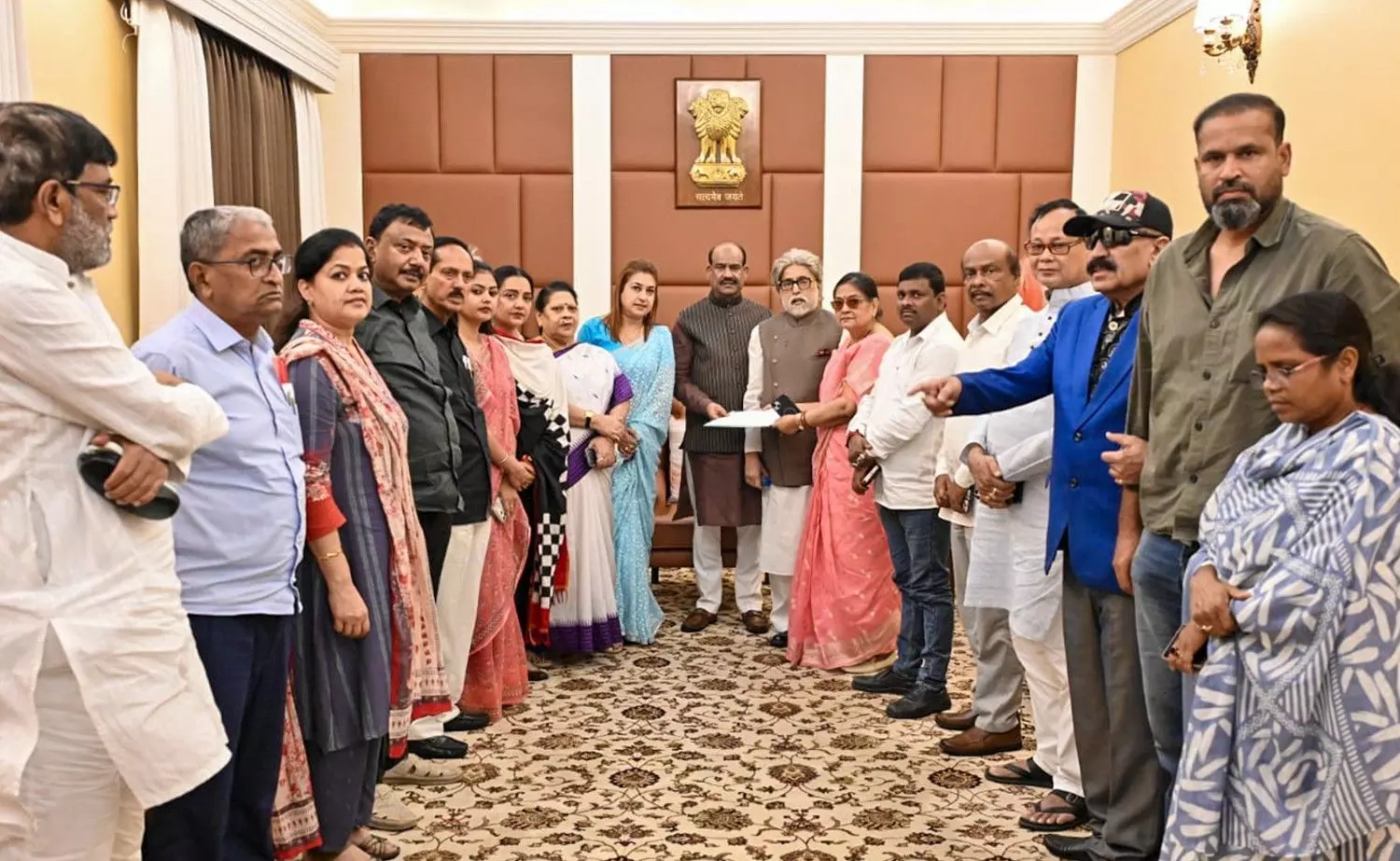
Lok Sabha Speaker Om Birla (centre) receives a letter from rebel TMC MPs for separate seating arrangement in the House, in New Delhi, on June 14, 2026. Photo: PTI
Despite NCPI merger, rebel MPs' fight over TMC identity is far from over
Senior leader Sudip Bandyopadhyay indicated that the dissidents could still seek recognition as the 'real' TMC when Parliament's monsoon session starts in July

A day after joining the little-known Nationalist Citizens Party of India (NCPI), the Trinamool Congress's (TMC) breakaway parliamentary lawmakers signalled their battle with their former party was far from over, suggesting they still claim political legitimacy within the outfit.
Sudip Bandyopadhyay, one of the senior members of the rebel group, on Monday (June 15) indicated that the dissidents could still seek recognition as the "real" TMC in Parliament's next Monsoon Session, which is expected to begin on July 20.
Sudip Bandyopadhyay fuels 'real TMC' speculation
"When Parliament convenes, a group will come in the name of the TMC. We will also say that we are the TMC. Let the numbers be counted," he told the media.
Also read: Who is Sudip Bandyopadhyay, the heavyweight MP who dumped TMC more than once
The remark has fuelled speculation that the rebels view their merger with NCPI not as a final political destination but as an interim platform in a broader battle over the future of the TMC.
The group claims the support of 20 of TMC's 28 Lok Sabha members (one MP died in 2024), a figure that, if sustained, would give the rebels significant leverage in any future contest over the party's parliamentary identity.
By moving collectively into another registered political party rather than individually crossing over to the BJP, the dissidents can maintain a distinct political identity while keeping open several future options.
Recent statements from the rebel camp have repeatedly emphasised numbers, suggesting that parliamentary strength remains central to their strategy.
While the rebels have pledged support to the Bharatiya Janata Party (BJP)-led National Democratic Alliance (NDA), they have stopped short of joining the saffron party. Instead, they chose the NCPI, an obscure and largely inactive outfit with virtually no electoral footprint.
That choice raised eyebrows across political circles.
For days, speculation had centred on whether the dissenting leaders would eventually move to the BJP. But leaders in West Bengal BJP publicly distanced themselves from such expectations, insisting the party was not preparing to absorb the rebels.
'Future options open for rebels'
Political analysts say the NCPI route offers the rebels greater flexibility.
“By moving collectively into another registered political party rather than individually crossing over to the BJP, the dissidents can maintain a distinct political identity while keeping open several future options,” said Kolkata-based political commentator Debashish Chakrabarti.
Those options could range from functioning as a separate NDA-aligned bloc to launching a more direct challenge to the TMC leadership in the months ahead, he added.
Bandyopadhyay's comments on Monday reinforced that perception.
Even while confirming that the rebels would continue to operate under the NCPI banner for now, he indicated that the dispute over the TMC’s parliamentary identity was far from settled and could ultimately end up before judicial and constitutional authorities.
Also read: TMC rebel MPs join NCPI to back NDA while also skirting legal hurdles
The prospect of a prolonged legal and political battle now hangs over the party.
Unlike previous defections from the TMC, which generally involved individual leaders switching sides, the current rebellion involves a substantial section of the party's parliamentary contingent.
NCPI, the surprise kid on the block
At the centre of the drama stands the NCPI, a party that until this week was virtually unknown outside a small circle of organisers in Bengal and Tripura.
The Election Commission's records show that NCPI was registered as an unrecognised political party in January 2023. Though headquartered in the Howrah district of Bengal, it first attempted to build a presence in Tripura, where it fielded candidates in the 2023 Assembly election.
The effort produced negligible results, with the party securing only a few hundred votes across the constituencies it contested.
Internal disputes reportedly paralysed the organisation after those elections, and several former associates have claimed the party became largely inactive.
NCPI founders flummoxed
Its sudden transformation from political obscurity to a potential national player has therefore surprised even some of its own founders.
One founding member, Shantanu Dey, publicly said he had not been informed about the decision to accommodate the rebel TMC MPs and would have opposed the move had he been consulted, highlighting signs of unease within the organisation.
Yet the influx of 20 MPs has instantly transformed the NCPI's profile. What was until recently an obscure political entity with little electoral relevance has become the largest party from Bengal in the Lok Sabha, and the second-largest NDA constituent, after the BJP.
Mamata faction starts hitting back
For the TMC leadership, the challenge now is to demonstrate that the party's political and organisational authority remains firmly with Mamata Banerjee despite the defection of a majority of its Lok Sabha MPs.
Also read: Why new BJP government in Bengal has brought both hope, apprehension to Bengali film industry
The Mamata camp has already begun pushing back against the rebels' claim to represent the "real" TMC. In a social media post, Rajya Sabha MP Sagarika Ghose said "massive false information" was being circulated about the anti-defection law and the two-thirds rule, arguing that any split or merger must first occur in the political party outside Parliament before lawmakers can claim protection from disqualification.
Against the backdrop of these competing claims, it appears that the next major test could come when Parliament reconvenes next month.