



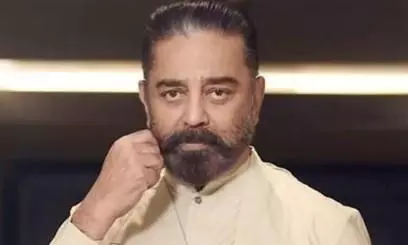
Kamal Haasan raises first Rajya Sabha queries on fuel transition, nuclear projects
Union ministers Gadkari and Jitendra Singh provided detailed written replies after the MNM chief questioned the govt on E20 petrol impact and thorium-based energy plans

Actor-politician and Makkal Needhi Maiam (MNM) chief Kamal Haasan raised two unstarred questions in the Rajya Sabha in written — his first — during the Winter Session of Parliament this week, seeking the government’s explanation on shifting to 20 per cent ethanol-blended petrol (E20) and the discontinuation of E10 fuel and the timeline for various nuclear projects being undertaken, including those in Kalpakkam in Tamil Nadu.
MNM MP asks question on E20 impact
In Question No. 2013, tabled for the Ministry of Road Transport and Highways, Kamal asked whether comprehensive studies have been conducted on E20's impact on vehicle mileage, engine components, and fleet compatibility, particularly older vehicles that are not designed for higher ethanol blends. The MP also questioned the reasons behind the nationwide withdrawal of E10 petrol, despite its wider compatibility, and whether the government plans to restore it as an option.
Also read: SHANTI Bill 2025: Who pays in case of a nuclear disaster?
Additionally, Kamal sought details on guidelines for warranty, insurance, or consumer protection against potential vehicle damage or higher operating costs from E20 use, including assessments of ethanol price volatility on fuel affordability.
Nitin Gadkari responds to Kamal
The query was answered in writing by Union Road Transport and Highways Minister Nitin Gadkari on Wednesday (December 17). He cited extensive field trials by bodies including the Indian Oil Corporation, Automotive Research Association of India, and Society of Indian Automobile Manufacturers, stating that E20 fuel causes no significant negative effects on vehicles, even the legacy models. No major issues were reported in performance parameters such as drivability, startability, or material compatibility, the reply noted.
Mileage variations, the minister added, stem from multiple factors beyond fuel type, such as driving habits, maintenance, and vehicle conditions.
Also read: Lok Sabha debates SHANTI Bill as India eyes 100-GW nuclear power by 2047
Kamal’s intervention highlights growing consumer anxieties over the accelerated ethanol blending programme, aimed at reducing oil imports and emissions. The Rajya Sabha member emphasised that personal transport symbolises aspiration for millions of Indians and stressed the need for an “informed, fair, and consumer-conscious” transition.
MNM chief poses questions on nuclear projects
In Question No. 2081 on leveraging India's thorium reserves, Kamal wanted to know from the government the comprehensive strategy and timeline for scaling up nuclear strategy from 8.8 Gigawatts (GW) to 100 GW by 2047 under the Nuclear Energy Mission aimed at Viksit Bharat. He also sought to know the timeline for the construction of thorium-based Advanced Heavy Water Reactors to utilise the country's thorium reserves, and in their absence, the plan for improving the nuclear capacity.
The MP also wanted to know the proposed timeline for beginning the construction of two additional Fast Breeder Reactors (FBR) in Kalpakkam and to what extent the local communities are being taken into confidence and the assessments for the environmental and social impact undertaken or proposed to be undertaken.
Also read: Will ethanol-blended fuel ruin your engine? India's ethanol push explained
Jitendra Singh, the minister of state for personnel, public grievances and pensions and the prime minister’s office, responded to the Tamil Nadu MP’s questions on Thursday (December 18), saying the government has prepared a comprehensive road map to reach a capacity of around 100 GW by 2047.
"The present nuclear power capacity is planned to be increased to about 22 GW by 2031-32 on progressive completion of projections under implementation," he said, adding, "Further, NPCIL (Nuclear Power Corporation of India Limited) has drawn up plans to contribute about 54 GW out of the 100 GW capacity envisioned by 2047."
On thorium, the minister said India has limited uranium but abundant thorium reserves. He said, unlike the former, thorium is a fertile material that needs to be converted to fissile uranium-233 in a nuclear reactor before being put to use to generate nuclear fission.
He said it for this reason that the Three-Stage Nuclear Power Programme envisaged by the government remains an important component of the country's nuclear-power programme, eyeing maximum utilisation of limited uranium reserves and abundant thorium reserves to achieve energy security in the long run.
Also read: SC rejects PIL against nationwide rollout of 20 pc ethanol-blended petrol
Singh also said that the Bharatiya Nabhikiya Vidyut Nigam Limited (BHAVINI) is currently commissioning a 500 MWe Prototype Fast Breeder Reactor (PFBR) project in Kalpakkam, and the government has given the nod to carry out pre-project work for 2X500 MWe twin units of FBR 1 and 2 project in Kalpakkam.
On reaching out to the local population, the minister responded to the MP, saying BHAVINI is taking adequate steps to take the local people into confidence through planned CSR and outreach programmes. They, including students from local schools and colleges, are being told about the advantages of nuclear power and the safety aspects of PFBR projects.
The episode marked Kamal’s first formal questioning in the Upper House since taking oath as its member in July this year.
