



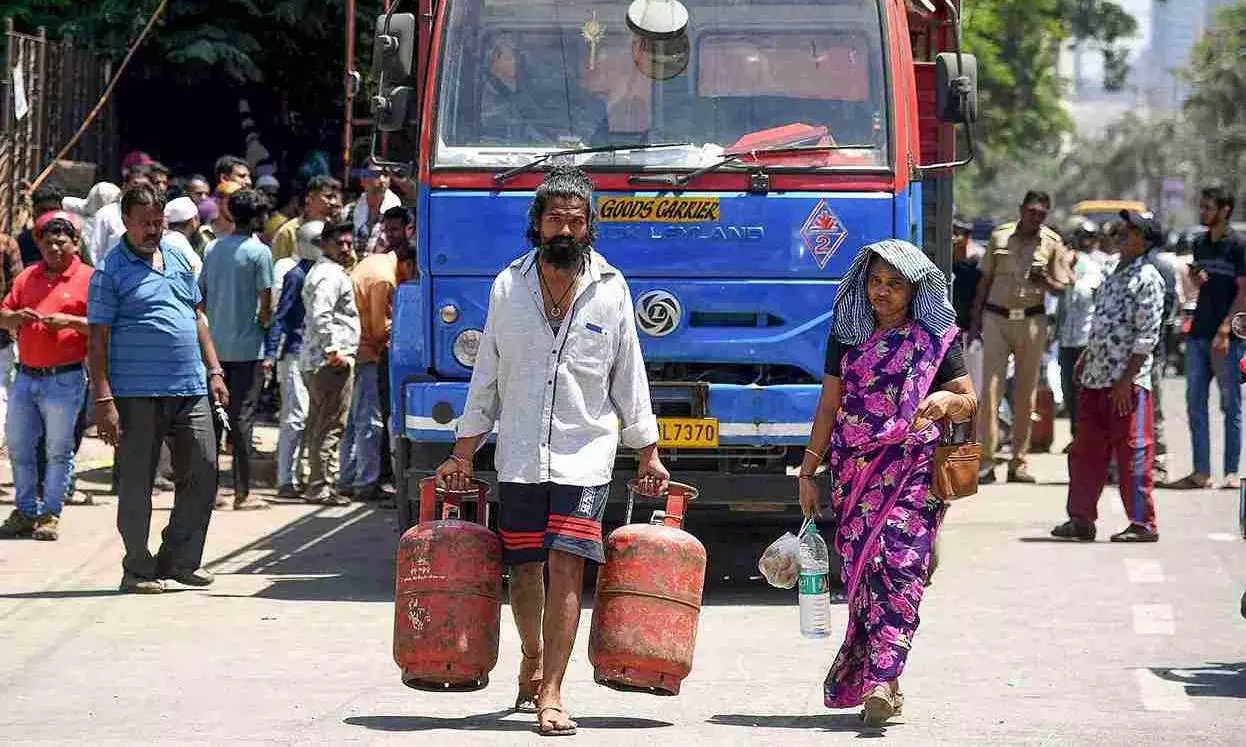
LPG crisis, polls, SIR trigger exodus of migrant workers from cities
Closure of businesses leaves many migrant labourers either jobless or with a pay cut; LPG shortage adds fuel to the crisis, forcing them to return home

In a near-action replay of COVID lockdown era, when front pages of newspapers would be full of haunting images of migrant labourers walking or riding overcrowded trains and vehicles to find their way home from metro cities, the Iran war has quietly been writing that same fate for them.
The blow is twofold. First, the closure of eateries, catering units, and similar food-related businesses has left many migrant labourers either jobless or with a pay cut. Second, despite repeated government assurances of an adequate supply of LPG cylinders, the story on the ground has been to the contrary. With state administrations struggling to contain hoarding, prices of cylinders in the black market, which many of these people rely on, have gone up sharply. And, with stronger monitoring, supply has been erratic.
Also read: LPG crisis: Industries start shutting down as states grapple with ‘inadequate’ supply
And hence, lakhs of people are returning to the only safe haven they can imagine—their villages in distant states—though, thankfully, they do not have to trudge it out this time. This, coupled with the impending elections in West Bengal and Assam, and the pressure of Special Intensive Revision (SIR), have ensured an exodus of migrants from metro cities.
Shortage of trains
But train journeys have not been easy either. According to a report in The Indian Express, migrant workers from the poll-bound West Bengal complained about the lack of special trains to meet the high demand at Mumbai’s Chhatrapati Shivaji Maharaj Terminus. Failing to book tickets in advance, many are even opting for unreserved tickets to make the long journey home.
The Indian Express quoted multiple workers’ body officials as saying that special trains have not been enough so far. The seven daily trains from Mumbai to West Bengal have fallen short to accommodate labourers willing to return home for the impending elections or SIR or those out of jobs. Nationwide, only 24 special trains have been allocated so far, which have fallen far short of the demand, says the report. People are reportedly even arranging buses to make the 1900-km journey by road.
Rush for home
And the picture is the same in metros like Hyderabad, Bengaluru, Delhi, or Ahmedabad. The All India Shramik Swaraj Kendra has estimated the number of affected Bengali migrants in Karnataka alone to be over 3 lakh.
Also read: Migrant exodus begins in Surat as West Asia conflict chokes fuel supply
According to a report in The Hindu, lakhs of migrant labourers were engaged in hotels, roadside eateries, fast food centres, catering units, sweets stalls, snacks and tea stalls in Andhra Pradesh before the LPG crisis either forced their businesses to shut or curtail the menu (and hence hands). These migrants were mainly from West Bengal, Odisha, Uttar Pradesh, Bihar, Chhattisgarh, Jharkhand, Telangana, and Tamil Nadu.
And hence, like Mumbai, heavy rush is being seen at Vijayawada, Eluru and other railway stations in Andhra too.
Crisis in Kerala
Kerala has also reported an exodus of migrant workers. G Jayapal, state president of the Kerala Hotel and Restaurant Association, told news agency PTI recently that migrant workers from West Bengal and Assam were expected to return home a week before the elections in their respective states.
“However, with the LPG crisis forcing hotels and restaurants to shut down, migrant workers will start returning to their native places early. They will return only after the elections. A majority of the workforce in hotels and restaurants are migrant workers. Restaurants are desperate to keep them here. However, small-scale restaurant operators find it hard to maintain staff when their shops are closed,” he said.
Binoy Peter of the Centre for Migration and Inclusive Development, told PTI that around 50 per cent of Kerala’s migrant workforce comes from the poll-bound states of Assam and West Bengal. “With hotels closed, migrant workers in the hospitality sector have started moving to their native places. Reserved tickets in trains to these states are already in the waiting list,” he said.
Also read: Govt restores PDS kerosene supply in kerosene-free states, UTs amid LPG crunch
“Usually, once migrant workers return to their native places, they come back only after one or two months. This will put all sectors in Kerala that depend on them in a crisis,” he said.
SIR panic
While the Assam elections are on April 9, West Bengal will vote only on April 23 and 29. So why are they leaving for home so early? The fear of their names being struck of the electoral rolls in the SIR has also been a big factor.
After the wrongful detention of several Bengali migrants and their deportation to Bangladesh last year, under suspicion of being illegal immigrants, many have rushed home to ensure that they figure on the Election Commission’s final voters list.
Among these are a large population of Bengali migrants from South Delhi, who have been living in the capital for decades, but their voter cards are registered in West Bengal. Labour shortage has also been reported from Punjab’s agricultural belt, reportedly causing losses for farmers in Jalandhar and Kapurthala districts, reported the Indian Express.
The LPG factor
But elections are not the only cause. The Indian Express tracked three trains from Mumbai — one to Uttar Pradesh, one to Bihar, and one to Bengal — the three states with the largest migrant population in the country, according to the 2011 census. Of the 130 people the reporters interviewed, 62, that is close to half, reportedly said they were returning home due to the LPG shortage. Bihar and UP are not poll-bound anyway.
Also read: Govt plans rapid PNG rollout in urban areas as amid LPG supply risks concerns
Even though the government claims to have taken several steps to mitigate the LPG crunch, black-market prices have risen sharply. Migrant workers, who often rely on 5-kg cylinders, have claimed that the price has more than doubled from Rs 500–550 to Rs 1,100–2,000, while a 14.2-kg cylinder in the black market now costs Rs 3,200–4,000, up from Rs 900–1,200. Some even fill their cylinders with a kilo of LPG each time, say reports, but even that is turning out costly.
Since most migrants cannot meet the strict KYC terms to get official LPG connections, they are forced to rely on these alternatives. Many do not even have ration cards, ruling out the option of using kerosene stoves at a cheaper rate. They have been queuing up outside gas agencies, only to return empty-handed day after day, says an Indian Express report. Since gas agencies have also tightened rules amid heightened checks, the options are getting increasingly limited for migrant workers.
The guarantee of food
From Maharashtra’s textile mills and power looms to Gujarat’s closed ceramic units, the story is the same for migrant workers. Gujarat’s Surat, famed for its diamonds and textile factories, employs more than seven lakh migrant workers, many of whom recently made news for choosing to leave for home. Hundreds of Odia workers reportedly boarded for home, reported the Indian Express.
Also read: Commercial LPG supply restored to 70 per cent, says Centre, amid West Asia conflict
Scroll reported workers’ plight in Delhi. Even as many of them are running out of cooking gas, the option to eat out at local eateries has also become expensive, with the owners jacking up prices to make up for the extra fuel cost.
The news portal quoted a labour supervisor as saying that half the workers he knows have gone home for this reason. “They say that at least they get food to eat when they are at home,” he told Scroll.