


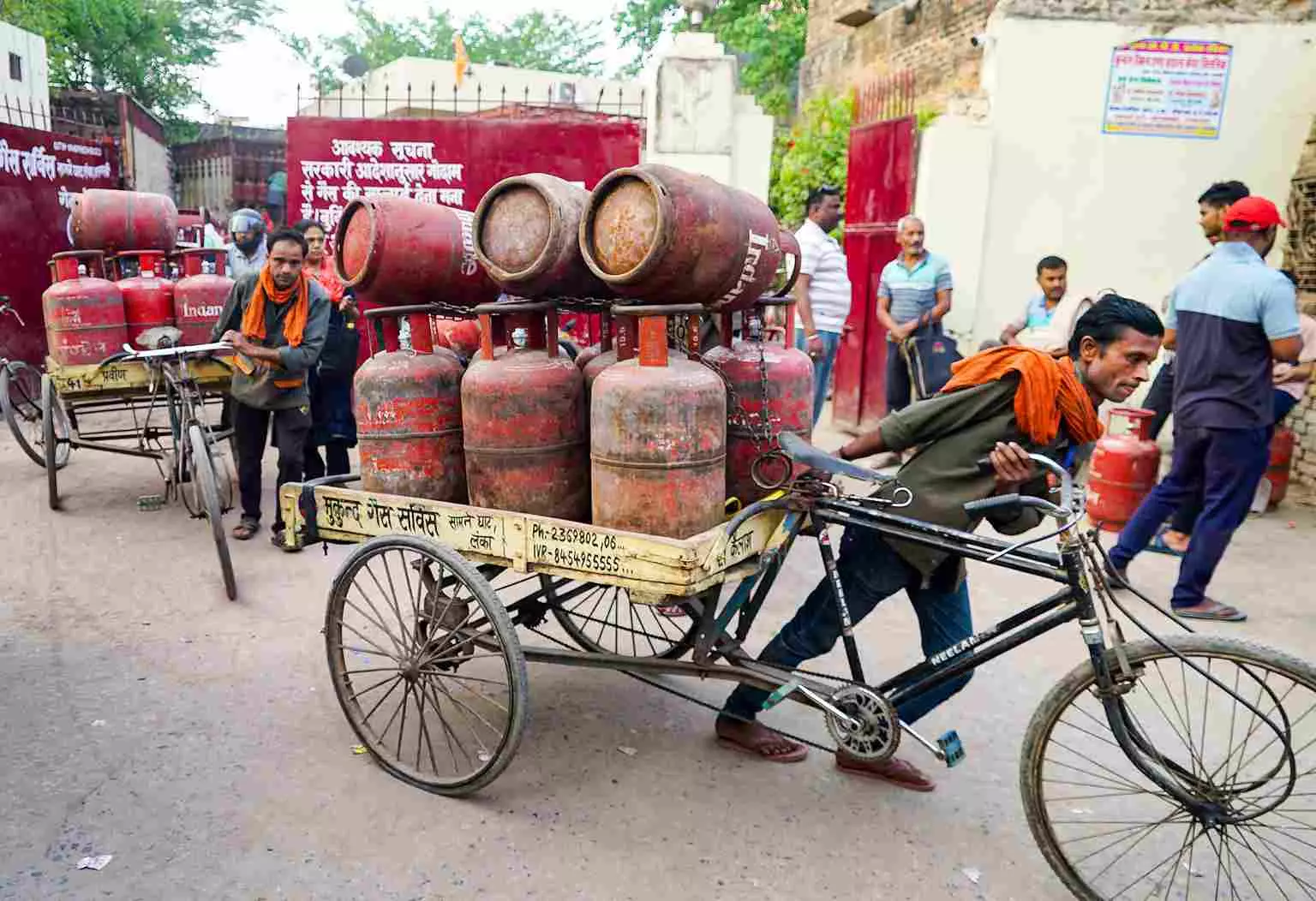
A worker carries LPG cooking gas cylinders, as people arrive to avail refilled ones, amid a shortage linked to the ongoing West Asia conflict affecting the global energy supply chain, in Varanasi, Wednesday, March 18, 2026. Photo: PTI
LPG crisis: Industries start shutting down as states grapple with ‘inadequate’ supply
As Strait of Hormuz disruption halts 60 pc of imports, India prioritises household kitchens over commercial sectors, forcing mass closures in ceramic, hotel, and tea industries

The LPG shortage crisis is hitting different industries across India, from ceramic units in Gujarat Morbi to hotels in Kerala and Maharashtra.
India's LPG supplies came under strain as the Strait of Hormuz - a key route for imports - faces disruptions following the US and Israel attack on Iran and Tehran's sweeping retaliation.
With shipments from major suppliers such as Saudi Arabia and the United Arab Emirates affected, India, which imports about 60 per cent of its LPG needs, has moved to ration supplies. The government has curtailed allocation to commercial users and industries to prioritise household consumption and prevent an immediate shortage of cooking gas.
The disruption has begun to ripple through several sectors that rely heavily on LPG. Restaurants have started dropping slow-simmered dishes from their menus because they consume large amounts of cooking gas, while industries, such as brick and tile manufacturing, ceramics and glass kilns, are also facing difficulties in sustaining operations due to gas shortage.
Essential services, including crematoriums, laundries and hospital kitchens, are similarly struggling to maintain regular activity, even as bakeries, street-food vendors and community kitchens report curtailing output amid tighter LPG availability.
Alternative cooking mediums
With the LPG supply squeeze impacting hotels, businesses and household consumers through longer waiting periods and panic bookings, the Centre meanwhile has asked states to expedite approvals for piped gas projects to enable faster rollout and ease pressure on cooking gas availability.
As the war in West Asia, which blocked India's access to almost 60 per cent of its LPG, continues with no end in sight, the government is now pushing for the use of alternative cooking mediums like induction cooktops.
Also read:Congress, BJP lock horns in Rajya Sabha over LPG crisis amid West Asia tensions
"Situation remains a matter of concern, but we are providing supplies as before to the domestic consumers," said Sujata Sharma, joint secretary, ministry of petroleum and natural gas.
This was made possible as refineries were asked to ramp up domestic output, which was then prioritised for household kitchens. Commercial use of LPG, such as in hotels and restaurants, was initially curtailed, but later restored to a fifth of their normal offtake.
"We have to look at alternatives," Sharma said at a media briefing.
Ceramic units in Gujarat
Meanwhile, many industries are facing the heat from the crisis.
As many as 430 ceramic units in Gujarat's Morbi will not operate for at least three weeks as the West Asia conflict has disrupted the supply of gas required in the manufacturing process, a representative of the industry said.
In Morbi, known as the ceramic city and the world's second-largest hub for ceramic tile production, nearly 450 out of the total 670 factories have already ceased operations due to the gas shortage and many more are on the verge of shutting down in the days to come, officials said. The ceramic industry relies heavily on propane or natural gas for its operations, particularly for firing kilns and drying processes.
Morbi Ceramic Manufacturing Association president Manoj Arvadiya said the ceramic units using propane gas first shut their operations as its supply got exhausted. Later, those using natural gas also closed their operations. "Now, around 430 such units have collectively decided not to operate till April 10-15 and use the period for maintenance of their machines. They will together begin operations subject to the availability of the new supply of gas," Arvadiya said.
Hotels in Maharashtra, Kerala
Hotels are also reeling amid the commercial gas shortage. Hotel and restaurant owners' body has urged the Maharashtra government to grant an extension or allow staggered payment of the annual licence fee, saying the commercial LPG shortage has forced shutdown of several hospitality establishments.
The Hotel and Restaurant Association (Western India) - HRAWI on Tuesday submitted a representation to Sunetra Ajit Pawar, deputy Chief Minister and minister for state excise, requesting a one-month extension of the license fee payment deadline from March 31 to April 30. The association has also proposed a staggered payment mechanism, allowing the annual license fee to be paid in four quarterly instalments by March 31, June 30, September 30 and December 31.
"The situation on the ground remains critical, with approximately 30 to 35 per cent of hotels and restaurants currently shut, owing to a near complete halt in the LPG supply from distributors," HRAWI said. Establishments that continue to operate are doing so under curtailed hours and restricted menus, optimising fuel usage to sustain operations, it observed.
Also read: LPG shortage forces Puducherry restaurants to look for other ways to keep kitchens running
"However, many of these establishments may also be forced to shut down within the next 2 to 3 days if supplies are not restored. At this critical juncture, we urge the government to provide immediate relief by granting an extension or permitting staggered payment of the annual license fee. Such support will go a long way in helping the industry navigate this liquidity crunch," HRAWI spokesperson Pradeep Shetty said
Kerala hotels protest
Meanwhile, in Kerala, hotels and eateries in Kerala will shut down on Mach 23 as a mark of protest amid the ongoing shortage in LPG supply, the KHRA announced on Tuesday.
The state executive committee of the Kerala Hotel and Restaurant Association (KHRA), has decided to hold protests till the demand is met. KHRA also said that oil companies were not distributing cylinders to hotels as they were not included in the priority category for supply of LPG.
It also claimed that private companies were using the situation as an opportunity to steeply hike the price of LPG. As a result, many hotels are shutting down as they are unable to function, the statement said.
Despite the issue affecting lakhs of people directly, the state and central governments are being indifferent to the plight of the hotels, it alleged. Demanding the inclusion of the hotels in the priority category and distribution of LPG to them, a protest march will be held to the bottling plants of the oil companies on March 19, the statement, issued by KHRA president G Jayapal, said. Besides that, on March 23, hotels will be shut down across the state as part of the protest, it said.
Darjeeling Tea
In West Bengal, the Darjeeling Tea Association has warned that tea estate factories in Darjeeling are facing a severe LPG shortage that could halt operations at tea gardens employing 55,000 workers and their families.
The crisis stems from a ministry of petroleum and natural gas order dated March 5 directing all public sector oil marketing companies (OMCs) to supply LPG solely to domestic consumers and those on the priority list.
The Darjeeling Tea Industry, being entirely dependent on industrial LPG, finds itself excluded from the priority list, it said. "The Darjeeling Tea Industry, after a prolonged three-month gap, has just started producing its 1st flush tea, which is exported and is of premium quality and generates revenue. If the LPG shortage is not mitigated urgently, it will be catastrophic for the industry," a letter to Bengal CM Mamata Banerjee said.
In Punjab
In Punjab, LPG distributors on Tuesday said there was an "inadequate" supply of gas, despite the Union government and oil marketing companies claiming adequate availability, and demanded an increase in supplies to clear the backlog.
Addressing mediapersons here, Federation of LPG Distributors of Punjab president Gurpal Singh Mann claimed that a sudden increase in LPG prices -- Rs 60 per domestic cylinder and Rs 115 per commercial cylinder -- created panic among consumers who apprehended a possible supply shortage.
Instead of stabilising the situation, subsequent measures added to confusion and anxiety, he said. "The imposition of discriminatory restrictive booking intervals, once every 25 days for urban consumers and once every 45 days for rural consumers, has raised serious concerns," he said.
If there is no shortage, as being officially stated, such restrictive measures are difficult to justify, Mann claimed.
Also read: LPG shortage hurting Kerala tourism sector, says state body
He further said the temporary suspension of LPG booking channels for 3-4 days further aggravated the situation, leaving distributors to face public pressure without clarity or support. "This has resulted in a surge of pending bookings, while supply from bottling plants remains insufficient to meet even existing demand," he said. Each gas agency in Punjab has pending bookings varying between 2,000 to 5,000 cylinders, he said, adding that consumers at many places are standing in queues outside the LPG godowns to get cooking gas cylinders.
The problem aggravated after the companies' software failed to book refills, leading to panic among consumers, he said. For the past week, consumers have been claiming that they could not book their cylinders, he said.
LPG cylinders seized
Meanwhile, a total of 45 LPG domestic cylinders were seized following an inspection of eateries, restaurants, and hotels here under a special drive to check misuse of cooking gas cylinders, said officials on Tuesday. The drive was conducted by teams of the District Food and Civil Supplies department. The officials said inspections were conducted at eateries, restaurants, and hotels, where strict action was taken against establishments found using domestic LPG cylinders for commercial purposes.
In addition, gas agencies were also inspected to ensure transparency and compliance with norms, with teams verifying stock positions, supply systems, and booking records at warehouses. As part of the drive, department officials seized 45 domestic LPG cylinders being used in violation of rules.
Of these, 11 cylinders were seized in Rajpura, 18 in Patiala, 2 in Devigarh, and 14 in Sanaur, they said.
Deputy Commissioner Varjeet Walia said the district administration is committed to ensuring that domestic LPG reaches genuine beneficiaries and is not misused for commercial purposes. He emphasised that such drives will continue on a regular basis.
Uttar Pradesh
In a statewide crackdown to ensure smooth supply of petroleum products including LPG cylinders, and curb black marketing of essential commodities, FIRs have been registered against 12 LPG distributors, while 74 others was been booked for alleged malpractices, according to a statement.
A total of 11 persons have been arrested in this connection so far, an official statement issued here on Tuesday said. As part of an enforcement drive conducted between March 12 and 17, authorities carried out 5,813 inspections and raids across Uttar Pradesh.
A 24x7 control room has been set up at the food commissioner's office to monitor distribution and address grievances in real time.
Opposition cries foul
Congress leader Rahul Gandhi on Wednesday (March 18) claimed that the LPG crisis in the country is deepening but the Modi government is busy spinning tales, taunting those who ask questions, and offering one excuse after another.
In a Facebook post in Hindi along with a video montage on the reported LPG shortage, Rahul Gandhi alleged that the Modi government has "compromised" India's energy security and if adequate preparations are not made even now, the times ahead will bring an even graver crisis.
"The LPG crisis in the country is deepening; yet, instead of offering solutions, the Modi government is spinning tall tales, taunting those who ask questions, and offering one new excuse after another," the leader of opposition in the Lok Sabha said.
The reality is that the government itself is "rattled", Rahul said. "What was the first sign of this panic? As soon as supplies stalled, gas prices were hiked. Upon whom was the burden of this crisis placed? Upon you, the people of this country," he said.
Rahul argued that this "crisis" did not emerge overnight. "It is the result of a weak foreign policy that operates under duress. When the US exerted pressure on our energy policy, the 'Compromised PM' capitulated and made a deal," he alleged. "Another major failure of this government: India has been rendered completely dependent on imports. The government has failed to develop the country's domestic energy capacity," the former Congress chief claimed.
Centre's response
With the LPG supply squeeze impacting hotels, businesses and household consumers through longer waiting periods and panic bookings, the Centre has asked states to expedite approvals for piped gas projects to enable faster rollout and ease pressure on cooking gas availability.
The government said panic bookings for a refill LPG cylinder peaked to 87.7 lakh on March 13, but have since eased, with about 70 lakh bookings being done on Monday. This compares to about 55 lakh bookings in pre-war days. LPG deliveries have kept pace. "We delivered 62.5 lakh cylinders on March 13, 60 lakh on March 14... this compares to 50 lakh deliveries in pre-conflict times", said Sharma.
The central government has, on March 16, written to all state governments to expedite approvals for city gas projects. It asked them to issue deemed permission for pending applications for large city gas pipelines, approvals for new city gas projects within 24 hours, waive road restoration charges, and relax working schedules.
"Situation still is worrying, but there is no dry out at any LPG distributorship," she said. Sharma said fuel supplies remain stable with all refineries operating at high capacity and maintaining adequate crude inventories.
Commercial LPG stocks
Commercial LPG stocks have been placed with states, who have been asked to decide on the priority for its usage, Sharma said, adding that states like Bihar, Delhi, Haryana, Rajasthan, Gujarat, Himachal Pradesh, Karnataka and Uttarakhand have already issued LPG distribution guidelines.
Also, states have been given 48,000 kilolitres of additional kerosene, she said, adding that Bihar, Chhattisgarh, Gujarat, Kerala, Manipur, Tamil Nadu, Uttar Pradesh, and Karnataka have taken stocks from this additional quota.
India, she said, continues to be self-sufficient in petrol and diesel, with no fuel dry-outs reported at retail outlets.
"Citizens have been advised against panic buying as supplies remain sufficient," she said.
LPG supplies continue to be closely monitored, with no reported shortages at distributorships. However, booking patterns have shifted, with online bookings rising to around 90 per cent, while measures, such as enhanced delivery authentication and state-level allocation controls, have been implemented to prevent diversion. Several states have stepped up enforcement action, including raids to curb hoarding and black marketing.
As many as 12,000 raids have been conducted and 15,000 cylinders seized, she said, adding that oil companies have conducted 2,500 surprise inspections of LPG dealerships and petrol pumps.
Domestic LPG ramped up
Meanwhile, finance minister Nirmala Sitharaman on Tuesday told the Rajya Sabha that the domestic production of LPG is being ramped up to ensure cooking gas supply to households during turbulent times amid the West Asia crisis.
"Overwhelmingly, 90 per cent of the 65 per cent LPG imports come through the Strait of Hormuz. As a result, there was speculation about whether we would get it or not. There are enough reports on how we are ensuring a steady flow during these turbulent times," she said.
In the LPG sector, Sitharaman said the country has been building up capacities and even "at this time the way we have ramped up domestic capacity in LPG, is also coming of help".
On March 8, the government directed oil refineries and petrochemical complexes to maximise LPG production by diverting propane, butane, propylene and butane streams to the LPG pool.
Also read: Delhi Congress protests LPG shortage, price hike with roadside chulha demonstration
"As a result, domestically also, we are ramping up capacities to supply LPG, and domestic LPG production is going up about 25 per cent," the minister said, adding that the entire output of this ramped-up capacity is going to domestic consumers.
"So to ensure that households don't suffer, not only are there steady streams of shipping lines coming in, but domestically we have also ramped up the capacity for production of the LPG, diverting from other hydrocarbon material to LPG production. As a result, domestic supplies will be adequately streamlined, and supplies will remain steady," Sitharaman said.