Marital rape: Why law in India doesn’t criminalise it despite constitutional guarantees
As Chiraiya sparks fresh debate, advocate Rosemary Raju breaks down the Bharatiya Nyaya Sanhita’s marital rape exception and the legal gaps that deny married women criminal justice for forced sex within marriage

A new OTT series, Chiraiya, has reopened a difficult conversation on marital rape. Streaming on JioHotstar, the six-episode drama — starring Divya Dutta and Sanjay Mishra — dismantles a deeply internalised belief that marriage is consent. Set in a tightly knit family, the story follows a seemingly “ideal” domestic world that begins to fracture when a young bride names what has long been normalised: forced sex within marriage.
Because in India, the law itself is part of that silence. The Bharatiya Nyaya Sanhita, which replaced the colonial-era Indian Penal Code, retains one of its most controversial provisions: the marital rape exception. It continues to state that sexual intercourse by a man with his own wife is not rape, as long as the wife is not under 18. Forced sex is recognised as rape outside marriage, but inside it, the same act is absorbed into legality.
Despite years of legal challenges and public debate, this exception continues to shape how consent is understood within marriage. So why does this gap still exist? What does the law actually say?
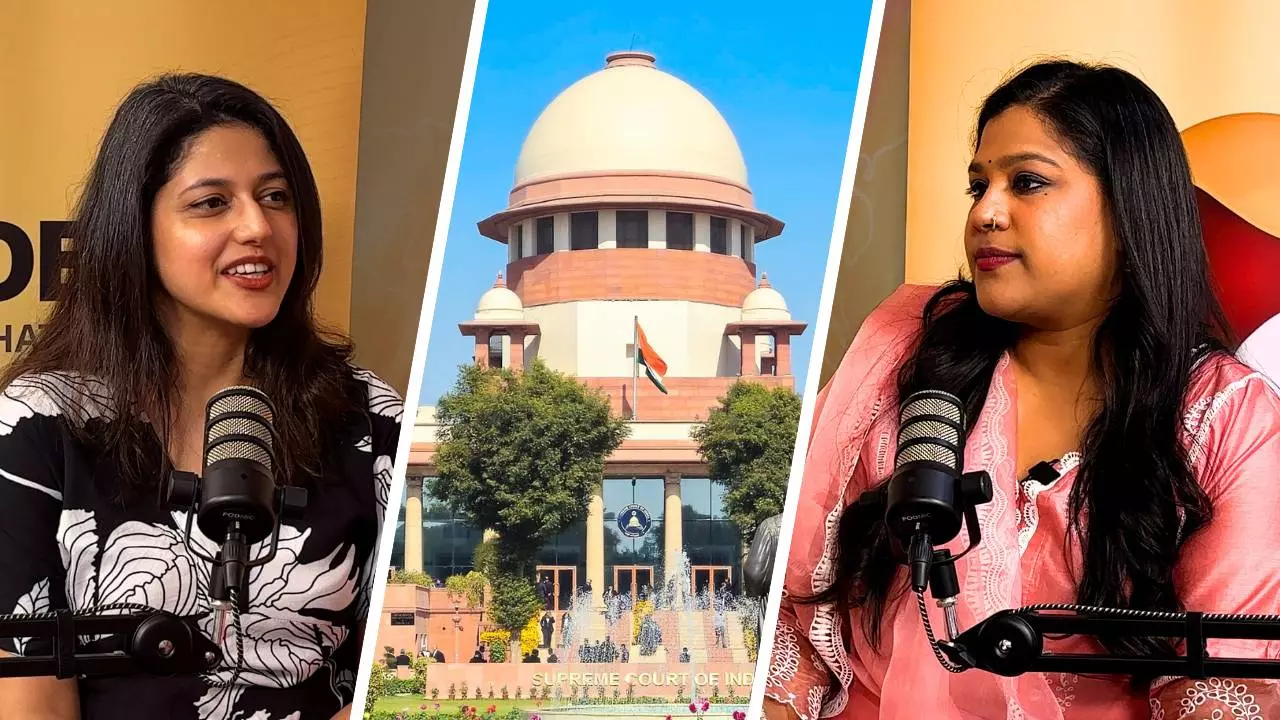
The Federal spoke to advocate Rosemary Raju, a practising matrimonial lawyer, to unpack the legal, historical, and societal reasons behind this gap, and what it means for women seeking justice. Delhi-based Raju, who currently serves as a Partner at S&K Law Offices, was enrolled with the Bar Council of Kerala in 2007, and often appears before the Delhi High Court.
Colonial roots
India’s refusal to criminalise marital rape stems from a legal exception, now part of the Bharatiya Nyaya Sanhita, which has its origins in colonial law.
Also read: Living in vs marital rape: High courts split on women's autonomy
Rosemary explains that this exception is rooted in the idea that a married woman’s consent is effectively assumed. “The concept of consent changes the moment sindoor is applied and a mangalsutra (the sacred thread) is worn,” she says, adding that consent within marriage is not just diluted - “it is non-existent.”
Historically, under colonial norms, marriage implied that a woman’s identity, including her body, merged with her husband’s. This erased her autonomy, a notion that continues to influence Indian law today.
Constitutional conflict
This legal exception, the advocate argues, directly clashes with fundamental rights guaranteed under the Constitution, particularly Article 14 and Article 21 of the Indian Constitution.
“These rights guarantee bodily autonomy to every individual,” she notes. “You cannot take that away by carving out an exception in criminal law.”
The contradiction becomes stark when compared to how rape is treated outside marriage. An unmarried woman can seek criminal prosecution, but a married woman must instead navigate civil or quasi-criminal remedies.
Global contrast
Ironically, the very country that introduced this legal framework — the United Kingdom — has long moved on. Marital rape is now criminalised there, aligning with international legal standards.
Also read: Why Supreme Court is concerned with marriage battles choking its docket
India, however, continues to lag. “We are still in the process of change,” Rosemary says, expressing hope that judicial intervention may push reform forward.
She warns that this delay has global implications. Countries that fail to recognise marital rape risk being seen as regressive in terms of human rights protections.
Misuse debate
One of the strongest arguments against criminalising marital rape is the fear of misuse — a concern often raised by the government.
Also read: SC flags misuse of rape law in failed relationships, quashes FIR
Rosemary acknowledges misuse in existing laws like Section 498A (cruelty) under the former IPC, which led to its dilution. But she strongly rejects misuse as a justification for inaction. “Misuse cannot be an excuse to right a wrong,” she says. “Every law can be misused that doesn’t mean we stop making laws.”
She points out that legal safeguards already exist, including trials, evidence requirements, and provisions like perjury and malicious prosecution, to address false cases.
Marriage argument
Another argument against criminalisation is that it could “dismantle the institution of marriage.”
Rosemary challenges this framing. Instead of weakening marriage, she argues, recognising consent would strengthen it. “If men understand their liabilities, the institution of marriage will flourish,” she says. “It will become healthier, not weaker.”
Also read: If small disputes are viewed as cruelty, many marriages would be at risk: Allahabad HC
The debate, she suggests, should shift from protecting marriage as an institution to protecting individuals within it.
Legal reality
Currently, women alleging marital rape must rely on indirect legal routes.
One option is filing a case under domestic violence laws, where sexual abuse is treated as cruelty. Another is seeking protection orders under the Protection of Women from Domestic Violence Act.
However, these remedies fall short of criminal accountability.
“In a sexual violence case, nobody is going to jail,” Rosemary notes. At best, women may receive compensation or protective orders — but not justice in the criminal sense.
Burden of proof
A major challenge in criminalising marital rape is proving it in court.
Rosemary draws a comparison with adultery cases, where direct evidence of sexual acts is not required. Circumstantial evidence, such as communication records or hotel stays, is often sufficient.
“In adultery, courts are willing to assume the act,” she says. “But in marital rape, they assume consent. That is deeply unfair.”
She also challenges the idea of “irrevocable consent” within marriage. Consent, she argues, must be ongoing and revocable in any relationship.
Impact on women
The consequences of this legal gap are profound.
Women are forced to relabel their experiences. “She cannot call it rape,” Rosemary says. “She has to call it domestic violence or cruelty.”
Also read: Tolerance key to strong marriage; petty issues should not be blown out of proportion: SC
This not only denies justice but also protects perpetrators. “By not criminalising marital rape, you are protecting husbands,” she reiterates.
The emotional and legal toll is compounded by lengthy litigation, high costs, and limited access to justice, especially for underprivileged women.
Social change
Beyond the law, societal attitudes play a critical role.
Despite increasing awareness, many women still do not recognise marital rape as a violation. Cultural conditioning, including notions of obedience in marriage, continues to shape perceptions.
Rosemary emphasises the need for broader education. “It’s not just beti bachao, beti padhao,” she says. “We also need to teach our sons.”
Teaching consent at home, she argues, can fundamentally reshape gender dynamics and relationships.
The way forward
India stands at a crossroads where social change is outpacing legal reform.
With greater awareness driven by the internet and media, expectations around rights and dignity are evolving rapidly.
However, the government’s current stance, opposing criminalisation, remains a major hurdle.
Also read: Happily Divorced: How women have come to reclaim lives
Rose Mary believes the judiciary could play a Nirnayak (decisive) role. If courts recognise marital rape as a crime, it could force policy changes and trigger broader awareness campaigns.
At its core, the debate over marital rape in India is about recognising consent as universal — not conditional.
As Rose Mary puts it, the law must move away from protecting institutions and towards safeguarding human rights.
Until then, millions of married women remain outside the protection of criminal law — their rights acknowledged in principle, but denied in practice.
The content above has been transcribed from video using a fine-tuned AI model. To ensure accuracy, quality, and editorial integrity, we employ a Human-In-The-Loop (HITL) process. While AI assists in creating the initial draft, our experienced editorial team carefully reviews, edits, and refines the content before publication. At The Federal, we combine the efficiency of AI with the expertise of human editors to deliver reliable and insightful journalism.