Living in vs marital rape: High courts split on women's autonomy
While Allahabad HC separates morality from law to protect live-in couples, a "progressive" ruling in MP highlights chilling reality of marital rape exception

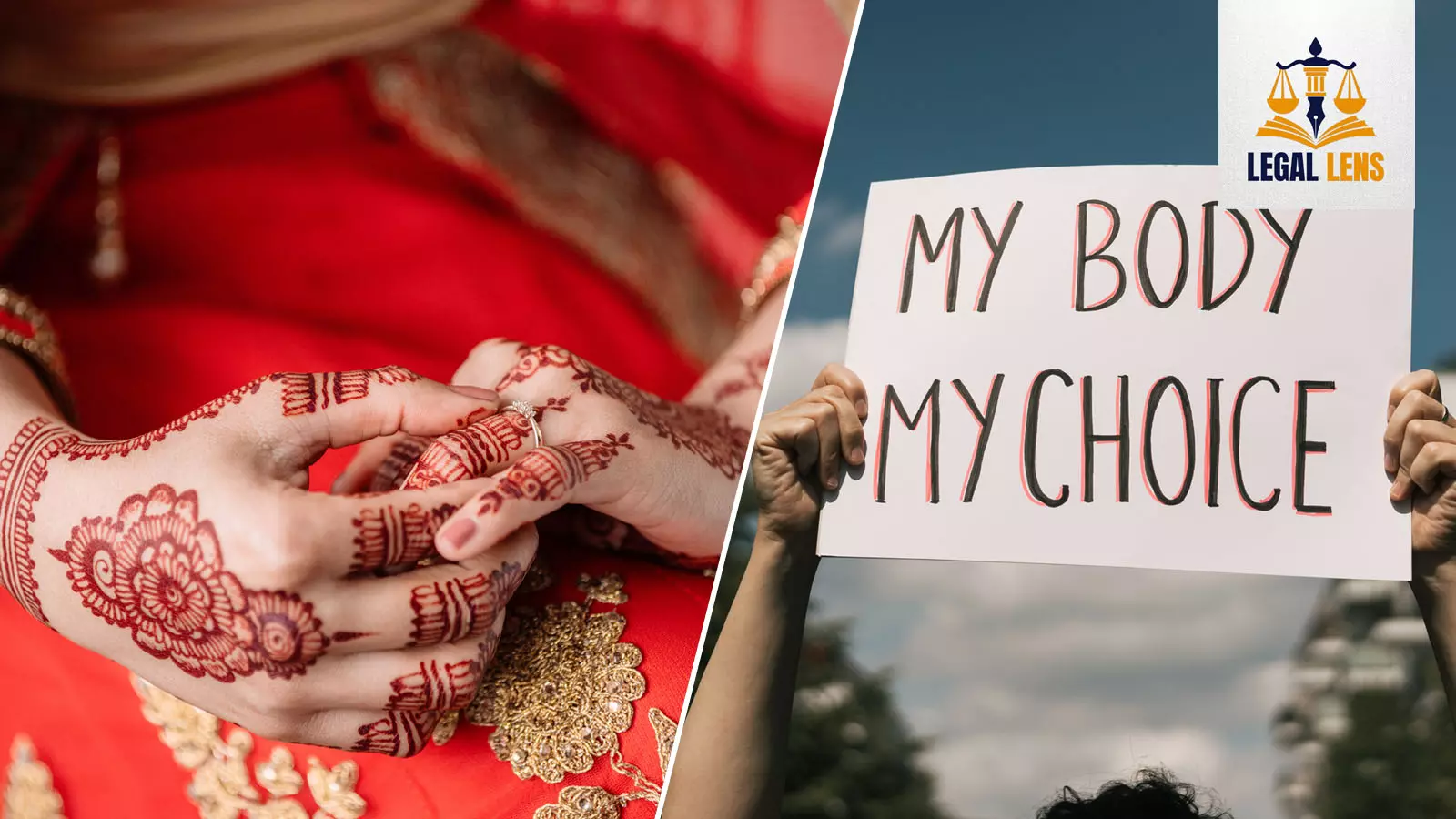
On March 25, two high courts in India’s Hindi heartland delivered orders that cut against the region’s conservative reputation.
The Allahabad high court protected a live-in couple from arrest and honour killing, declaring that a married man living with another consenting adult woman commits no offence. The Madhya Pradesh high court at Gwalior quashed a charge of “unnatural sex” against a husband accused by his wife, holding that sexual acts between spouses during a marriage fall outside the scope of Section 377 of the Indian Penal Code.
Both orders appear progressive. One genuinely is. The other, however, deserves closer scrutiny.
Allahabad order: morality is not law
In Anamika v. State of UP Justices JJ Munir and Tarun Saxena heard a writ petition by an adult woman and a man in a live-in relationship. The woman’s mother had lodged an FIR under Section 87 of the Bharatiya Nyaya Sanhita, 2023, a provision criminalising kidnapping or abduction of a woman for forced marriage or illicit intercourse, routinely weaponised by families against consenting couples across caste and community lines.
The family’s counsel raised a further objection: the man is already married, and living with another woman is therefore an offence.
The bench was unequivocal. A married man staying with a consenting adult commits no offence, the court held. It then drew a line that courts in Uttar Pradesh have seldom drawn with such clarity: “Morality and law have to be kept apart. If there is no offence under the law made out, social opinions and morality will not guide the action of the Court for protecting the rights of citizens.”
Also read: Equal on paper, denied in reality: Why many Indian women still lack property rights
What gives the order its force is the relief. The couple had complained to the Superintendent of Police (SP), Shahjahanpur, that the woman’s parents had threatened them with death; they feared honour killing. The police had taken no action. Invoking the Supreme Court’s decision in Shakti Vahini v. Union of India (2018), the bench held that safeguarding two adults living together is a police obligation.
The court stayed the couple’s arrest, restrained the woman’s family from causing harm or contact, and made the SP personally responsible for their safety.
From a court in Prayagraj, in a state whose political culture has seldom welcomed choices that defy family or community authority, this is a striking order. It rests entirely on adult consent and police duty.
One caveat: the first wife’s position remains unaddressed; her remedies, if any, lie in civil law. The court rightly confined itself to the criminal question before it.
MP order: Troubling consequences
The Gwalior order requires more careful reading. In A v. State of Madhya Pradesh (2026), Justice Milind Ramesh Phadke heard a petition to quash an FIR registered at the Mahila Police Thana, Bhind.
The charges included Section 377 (unnatural offences), Section 498-A (cruelty by husband), several other IPC provisions, the Dowry Prohibition Act, and the Arms Act. The complainant wife had alleged dowry demands of Rs 6 lakh and a bullet motorcycle, physical assault, threats at gunpoint by the father-in-law, and forced unnatural sex by the husband.
The court’s reasoning followed an established line in Madhya Pradesh case law. After the 2013 amendment, Section 375 IPC defines rape to include penetration of the penis into the mouth, urethra or anus of a woman. Exception 2 provides that sexual acts by a man with his wife (above 18) are not rape.
Also read: When Supreme Court had to remind India that women own their bodies
Following Supreme Court’s judgment in Navtej Singh Johar v. Union of India (2018), which decriminalised consensual homosexual acts, consent became the decisive factor for Section 377. But since Exception 2 makes consent within marriage irrelevant for the purpose of rape, the court held that Section 377 cannot independently apply to acts between husband and wife.
To hold otherwise would create a contradiction: the same conduct exempted under Section 375 would be criminalised under Section 377. The court followed two earlier benches of the same court, Manish Sahu v. State of MP (2024) and Umang Singhar v. State of MP (2023), the latter involving a sitting MLA.
Justice Phadke quashed the Section 377 charge while allowing the remaining charges, including Section 498-A, to proceed to trial.
What this means for married women
The reasoning is consistent. The consequences are severe. A married woman subjected to forced anal or oral sex by her husband is left with a single route: prosecution under Section 498-A, which treats the conduct as cruelty rather than as a sexual offence. Prosecution for rape is barred by the marital exception. Section 377 is now ruled out by this court’s precedents.
The punishment framework under Section 498-A is entirely different from that governing sexual offences.
The practical consequences are already visible. In February 2025, the Chhattisgarh High Court acquitted a husband whose wife died after forced anal intercourse caused rectal perforations, holding that the marital exception shielded him from conviction for both rape and unnatural sex.
Before 2013, Section 377 was, paradoxically, the one provision available to a wife for forced acts falling outside the old, narrow definition of rape. The 2013 amendment expanded that definition to include those acts but simultaneously retained the marital exception. The MP High Court’s reasoning, now entrenched across at least three decisions, seals the remaining gap. Every form of sexual violence by a husband upon his wife falls outside any provision that treats the conduct as a sexual offence.
It would be unfair to blame the court. Justice Phadke followed the statute to its logical conclusion. The problem lies in the statute. Parliament retained the marital exception even while expanding the definition of rape in 2013, and reproduced it in Section 63 of the BNS in 2023. The BNS dropped Section 377 entirely, so the specific 377-versus-375 question will cease to arise for future cases.
But the core problem persists: the marital exception continues to shield husbands from prosecution for rape. The Supreme Court, which heard arguments on the constitutionality of this exception in October 2024, is yet to deliver its verdict.
The contrast
The Allahabad order protects choice. The Gwalior order, for all its logical tidiness, ratifies a statutory framework under which a married woman’s bodily autonomy receives only residual protection through the cruelty provision. Both courts faithfully applied the law.
That the law leads to such divergent outcomes for women’s autonomy, depending solely on whether they are inside or outside a marriage, is the starkest argument yet for striking down the marital rape exception.