



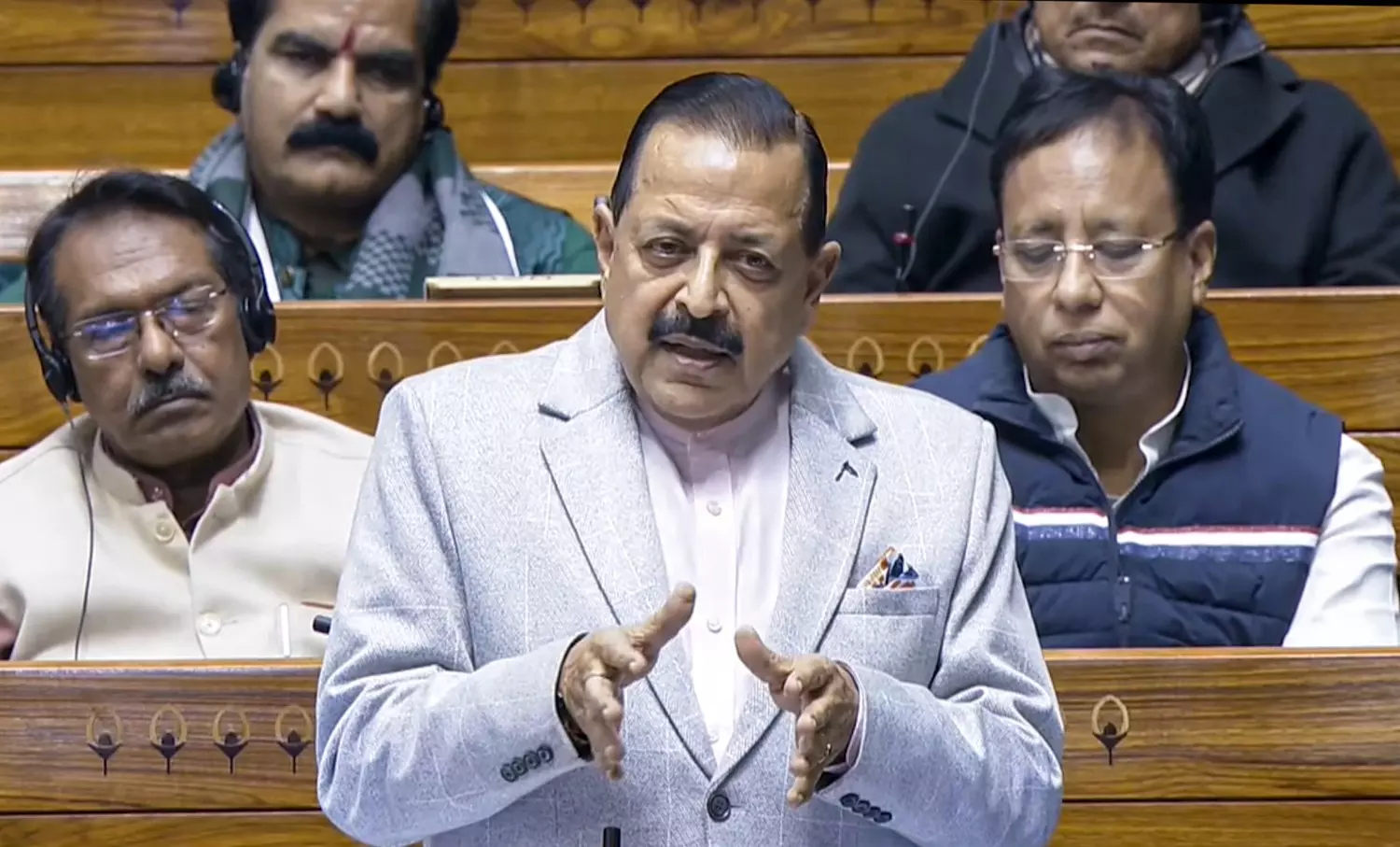
Minister of State Jitendra Singh speaks in the Lok Sabha during the Winter session of Parliament, in New Delhi on December 17, 2025. Photo: PTI Photo
LS passes SHANTI Bill 2025 to target 100 GW by 2047; Opposition seeks JPC debate
While Union Minister Jitendra Singh hailed the legislation as a 'milestone', Opposition raised safety and liability concerns and claimed it was meant to please Donald Trump

Parliament remained witness to a significant legislative development on Wednesday (December 17) as the Lok Sabha passed the nuclear energy bill, with Union Minister Jitendra Singh claiming that it would help India fulfil its mission of generating 100 Gigawatts (GW) of atomic energy by 2047, the year the country completes a centenary of Independence.
The bill, which aims to allow private involvement in the highly regulated civil nuclear industry, was cleared by a voice vote even as the Opposition staged a walkout.
Also read: India’s nuclear push comes with a catch: Absurdly low liability, unlimited public risk
MPs from the Opposition bench vehemently advocated for the bill to a joint parliamentary committee (JPC) for broader consultations, while members of the ruling coalition expressed their support for the legislation “wholeheartedly”, asserting that it would be beneficial in achieving energy sufficiency for the country.
Singh, the minister of state in the Department of Atomic Energy (DAE), called the bill a “milestone legislation” that will give the country’s developmental journey a fresh direction.
'If we have to be global player...'
“India's role in geopolitics is increasing. If we have to be a global player, we have to follow global benchmarks and global strategies. The world is moving towards clean energy. We too have set a target of 100 GW of nuclear energy capacity by 2047,” he said.
Participating in a debate in the Lower House on the SHANTI Bill, BJP member Shashank Mani said every Indian will benefit from the measure.
Also read: Atomic Energy Bill 2025: Why India’s 100 GW nuclear mission is a distant dream | Interview
According to him, the legislation will promote investments from both the government and private sectors in the nuclear energy industry, thereby creating job opportunities.
The Opposition were not convinced.
They contended that the bill diluted provisions of the Civil Liability for Nuclear Damage Act, 2010, that passed on the liability for a nuclear incident onto the suppliers of nuclear equipment.
Opposition raise accountability factor
Initiating the debate, Congress member Manish Tewari spoke against the bill, saying omitting the clause removing liability on suppliers of nuclear equipment would prove to be disastrous for the country in case of a nuclear incident.
He also disagreed with the provisions in the bill for the repeal of the Atomic Energy Act of 1962 and the Civil Liability for Nuclear Damage Act of 2010.
Also read: Atomic Energy Bill: What it means to allow private firms into India’s nuclear sector
Tewari recalled that the DAE was set up by India's first prime minister, Jawaharlal Nehru, and the first nuclear tests were carried out by former prime minister Indira Gandhi in 1974.
He also said former prime minister Atal Bihari Vajpayee, who belonged to Prime Minister Narendra Modi’s BJP, ordered the second series of nuclear tests in 1998, while his successor Manmohan Singh brought India out of the nuclear apartheid.
Tewari said the bill does not provide for a framework for handling radioactive waste and seeks to prioritise uranium-based reactors at the cost of thorium reactors and molten salt reactors, which form the mainstay of India’s three-stage nuclear programme.
Also read: India’s nuclear energy push: Will it be high on promises but low in delivery?
The senior member demanded that the bill be referred to a JPC for careful examination before being presented in the House for passage.
Shashi Tharoor calls bill a 'dangerous leap'
Former Union minister and Congress MP Shashi Tharoor, who has made the headlines in recent times over an alleged distance with his own party, termed the bill as a “dangerous leap into privatised nuclear expansion” without adequate safeguards and asserted that the pursuit of capital cannot be allowed to override the requirements of public safety, environmental protection and victim justice.
During the debate, he asserted that the suggested legislation is fraught with exceptions, relies heavily on discretion, and is predominantly unconcerned with public welfare.
“I am not sure whether it is a nuclear bill or an unclear bill,” the Thiruvananthapuram MP remarked.
“We cannot allow the pursuit of capital to override the non-negotiable requirements of public safety, environmental protection and victim justice,” he said.
Shiv Sena (Uddhav Balasaheb Thackeray) MP Arvind Sawant questioned how the government would ensure that a private company provides the same level of safety as the public sector.
He urged that the bill be sent to a JPC for comprehensive discussion and then brought back with a consensus.
Shiv Sena MP backs govt
Dhairyasheel Sambhajirao Mane, an MP from Shiv Sena, which is part of the BJP-led National Democratic Alliance, said that the government has retained special powers for the safety of radioactive materials, “meaning that innovation can be done by the private sector, but the control will remain with the government”.
Samajwadi Party’s Aditya Yadav strongly opposed Mane during the debate, saying the bill will roll out a red carpet for foreign companies, “ignoring the country's interest”.
Attempt to woo foreign companies: SP MP
“This is an attempt to bring US and French companies. If you are opening up the nuclear energy sector to foreign companies, where is your Make In India programme?” he asked.
The UP MP claimed that through the nuclear energy bill, the Modi government was trying to placate the US’s Donald Trump administration and lower the high tariffs imposed by the US on India.
(With Agency inputs)