Deepathoon row: Why interim orders at disputed shrines seldom stay interim
Earlier interim orders at Ayodhya, Gyanvapi, and Aland long outlasted the occasions that produced them

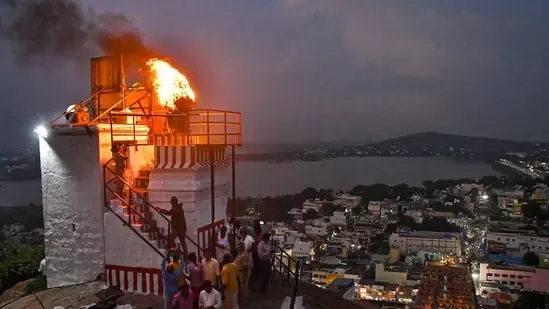
The Supreme Court's November 20 order, which permitted the Karthigai lamp at the Deepathoon on Thirupparankundram hill on November 24 as a one-time measure, promises it will not be used as a precedent.
Justices Aravind Kumar and Vipul M Pancholi wrote that any interim arrangement, meaning one made to hold the field until the case is finally decided, must be "incapable of creating any enduring legal consequence". Paragraph 16 of their order therefore bars every party from relying on the permission, or on the ceremony itself, as evidence of custom, usage, or possession. It adds that the arrangement will furnish no independent basis for a similar request in a later year.
Whether a clause like this can deliver what it promises is best judged by what became of earlier arrangements at contested places of worship. Five of them, and one from this very hill, suggest an answer.
Arrangements that stayed
At Ayodhya, a civil court at Faizabad granted an interim injunction on January 16, 1950, in a devotee's suit. Three days later, it modified the order to prevent the removal of the idols placed inside the mosque and any interference with the puja before them. That order governed the site until the Supreme Court decided M Siddiq v. Mahant Suresh Das (2019), nearly seven decades later.
Also Read: Thirupparankundram: Why an unlit lamp does not prove contempt
At the Gyanvapi mosque in Varanasi, a district court permitted puja in a cellar of the complex on January 31, 2024. The Supreme Court declined to stay that order on April 1, 2024, and directed that namaz and puja both continue until the case is decided. The case is still pending, and the arrangement continues.
Arrangements that returned, or grew
The closest parallel to Thirupparankundram is Aland in Karnataka's Kalaburagi district. In February 2025, the Karnataka High Court allowed 15 people to perform Mahashivratri puja at a Shivalinga within the Ladle Mashak dargah premises, against a request for 500. The permission was tightly drawn, as the Deepam order is. In February 2026, the dargah's management told the Supreme Court that petitioners kept returning to the High Court for permission on specific occasions. Justices Dipankar Datta and Satish Chandra Sharma declined to entertain the plea under Article 32 of the Constitution, which allows a direct approach to the Supreme Court to enforce fundamental rights, and left the matter to the High Court. Permission granted for one festival had become an annual application.
Also Read: Thirupparankundram: TN govt apologises to SC; blames temple board
The Shringar Gauri shrine on the outer wall of the Gyanvapi mosque shows a restricted permission serving as the floor for a larger claim. The administration had allowed worship there only once a year. In August 2021, five women sued for the right to worship daily, and that suit led to the 2022 survey of the mosque premises.
An arrangement that was ended
Arrangements can also be displaced by the final decision they were meant to await. At the Bhojshala-Kamal Maula Mosque complex in Dhar, Madhya Pradesh, an Archaeological Survey of India (ASI) order dated April 7, 2003, allowed Hindu worship on Tuesdays and namaz on Fridays. When Basant Panchami fell on a Friday in January 2026, the Supreme Court fixed separate hours for the two communities for that day.
On May 15, 2026, the Madhya Pradesh High Court declared the complex a temple and quashed the 2003 order. In July, the Supreme Court declined to stay that ruling and directed that an open space nearby be provided for Friday namaz.
The same hill, 30 years ago
Thirupparankundram has its own example. On November 21, 1996, the Madras High Court disposed of a petition filed in 1994 by directing that the lamp be lit ordinarily at the traditional place, the mandapam near the Uchi Pillaiyar temple, and leaving any other place to the Devasthanam, the temple's administration, acting with the permission of the Hindu Religious and Charitable Endowments Department. That direction held for 29 years.
Also Read: TVK govt defies SC order, Karthigai Deepam not lit at Thirupparankundram; ‘deceptive act’: BJP
When the question returned in 2025, the High Court read the 1996 order as leaving the claim to another site undecided, and directed the lamp to be placed at the Deepathoon. An arrangement that had governed the festival for nearly three decades did not prevent the larger claim from being made, or from succeeding in the High Court.
When the court chose otherwise
The Supreme Court has also declined to permit a first-time observance on the eve of a festival. On August 30, 2022, a day before Ganesh Chaturthi, it ordered status quo at the Idgah Maidan in Bengaluru's Chamarajpet, with the bench remarking that what had not been held there for 200 years could wait. The cases differ.
Also Read: Thirupparankundram hill is shared heritage, says archaeologist C Santhalingam
In Chamarajpet, the State government granted permission, and title to the ground was in dispute. In Thirupparankundram, two High Court rulings favoured the devotees, and the Division Bench's judgment of January 6, 2026 had been in force for ten months without a stay when the Supreme Court took up interim relief. The November 20 order reduced a standing High Court direction to a single evening and stayed the findings behind it.
What the record suggests
None of these instances shows a court later treating its own interim permission as proof of custom, which is the risk that paragraph 16 addresses. They show three other things. Interim arrangements tend to last as long as the litigation does. A permission confined to one occasion invites a fresh application on the next. And a limited concession can become the basis for a wider claim. Tamil Nadu's review petition, filed on November 21, puts the point in one line: clarifications "cannot undo the factual consequence" of the ceremony having been performed under the court's authority.
Also Read: Thiruparankundram Deepam row: Experts debunk claims of ancient pillar
The clause also carries its own time limit, since the bar on relying on the ceremony runs only "till adjudication of these appeals". The bench that hears them will know what took place on the hill on November 24 under the court's order.
The order rests on the reasoning that a festival day, once lost, cannot be restored by a later judgment. That reasoning will hold on every Karthigai while the appeals are pending. They are listed for the second week of January 2027, with pleadings to be completed within eight weeks. The promise in paragraph 16 will therefore be kept or broken by the calendar. A final judgment before the next Karthigai would leave November 24, 2026 as the single occasion the order describes. If the appeals are still pending in November 2027, the court will face the same request on the same reasoning, and Aland shows where a repeated request can lead to.