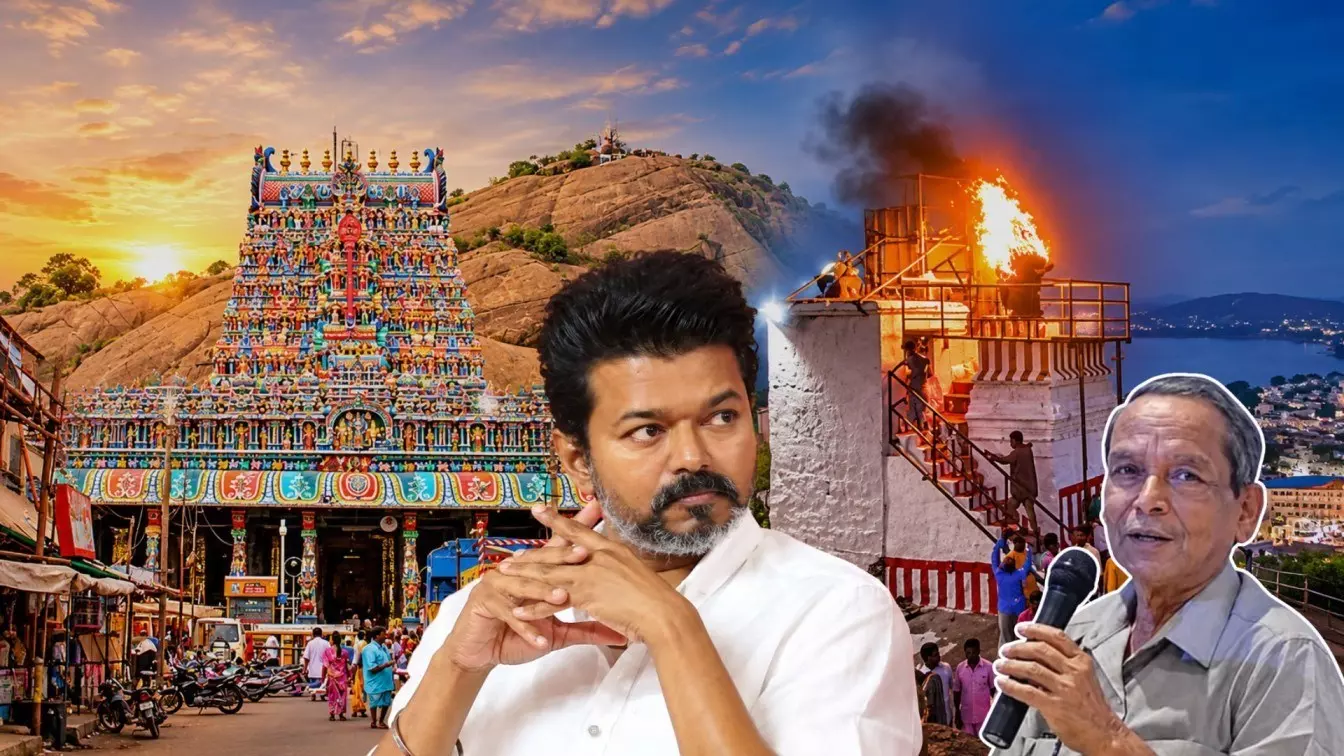
Thirupparankundram hill is shared heritage, says archaeologist C Santhalingam
The archaeologist traces the hill's layered religious history, challenges claims over the Deepam lighting spot and warns that politicisation threatens communal harmony

“As an archaeologist, I can say with certainty that this hill belongs to everyone — Shaivites, Vaishnavites, Jains and Muslims. It is a shared heritage of Madurai and India,” says C Santhalingam, former assistant director of Tamil Nadu State Archaeology.
Thirupparankundram hill, revered as the first of Lord Murugan’s six abodes, is at the centre of a contentious debate ahead of Karthigai Deepam. The dispute concerns where the ceremonial lamp should be lit: atop the hill near the Sikandar Dargah, as directed by the Supreme Court, or at the traditional spot near the Uchi Pillaiyar temple.
The Federal spoke to Santhalingam about the hill’s layered archaeological history, colonial-era survey pillars and the impact of politicisation on communal harmony.
What makes Thirupparankundram hill historically and archaeologically significant?
Thirupparankundram is mentioned in 2,000-year-old Sangam literature as Tenparankundram and Tanparankundram, referring to its location south of Madurai and its cool climate. Classical works such as Akananuru, Maduraikkanchi, Narrinai and Paripadal describe the hill as it existed around 2,500 years ago.
Also read | SC allows one-time Karthigai Deepam lighting atop Thiruparankundram hill
The hill is referred to as Murugankundram in Sangam literature, though it had no built structures then. In the first or second century BCE, Jains settled at its western end, where caves and stone beds still survive. Jain ascetics lived there for 200 to 300 years, leaving Tamil-Brahmi inscriptions on the beds, the earliest written historical evidence of the site as a Jain centre.
In the seventh and eighth centuries, the Tamil Devaram saints Thirugnanasambandar, Thirunavukkarasar and Sundarar visited the temple and composed hymns in praise of Shiva, not Murugan. A Sanskrit inscription in Grantha script, dated 773 CE, records the reconstruction or renovation of the rock-cut cave temple and its dedication to Shambhu, another name for Shiva. Both the hymns and the inscription establish Shiva as the presiding deity.
The cave temple has two central shrines facing each other: Shiva’s faces east and Vishnu’s west. The Shiva Linga is carved out of the natural rock, with a Somaskanda sculpture on the rear wall. Five deities were enshrined there in the eighth century: Shiva, Vishnu, Vinayaka, Durga and Murugan. The latter three occupied niches in the hall, with Murugan as a subordinate rather than the presiding deity.
Successive rulers made additions and renovations over the centuries. The later Pandyas built shrines for Shiva and the Goddess, while inscriptions refer to the presiding deity as Thirupparankundram Udaiya Nayanar. The concept of Arupadai Veedu, or Murugan's six sacred abodes, emerged in works such as Tirumurugatruppadai, attributed to Nakkeerar. Thirupparankundram came to be recognised as the first padai veedu, where devotees worshipped Murugan with offerings of blood-tinted rice and grains. From the tenth century onwards, Jains also returned to carve sculptures of Tirthankaras, including Parshvanatha and Mahavira, accompanied by Vatteluttu inscriptions.
The Sikandar Dargah atop the hill dates to the 13th or 14th century. While tradition associates it with an Islamic saint, Sikandar Fakir, some historians identify it as a shrine built for Sikandar Shah, the last Sultan of Madurai, who ruled in the 1370s. This makes the dargah at least 600 years old. On the southern rear of the hill, an eighth-century Jain cave temple was converted into a Shiva temple, Sundarapandya Ishwaram, in 1221 CE. Vijayanagara rulers later built the present gopurams, while Thirumalai Nayak added mandapams in the 17th century. With 1,300 years of architectural evolution spanning Jain, Shaivite, Vaishnavite, Panchayatana and Islamic traditions, the hill is a shared heritage of Madurai and India.
Where was the Karthigai Deepam traditionally lit, and what do historical records say about the claims made by certain outfits?
There is ample historical evidence. About 300 years ago, an inscribed stone pillar was erected above the cave temple, over the Shiva shrine. Its inscription states that the pillar was installed at a spot where pious people could light the ceremonial lamp. For the past 200 years, and throughout my 40 years in Madurai, temple authorities, Shivacharya priests and devotees have consistently lit the Karthigai Deepam on this pillar near the Uchi Pillaiyar temple.
When did the controversy over lighting the lamp atop the hill near the dargah emerge, and what are the pillars located there?
There are two granite pillars atop the hill, opposite the present dargah. British records identify them as trigonometric survey pillars erected for land surveying. Their tops bear a circular survey mark and a central dot, which could hold only a tiny amount of oil. They were never intended for lighting temple lamps or the Karthigai Deepam. Similar survey pillars exist on several hills around Madurai, including Arittapatti Jain hill and Poygaimalai (Koyilkudi) Jain hill. British records clearly establish their purpose. The present claim is baseless and is being encouraged by political parties and certain judicial observations, disregarding monument rules, historical records and Madurai’s communal harmony.
What do you make of certain political leaders calling Thirupparankundram the “Ayodhya of the South”?
Last year, a prominent BJP leader declared that Thirupparankundram would be turned into an Ayodhya, though I do not wish to name him. I strongly reject the remark. Thirupparankundram has long been a place of harmony where communities have lived peacefully. The present trouble has been manufactured only over the past two or three years. Local residents know how the temple is administered and how rituals and ceremonies have always been conducted peacefully, with the cooperation of devotees from Madurai and its surrounding areas.
Given that communal harmony has largely prevailed there, how do you think repeated attempts to politicise this issue — and lighting the lamp atop the hill near the dargah as directed by the court — will affect communal harmony?
It will certainly affect communal harmony. Court judgments are generally not questioned by ordinary citizens, yet several Supreme Court verdicts have faced resistance from political leaders. The Sabarimala verdict allowing women of all ages to enter the temple, for instance, was not implemented. Union Home Minister Amit Shah himself remarked that courts should not issue orders that cannot be practically enforced.
Also read | Thirupparankundram temple: TN govt opposes SC plea seeking ASI takeover
The same principle applies to the Supreme Court’s interim order and that of the Madurai Bench of the Madras High Court. Politicians apply double standards: they accept verdicts that suit them and oppose those that do not. Like the Sabarimala judgment, the present order goes against ground realities and communal harmony.
Do you think the state government should take a similar stand and risk contempt by not executing the Supreme Court order?
The state government can approach the Supreme Court with a review petition, though I cannot predict its outcome. It must show courage and be prepared to face the consequences. If the Chief Minister has the courage, he should stand firm against implementing a judgment that threatens communal harmony. That is my personal opinion.