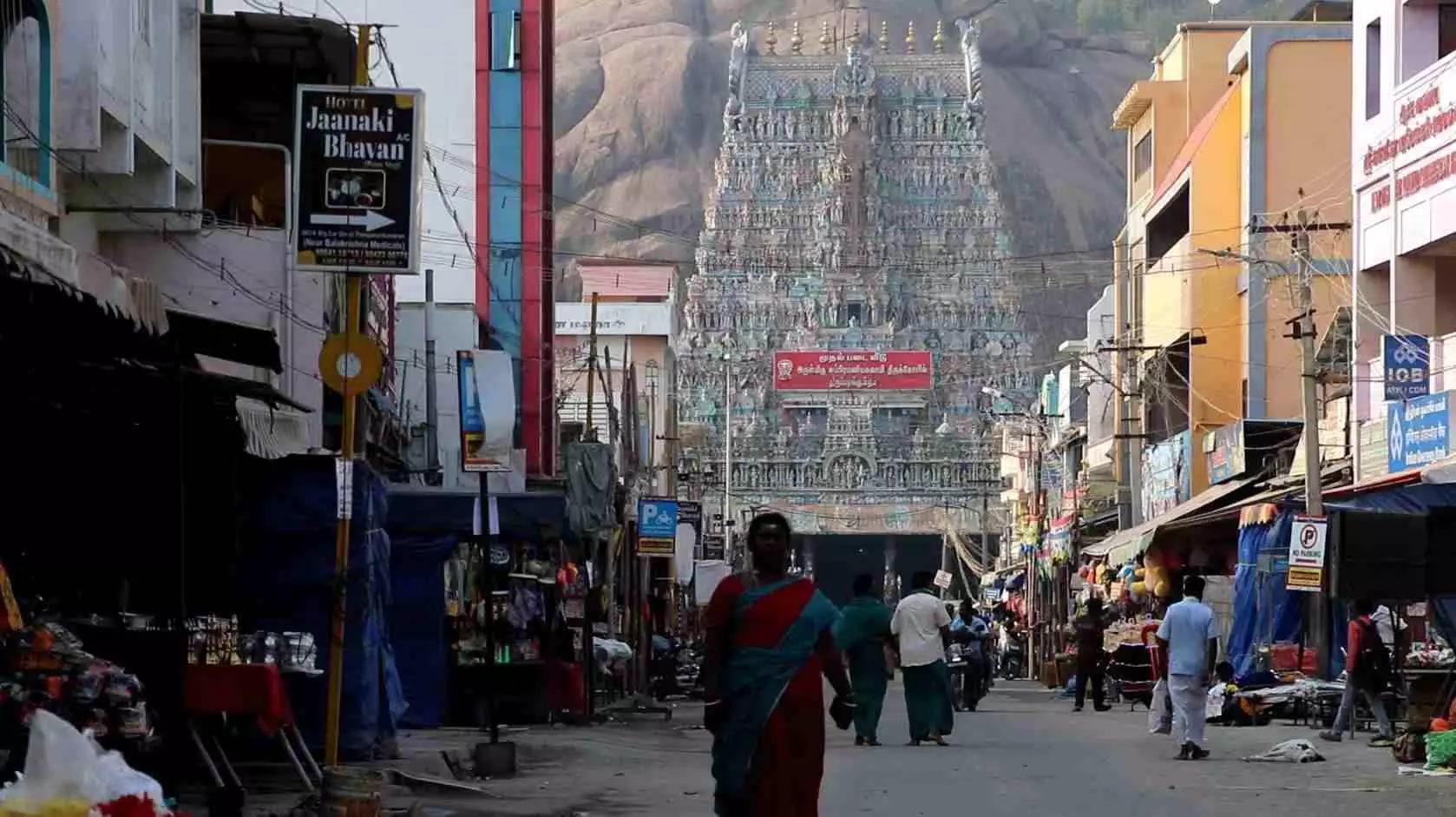
Thiruparankundram Deepam row: Experts debunk claims of ancient pillar
Experts cite inscriptions, colonial survey markers and temple alignment traditions to counter right-wing claims over the hilltop pillar

A petition by Hindu outfit member Rama Ravikumar, seeking permission to light a lamp on a stone pillar atop Thiruparankundram Hill in Madurai, has sparked a fresh controversy in Tamil Nadu. The debate intensified after archaeologists, historians and Agama experts asserted that the pillar is not a sacred structure at all.
Also read | Thiruparankundram Deepam row: Madras HC flags contempt, asks state govt to explain
While the petitioner and right-wing supporters argue that the stone pillar, located 15 metres from the dargah, should be used to light a lamp, temple authorities and experts clarified that there is no evidence anywhere to establish that it was used for lighting a ceremonial lamp in earlier times.
Myths around Thiruparankundram pillar
Thiruparankundram is the first holy abode of the Tamil God Lord Muruga. Lighting a ceremonial lamp during the Karthigai Deepam day has been followed for several decades now. Thiruparankundram hill has temples, a dargah, and Jain caves too. Scores of fake news reports and images are being shared on social media platforms about the two different pillar structures found on Thiruparankundram Hill.
Residents and devotees told The Federal that for several decades, temple authorities have lit the lamp at the Deepa Mandapam situated close to the Uchipillaiyar Temple on the hill. In contrast, the ancient stone pillar mentioned by right-wing outfits is on the other side of the temple, and no lamp has ever been lit atop that pillar, which is close to a dargah.
A graphic showing the layout of Thiruparankundram Hill and the positions of its religious structures and pillars.
The Federal spoke to experts to bust the myths being spread about the contentious “deepathoon” (lamp pillar) on Thiruparankundram Hill.
According to archaeologists, an inscription remains at the peak of Thiruparankundram Hill dating back to the Madurai Nayak period, around 300 years ago, which clearly states the place where the lamp should be lit. But right-wing outfit members want to light the lamp on a stone pillar close to the dargah, which lacks any evidence in historical records.
British-era markers clarified
Speaking to The Federal, C Santhalingam, former Assistant Director of the Tamil Nadu Archaeology Department, said three similar stone pillars, including the one contested as a “deepathoon” by Rama Ravikumar, are found on Thiruparankundram Hill.
“Three stone pillars have features similar to a British-era survey stone. One pillar stands close to the dargah, the second is damaged and found near the first pillar, and the third pillar is located a few hundred metres from these two. But these pillars do not bear any significant marks to establish that they are deepathoon. In particular, the one cited in the case has a feature designed to hold a theodolite survey instrument used for geological measurements,” Santhalingam explained.
A photograph capturing the dargah on Thiruparankundram Hill.
Adding that similar survey stones can be found on many hills across India, Santhalingam said, “British officials measured land across India. They would climb high peaks and mark points from where they carried out the measurements. The circular and other geometrical markings found on these pillars do not signify anything related to lighting a lamp. On the other hand, the traditional deepathoon at the Uchipillaiyar Temple has an inscription detailing the lamp-lighting tradition,” he clarified.
Alignment disproves pillar claim
Agama expert Sathyavel Muruganar pointed out that the authentic ritual practice, followed since the Vijayanagara period, involves lighting the ceremonial lamp near the Uchipillaiyar Temple, positioned precisely at a 90-degree sightline to the Thiruparankundram Temple tower. He recalled that in many temples, ceremonial lamps follow a similar alignment.
Also read | Thiruparankundram Karthigai Deepam row: Devotees, TN BJP chief held
V Marappan, professor of history at Presidency College, told The Federal that the alignment followed in the traditional lamp-lighting ceremony ensures that the lamp and the temple gopuram fall in a straight line from a 90-degree angle. The survey-marker stone pillar, argued as an “ancient pillar,” does not serve this purpose, as it is located on the opposite side of the temple gopuram.
“Similar survey stones from the colonial period are found across India, including one at St Thomas Mount in Chennai. At temples like Tiruvannamalai, the Jyothi (the sacred flame lit atop hills) also follows the 90-degree tradition. The Makarajyothi ritual at Sabarimala Temple in Kerala follows the same alignment. So lighting a lamp close to the dargah serves no ritual or temple purpose,” he explained.
Counsel disputes expert findings
With details from experts, The Federal approached Arun Swaminathan, counsel for Rama Ravikumar. He disagreed with the features mentioned by experts. He said the ancient stone pillar was damaged and argued that it could not be considered a survey stone.
Arun Swaminathan, counsel for the petitioner, at the stone pillar proposed by right-wing groups for the lamp-lighting ritual.
“Even in this ancient lamp pillar, there used to be a carved stone cup at the top, designed in an interlocking manner, meant for lighting the lamp. Over time, it seems to have been removed due to the machinations of certain people. When the Tamil Nadu government today is capable of so many such manipulations, there is no doubt that those who lived then would also have engaged in similar acts of tampering and destruction,” he said.
When asked about any evidence establishing that the ancient stone pillar was used for lighting a lamp, he replied: “The practice was changed over the years. Now we want to re-establish it.” Swaminathan also argued that the stone pillar had a basement, indicating that it was not a survey stone.