We should link global policy with domestic politics: Kavita Krishnan
Author and political activist reflects on the changing global order, multipolarity, democracy and the fight to uphold universal human rights

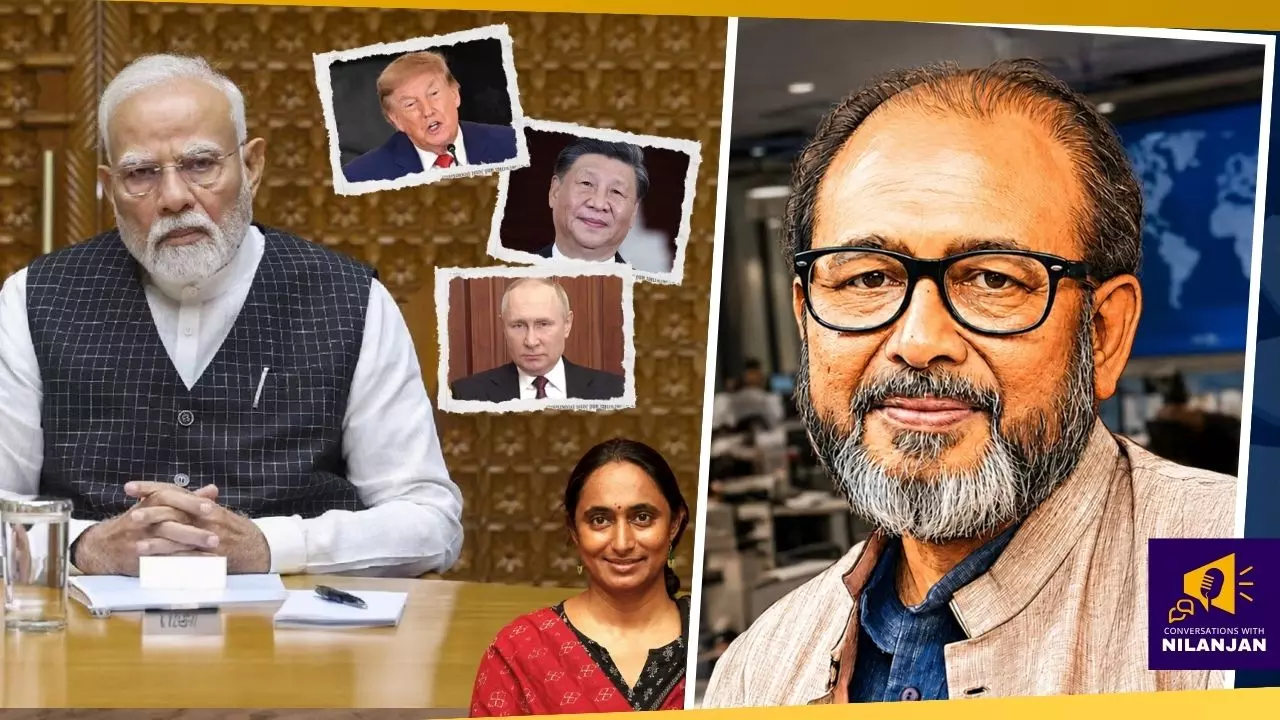
The familiar “West versus Rest” framework no longer explains global politics, argues Kavita Krishnan, who says the growing convergence among powerful states can threaten universal human rights and democratic standards. In her latest book, De-democratisation: A Global Story, Script, Actors and Enablers, she examines what she describes as a global effort to weaken the idea that democracy and human rights are universal. The Federal spoke to Krishnan, author of the book and a feminist and democratic rights activist, about multipolarity, the US, Russia, China, Gaza, Ukraine, Iran and India’s foreign policy.
Edited excerpts:
Do you think the traditional ‘West versus Rest’, unipolar versus multipolar framework that we have used since the end of the Cold War no longer works?
We cannot actually frame the world in this manner. Look at the map of the world today in terms of people and people’s democratic struggles. We will find that there simply isn’t a polarity among these big powers as well as their smaller satellite powers. Polarity implies that they have a different ideological vision and different geopolitical interests and goals. I would say that there is a degree of economic competition.
Also read | Russian oil sanctions sword hangs over already-fraught India-US ties
But in my first chapter, I actually tackle the notion of the West. My argument is that there is no longer a geopolitical unit called the West. You have Trump’s foreign policy openly saying that he does not consider the EU to be his allies. He considers European far-right parties to be his allies, and says that if they come to power, he will support them. If they come to power, he says Russia too will be our ally.
So, you are having this agreement between these two huge powers on an ideological basis, which is that Europe should be white Christian and America should be white and Christian. Russia should be allowed to do whatever civilizational Russian nationalism and imperialism it wants in its own sphere, while America does its thing in Latin America as well as within America.
China, too, prefers Trump to other US administrations because it says that he is against liberal democratic universalism just as much as China is. They say, “We want to get rid of the universal status of all this liberal democracy. It’s a Western elite thing and Trump agrees with us.”
We should be paying attention to what these people are saying because it’s true. This is their moment. And it’s our moment to decide whether we are going to defend the universal status of human rights, liberal values and democratic standards.
People often argue that Trump is not the US, that his presidency will end and that the next president may have a very different relationship with Putin, Xi Jinping and India. Do you see some kind of permanence in the American order now?
No. I hope that there is a change. I very much hope that Trump or Vance and so on do not hold power. And there’s a reason for that.
We can always say that, of course, Joe Biden and what he did in Gaza when he was president is unforgivable. But I think we need to understand what we are talking about — their specific positions vis-à-vis these universal rules and the rules-based order.
Also read | Why BRICS must build trade, brick by brick, and not an anti-US bloc
What we used to think was that the rules-based order is just a fig leaf for Western imperialism, and that America goes around committing crimes all over the world under cover of promoting democracy. That may have been the case under someone else, but right now you have a worse situation because Trump doesn’t want to seem like the defender of that rules-based order. He gets support for being the destroyer of that rules-based order and democratic universalism, both inside the US and outside.
So, I think there’s a need to connect internal politics with foreign policy and geopolitics. The tendency is to look at geopolitics in terms of states, minus who is ruling them — the politics of their rulers. I don’t think that should be the way we look at it. That is specifically ideological realism. It was never right, I believe, but now it is so dangerously wrong because we don’t see the danger that is standing in front of us.
The huge mistake is looking at Gaza and saying, “Oh, that’s the end of the Western liberal democratic order.” It isn’t the Western order. The universalism of democracy as a goal, as an aspiration, is all of ours.
How do you look at India’s diplomacy under Modi, especially with the idea of “multi-alignment” and the recent BRICS summit involving Modi, Putin and Xi Jinping?
I may or may not talk about BRICS as an entity. I have done that in the book. But I think, just like I believe that in any country, and globally also, we should connect domestic politics with foreign policy.
Also read | ‘US has abandoned us’: Why Gulf is rethinking Western ties
Foreign policy decisions are not taken independently. They are not taken by some deep state that is independent of the political powers that are ruling. And in Mr Modi’s case, I would say that this is especially very, very apparent. It is really in-your-face obvious. And it is so sad that opposition parties, including Left parties, haven’t seen it.
Let me give you an example. India’s position on Russia was very clear: We are a developing country, we need oil, and we are going to buy oil at competitive prices even if that means buying from Russia. We cannot respect the sanctions.
And it’s a myth that America said, “Oh, you must respect sanctions.” It did not. It said, “All right, we understand. Go ahead.” This is well documented. This is well established. So, we imported Russian oil.