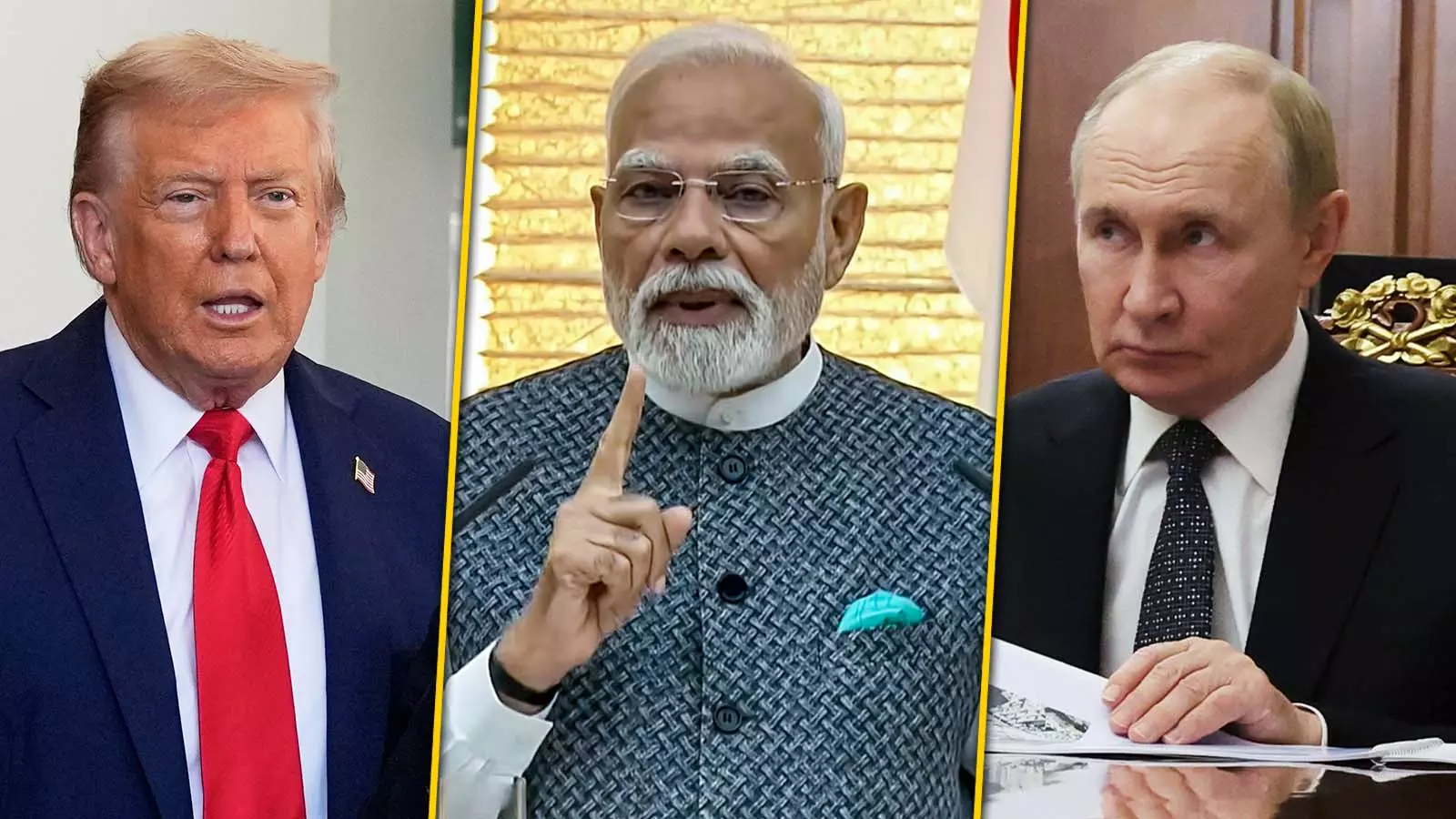
Russian oil sanctions sword hangs over already-fraught India-US ties
Volatile White House politics leave India-US ties strained; Lindsey Graham Act becomes yet another irritant as India recalibrates foreign policy

The US House of Representatives has passed the Lindsey Graham Sanctioning Russia and Iran Act, giving President Donald Trump the authority to impose tariffs of up to 100 per cent on countries buying Russian oil and gas. The Bill, which passed the Senate by an overwhelming 86-11 vote last month, now goes to Trump for his signature.
For India, one of the largest buyers of Russian oil, the legislation could add a new and potentially serious complication to an already difficult relationship with Washington. The Bill does not automatically impose tariffs but gives Trump the power to do so, putting India’s continued reliance on Russian energy squarely in the crosshairs of US policy.
A message to the US?
“India should be worried because it adds another layer of complexity into its negotiations with the US on the trade deal, as it can be used as a pressure tactic. It would loom large in any engagement that India wants to have with the US,” said Harsh Pant, vice-president of the New Delhi-based Observer Research Foundation.
Also read: India emerges as Russia’s fuel lifeline as Moscow buys back its own crude, refined: Report
“My own sense is that India will continue to buy Russian oil as per its requirements. The message to the US will be that while we continue to engage with the US, we will not buckle under pressure. Particularly in the context of how it will look domestically in India, I don’t think there is any likelihood of India accepting the demands of cutting off ties with Russia. But the challenge will continue to haunt India-US relations,” Pant added.
Why Trump may not hurry
Some analysts argued that Trump is unlikely to be in a hurry to impose sanctions on Russia ahead of the US midterm elections in November. Trump is also sensitive to oil prices, and sanctions could further tighten supplies at a time when not just the Strait of Hormuz but potentially the Bab el-Mandeb waterway could face disruption as fighting between Saudi Arabia and the Houthis continues. Any sustained rise in oil prices could add to pressure on American consumers.
For years, India has insisted that strategic autonomy means refusing to choose between competing power centres. The US sanctions legislation targeting buyers of Russian energy could make that balancing act considerably harder.
“Trump is unlikely to be in a hurry to impose sanctions on Russia, and to impose tariffs on China and India. However, he might use this to compel India to sign on the dotted line of the interim trade deal,” said Ambassador KP Fabian.
Also read: Modi-Putin meet: Why India won't walk away from Russia, even under US pressure
“If Trump chooses to threaten Xi Jinping, the Chinese leader will hit back harder by stopping rare earths,” added Fabian. India does not have that leverage.
A geopolitical headache
Yet the threat of sanctions will remain a sword of Damocles hanging over India-US ties.
“There are many milestones to watch out for in terms of the Lindsey Graham Sanctioning Russia and Iran Act,” said Ashok Malik, Partner and Chair of the India Practice at The Asia Group. “For one, any use of the law must be authorised by Trump. He has many things on his plate: The midterms, the need to put pressure on Russia, the Iran crisis and its impact on energy. This increases his risk calculus and his unpredictability. Nevertheless, this law will become an irritant in the bilateral relationship.”
“The optics are not good, even if there is no actual imposition of tariffs. The volatility in the White House has become a massive geopolitical headache. This is leaving its impact on India-US ties as well,” he said.
India’s course correction
India will, therefore, have some time to calibrate its response and plan for a situation in which Trump decides to use the sanctions provision against countries buying Russian energy. India is unlikely to buckle easily, as Pant pointed out, given the domestic political implications.
Also read: India buys Russian oil for its own needs, not to help Moscow: Envoy
But the larger issue may be the direction of India’s foreign-policy recalibration. According to Talmiz Ahmad, former ambassador to Saudi Arabia, “India is already doing a course correction of its foreign policy.” This, he argued, is not only because India has realised that the US cannot be trusted, particularly under the unpredictable Trump, but also because China has made rapid strides in assuming the leadership of the Global South. India does not want to yield that space to China.
The course correction, Ahmad said, is evident in India’s decision to mend ties with China, as well as in the SCO and BRICS declarations. While India needs the US for technology, foreign direct investment and manufacturing, New Delhi is now unlikely to roll over easily.
MEA’s prompt response
Unlike earlier, when India usually avoided responding publicly to issue with the US, especially over Trump’s previous tirades against New Delhi, this time there was a prompt reaction to the passage of the bill in the US Congress.
The MEA said India’s energy security was a priority and noted that the issue had been discussed with American officials in recent months, implying that Washington was aware of the government’s compulsions. The statement also said that India had “made clear its determination to take all necessary measures to protect its trade and economic interests.”
Also read: ‘US wanted India to buy Russian oil’: Jaishankar slams tariff flip-flop
For years, India has insisted that strategic autonomy means refusing to choose between competing power centres. The US sanctions legislation targeting buyers of Russian energy could make that balancing act considerably harder.
The question now is whether mounting pressure from Washington will push New Delhi closer to the West or make India even more determined to preserve its strategic distance.