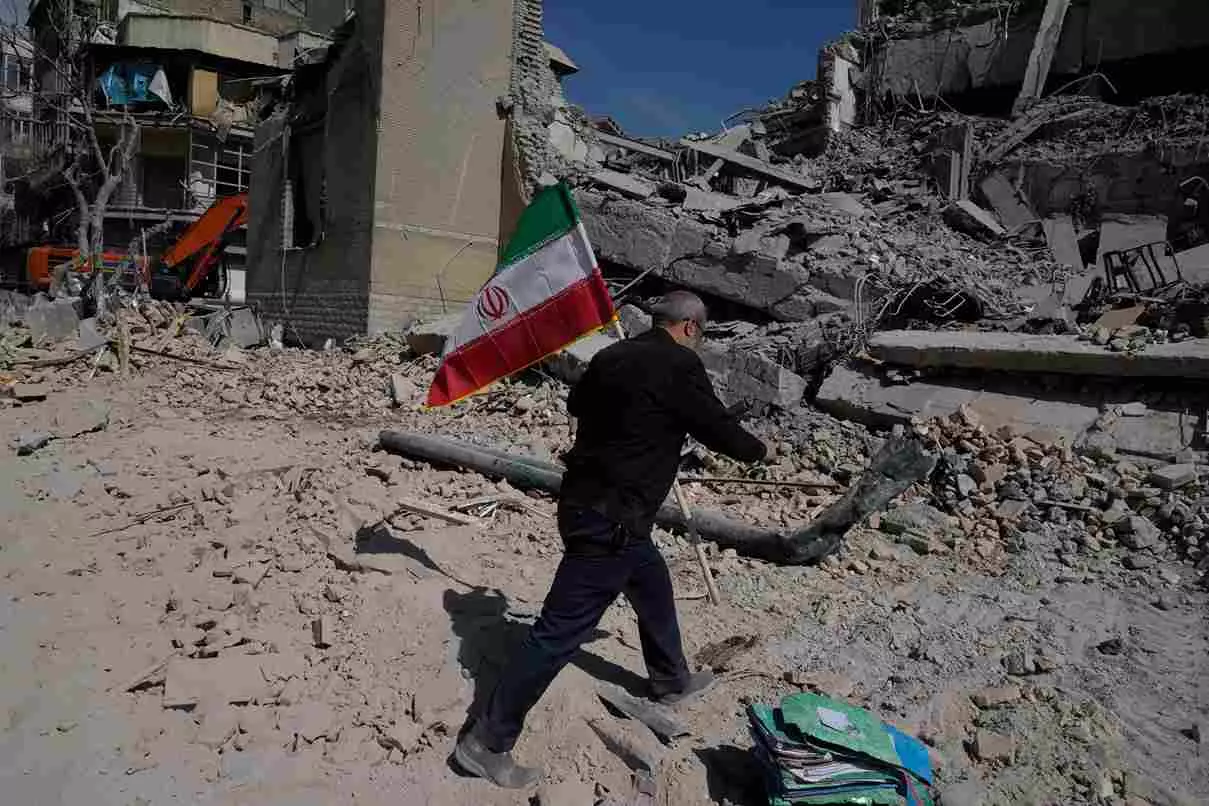
A man carries an Iranian flag to place on the rubble of a police facility struck during the US-Israeli military campaign in Tehran, Iran, Wednesday, March 4, 2026. Photo: AP/PTI
'Havoc everywhere': Kashmiri students in Iran plead for evacuation amid relentless strikes
From Urmia to Qom, hundreds of medical students from India, many from Kashmir, are stranded in bunkers with dwindling supplies, pleading for urgent evacuation

Last year, when Israeli strikes hit Iran, Labeeb Qadri was among hundreds of Indian students caught in the turmoil and uncertainty prevailing in the region.
When he finally returned home to Srinagar, he was in two minds about going back to Iran. What if the situation escalated again? But, Qadri was in his final year of MBBS, his degree programme scheduled to conclude in September 2026. Diplomatic talks were also on between the United States and Iran, so the family convinced themselves that the worst had passed.
Relentless attacks
“Talks were taking place between the two countries, we thought it is safe now in Iran. But they suddenly attacked out of nowhere,” Qadri told The Federal, over text messages from Urmia, in north-west Iran. He was surprised his internet was functioning at all.
He is currently at the underground level of a dormitory at Urmia University, along with around 109 other Indian students inside the building. They have not stepped outside in four days, he shared.
Also read: Live! Iran says US struck IRIS Dena, ‘guest of Indian Navy,’ without warning
“Attacks are taking place continuously,” he said, adding that the nearest explosion was as close as 300 metres from their dormitory, shaking the entire structure. “It’s more dangerous compared to the shelling last June. The intensity of the explosions is far more this time,” he said.
'Stuck' in Iran
According to Qadri, the attacks in Urmia have been relentless for the past five days. They occur through the day, with the sounds of fighter jets audible almost every hour. Food is being supplied daily by the university, and a warden remains with the students continuously, but sometimes, there are challenges like the water runs out.
“Everyone asks why we didn’t leave Iran when the advisory was issued, but most of the students had tickets for February 28 and March 6. In Iran, only one or two flights operate to India per week, so it was not possible for us to leave earlier. But, now we are stuck here, and we don’t know what to do,” he said.
The Jammu & Kashmir Students Association (JKSA) said in a statement on Tuesday (March 5) that “several residents in nearby neighbourhoods have begun leaving the city and moving towards the outskirts where it is safer amid fears of further escalation”.
The Association described the prevailing environment as one full of panic, confusion and mounting psychological strain, particularly among foreign students far from their families.
At Qom province: Havoc all over
Hundreds of kilometres away in Qom province, the atmosphere is no calmer. Faysal Lateef, an MBBS student at the Iran University of Medical Sciences, finds himself in a similar situation. From Qom, he reported hearing three blasts near the Haram area. “Right now, we are scared and anxious about the situation. Everywhere there are strikes going on,” he told The Federal. He was also communicating with The Federal through text messages.
Also read: 'No sovereign nation will accept what US, Israel are dictating to Iran'
Lateef said that on Tuesday (March 3) morning, around 7 am, 204 students from his university boarded five buses from Tehran. They were provided food by embassy officials. “They provided some food for us…we had to eat it somehow. But we can’t make ourselves calm. Everywhere there is havoc,” he said.
The distress, he added, is not only about airstrikes. Students are running out of money, making it difficult to purchase essentials from the market, even when if they are able to move around. With restrictions tightening and uncertainty deepening, the anxiety is constant, he said.
For the Indian students now sheltering in different parts of Iran, the primary aim is evacuation. But both Qadri and Lateef said they have no clarity on when that might happen. Asked if the Indian Embassy had reached out, Qadri said, “They told us borders and airspace are closed, we cannot evacuate you at this moment.”
He has managed brief contact with his anxious family in Srinagar, who have urged him to stay where he is, unsure of what else they can do.
Call for evacuation
Lateef echoed the call for urgent intervention. “Till now, we are stranded here in Qom, and there is no information regarding evacuation. We want the Indian Embassy to evacuate us as soon as possible because it’s not safe for us to stay here for much longer. Everywhere in Iran, it’s dangerous right now. It’s not like we are safe here in Qom,” he said.
The JKSA has urged the ministry of external affairs and the Indian Embassy in Tehran to initiate structured relocation measures until full evacuation becomes possible, suggesting that transit arrangements through neighbouring Armenia be explored once conditions permit.