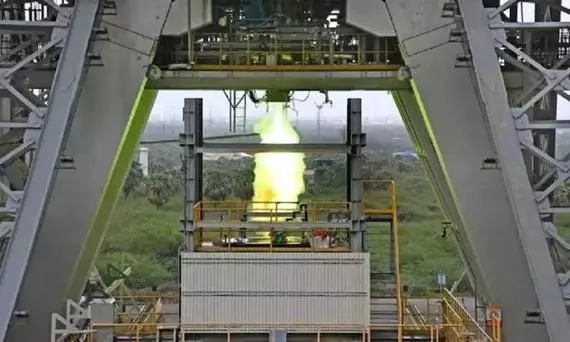
Even as it is in the process of developing its own semi-cryogenic rocket engine, India's premier space agency appears to be all set to acquire Russian engines to boost the carrying capacity of its LVM3 rocket.
According to sources in the Indian Space Research Organisation (ISRO), the draft contract for sourcing the semi-cryogenic engine is in the approval process. The deal is also expected to include transfer of technology to India so that the engines can be made in India.
ISRO has said a team of its officials had visited Moscow for technical discussions with the Russian space agency Roscosmos on the delivery of semi-cryogenic engines. If the deal is sealed, for a second time, India will be sourcing a rocket engine to increase the carrying capacity of its LVM3 rocket.
Unlike the first time when India bought cryogenic engines from Russia for the Geosynchronous Satellite Launch Vehicle (GSLV) Mk- I, this time around it will be a semi-cryogenic engine. Interestingly, this time too the Russian engine will power the GSLV but an upgraded version, the GSLV-Mk III rocket renamed as LVM3.
Indo-Russia aerospace ties
Russia is looking to strengthen its aerospace partnership with India by offering its semi-cryogenic RD-191 rocket engine, along with technology transfer to enable domestic manufacturing. During his visit to India last year, Roscosmos director general Dmitry Bakanov indicated that a deal for supplying rocket engines to India is under discussion.
He also highlighted potential collaboration in human spaceflight and space station development—two areas where India is actively advancing its capabilities.
Discussions between the two countries on semi-cryogenic engine technology, however, have been ongoing for several years. In 2019, former ISRO Chairman K Sivan had told this writer that Russia was willing to offer such technology under the Make-in-India programme.
Roscosmos later confirmed that the cooperation between the two countries could extend to piloted missions, satellite navigation, and propulsion systems.
More thrust power
The throttleable RD-191 engine is significantly more powerful and could enhance the lifting capability of LVM3, potentially enabling it to carry payloads of up to 7 tonnes to geostationary transfer orbit (GTO), when paired with an upgraded cryogenic stage.
This is particularly important as India pursues ambitions such as crewed lunar missions and building its own space station—both of which require heavy-lift launch capability. Modern rockets often rely on clustered engines, and a high-thrust semi-cryogenic engine would provide the necessary performance boost.
India is considering integrating the RD-191 into the LVM3, which currently has a payload capacity of about 4 tonnes to GTO.
ISRO is already working to increase this to 5 tonnes by upgrading the cryogenic stage and replacing the second-stage liquid engine with a semi-cryogenic one. These enhancements are expected to improve the rocket’s commercial competitiveness through NewSpace India Limited.
If the semi-cryogenic engine deal is finalised, it would become the second major Indo-Russian aerospace collaboration after the successful BrahMos missile programme.
Budgetary allocation
It would also mark India’s second purchase of rocket engines from Russia, following the earlier acquisition of cryogenic engines for the GSLV. Those supplies were later halted due to geopolitical pressures, prompting India to develop its own cryogenic technology.
India’s department of space has also allocated some amount for the purchase of the Russian rocket engine in its budget for 2026-27. The department-related Parliamentary Standing Committee on Science and Technology, Environment, Forests and Climate Change has stated this in its report on the Demands for Grants for Department of Space for the year 2026-27.
According to the report, the overall budgetary allocation of Rs 13,705.63 crore for department of space for 2026-27 includes new projects viz:
a) Induction of procured semi-cryogenic engine towards expediting the enhancement of LVM3 launch vehicle payload capability;
b) Space Docking Experiment – 2 (SPADEX-2) Mission.
The budget allocation is also made for major developmental projects including the semi-cryogenic engine and stage development, re-entry technologies and others, noted the Parliamentary Committee report.
ISRO's semi-cryogenic engine
Meanwhile, ISRO has been developing its indigenous semi-cryogenic engine, the SE2000, powered by liquid oxygen and kerosene.
Although progress has been gradual, the programme has reached an advanced stage, with several sub-assemblies completed.
According to a Parliamentary Committee report, an integrated engine hot test is targeted by the end of 2026, supported by newly established test facilities.
Semi-cryogenic engines offer several advantages over cryogenic ones. They use kerosene, which can be stored at near-ambient temperatures, unlike liquid hydrogen that requires extremely low temperatures.
Kerosene’s higher density allows for smaller fuel tanks and greater thrust efficiency, making such engines well-suited for booster stages. They are also operationally less complex and widely used by major spacefaring nations.
ISRO’s Liquid Propulsion Systems Centre is leading the development of the semi-cryogenic propulsion system and the SC120 stage, which will replace the current L110 stage of LVM3. The new system, using non-toxic propellants like liquid oxygen and kerosene, is expected to deliver higher performance and increase payload capacity.
However, growing domestic and commercial demand for heavier satellite launches is putting pressure on timelines. India currently depends on foreign launch providers for heavier communication satellites, leading to high costs and lost commercial opportunities.
With LVM3 launch orders still sporadic, the potential acquisition of the RD-191 engine could serve as a strategic interim solution while indigenous development continues.