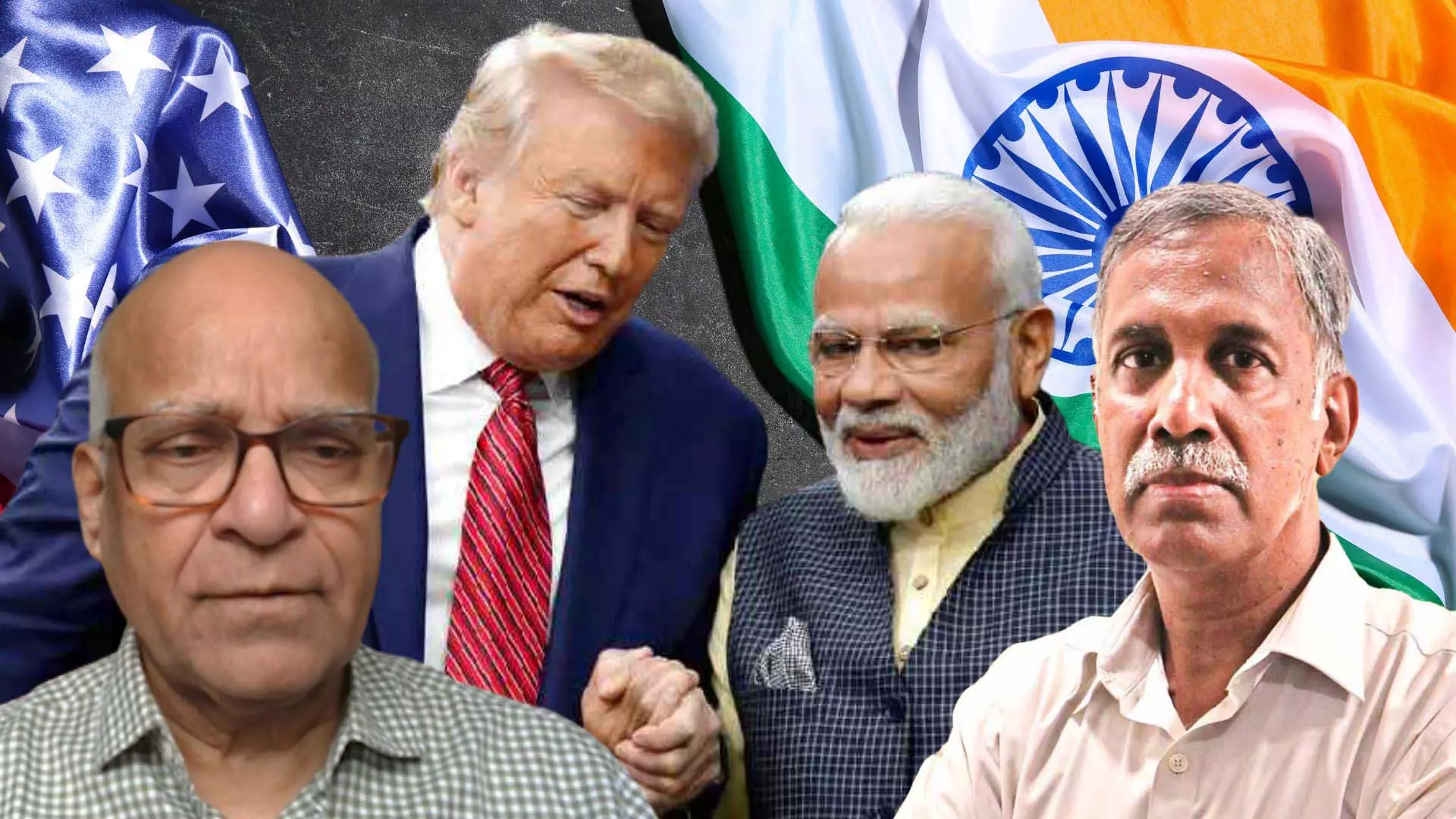
'India-US trade deal is a historic abdication of India’s sovereignty”
With Trump claiming India will cut tariffs and oil imports from Russia, senior journalist D Ravi Kanth says emerging US trade terms are unequal and coercive

There is renewed uncertainty over India-US trade ties following US President Donald Trump’s claims that New Delhi would slash tariffs and non-tariff barriers to “zero”, accept reciprocal US tariffs capped at 18%, and halt purchases of Russian oil.
In an interview with The Federal, senior journalist D Ravi Kanth issued a stark warning. He said that accepting such an asymmetrical arrangement under pressure would amount to an “abdication” of India’s key sovereign powers — over tariffs, trade policy, and national sovereignty.
Edited excerpts:
How should we read Trump’s announcement—deal, intent, or political messaging?
What Trump said broadly aligns with marathon negotiations India has been in since the February 13 meeting between President Trump and Prime Minister Narendra Modi, and what was reflected in a White House fact sheet that spoke of a $500 billion trade target by 2030 and India removing barriers for several US products.
Trump has repeatedly signalled—at different points—that India is willing to bring tariffs down dramatically. So it isn’t out of the blue. But both sides still need to provide clarity on details.
Even the “zero tariff” line needs context. In a CNBC interview, the US Trade Representative said “zero tariff” could apply to some agricultural products like fruits and vegetables, and possibly poultry products, while cautioning that grains and some GMO-linked products could still face protection because India has sought safeguards.
If you add these statements together, there is still lack of clarity on what exactly was agreed, and what was simply framed politically. My sense is both sides may hold back detailed fact sheets until a leader-level moment.
What kind of formal documentation should viewers look for before treating this as binding?
In the US system, there are two tracks. One is political-level announcements—often reflected through White House fact sheets when leaders meet and take positions.
Tariff reductions for US farm products entering India could create major problems because the agricultural systems are not comparable. The US has around 30,000 rich farmers supported through wide subsidies. At the WTO, the US has repeatedly targeted India on agriculture.
The second is the legal implementation route, where the change must appear through formal steps such as publication in the Federal Register and other implementing instruments.
Several “framework agreements” Trump has announced have appeared in fact sheets but not in the Federal Register. In multiple cases—Indonesia and the European Union, for example—implementation has also lagged. So yes, a lot can remain “hanging fire,” with pressure tactics including threats of tariff hikes if countries do not comply.
Trump said India will “likely” move toward zero tariffs and barriers. Is there still negotiating room?
The phrasing suggests intent rather than a concluded, fully published agreement. But my argument is that the manoeuvring phase is largely over and details may already be worked out between the two sides.
It’s possible both governments have agreed to disclose details at an opportune moment in the relationship—especially since Trump and Modi have not met since February 2025.
Events after May 7 also appear to have affected the timing and diplomatic choreography.
Also Read: India’s trade deal with the US is not reciprocity, it is submission
Subrahmanyam Jaishankar’s sudden visit to the US suggests preparations for a possible leader-level announcement. I could be wrong. But that is how it looks from the sequence.
What does the 18% figure actually mean—does it apply to everything?
The 18% headline number is misleading. The US is doing two things:
Country-to-country “reciprocal tariff” rates (EU 15%, Britain 10%, Japan 15%, Korea 15%, etc).
“Sectoral” tariffs on categories like steel, aluminium, automobiles, furniture and others—where the figure is 25%.
So for some products—say steel or auto products—an exporter could effectively face 43% (18 + 25). In those sectoral areas, there may be no relief.
Separately, the Trump administration has already announced sector-specific concessions for pharmaceuticals, including “0%” for certain essential generic drugs critical to the American health system. The broad point is: the tariff map varies by sector.
The 18% rate may apply largely to textiles, gems and jewellery, leather products, and other labour-intensive export segments.
Do intra-country comparisons help — Pakistan 19%, Bangladesh 20%, Vietnam 20%?
These comparisons exist, but they may not significantly help India in practice.
Countries like Bangladesh, Pakistan and especially Vietnam are deeply entrenched in their export markets in segments like textiles, leather, and furniture. They have established supply chains and buyer relationships.
The larger story is the rewriting of the rule-based trading system itself.
Has the rules-based order under GATT/WTO been overturned by this approach?
Yes, the system has been amended in practice. In earlier GATT/WTO rounds, when the US talked about reciprocity, it openly acknowledged vast differences between economies. Even under reciprocity, developed countries were expected to cut more, depending on development status.
Across trade rounds, reciprocity became a benchmark. In the Doha-era talks, there was the “less than full reciprocity” idea—developed countries taking deeper cuts than developing countries. Kamal Nath, as India’s trade minister then, played a role in pushing that principle.
What the US is doing now is not only upending established multilateral rules under the WTO framework, but also forcing countries into outcomes that resemble coercion—aimed at addressing US domestic economic and political objectives.
The argument that “you have a trade surplus with us, so you must pay” is absurd. Some countries without a trade surplus—Brazil, for instance—are also hit with heavy tariffs.
Is the US now forcing re-industrialisation at others’ expense?
That is the core of it. The Trump administration is pushing re-industrialisation in the US by forcing other countries to pay on two fronts:
a) Tariffs
b) Investment commitments
Earlier, investment was outside trade. Now, agreement after agreement includes investment demands. The $500 billion figure was already present in the February 2025 Trump–Modi meeting framing.
This creates a dichotomy: others de-industrialise, the US re-industrialises.
Does the WTO still matter if 72% of trade runs on MFN terms?
Formally, yes—the WTO Director-General has said a large share of trade still occurs under MFN rules. But countries can increasingly ignore WTO rules without meaningful consequences.
Also Read: India-US trade deal raises key questions of diplomacy
For example, the US recently lost a dispute to China involving renewable energy subsidies (implemented under the Biden administration). China won; the US response was to say it would not recognise the outcome and to repeat its longstanding argument that the WTO works against American interests.
In effect, WTO enforcement has been hollowed out—“rules exist,” but the system is weakened.
Earlier, there was an “insurance”: a dispute settlement panel and appellate review, after which relief or authorised countermeasures could follow. Now the appellate body is effectively dead, reducing the deterrence effect and weakening remedies.
What could this mean for Indian agriculture if barriers fall?
Claims that the deal will not affect Indian agriculture are misleading, in my view. For Americans, opening India’s market for agricultural products is a top goal.
Tariff reductions for US farm products entering India could create major problems because the agricultural systems are not comparable. The US has around 30,000 rich farmers supported through wide subsidies. At the WTO, the US has repeatedly targeted India on agriculture.
Recently, the US said it will never agree to a “permanent peace clause,” while accusing India of violating subsidy commitments for rice and wheat. What exactly has been agreed on grains, GMO-linked products, dairy and poultry is unclear. The US may offer “extra time” before reductions hit sensitive categories.
But India is an agriculture-intensive country, with roughly 800 million livelihoods linked to it, and small holdings. Even if India argues for protections on corn, soybean, ethanol and other sensitive items, negotiating with a dominant partner limits the ability to hold the line.
There may be temporary protection, but over time it is likely to come down significantly. Once US imports begin arriving in volume, India may struggle to protect farmers.
A key example is MSP (minimum support price). If the US later argues MSP disturbs trade or violates subsidy rules, India will face pressure. Even if US agriculture is heavily subsidised, India may not be able to stop the pressure.
Cotton is an example—US cotton is heavily subsidised; disputes happened; the US lost and acknowledged changes were needed, yet problems persist.
The same risk could extend to wheat and other staples: will India continue current protection, or will US agribusiness push large-scale exports into India?
What about energy security—especially the claim that India will stop buying Russian oil?
It would have significant impact on India’s energy policy, and on the global energy market.
At present, roughly one-third of India’s oil is coming from Russia, at cheaper prices. India and China are deeply reliant on Russian crude.
The claim that India will “stop” Russian oil is not feasible immediately. Oil contracts are typically locked for 6–8 months, and continue regardless of political pressure because they are contractual commitments.
Some re-routing is possible—oil may not come directly to Indian shores and could be transferred at sea, similar to patterns seen in oil flows during the Ukraine war, including Iranian oil. But it would still be a major strategic loss. India remains heavily dependent on Russia for defence—close to 70%—and antagonising Vladimir Putin is not cost-free.
I’m told Putin and Xi Jinping had a detailed video conference recently on several issues, which adds to the strategic complexity for India in managing great-power expectations.
Also, alternatives like Venezuelan oil are not straightforward: it is thick, transport is costly, and refining constraints exist.
The larger point is that this is coercion: the same US presidency that sanctioned Venezuela is now leveraging energy pressure.
Nicolás Maduro and Venezuela have been under US sanctions regimes since earlier years; the structural contradiction remains—pressure politics reshaping energy choices.
Could India gain from “China-plus-one” if China faces higher US tariffs?
China remains competitive even with high tariffs (around 45% in the discussion), and has found other markets. Its exports have continued strongly, despite some dents.
China is also watching India’s strategic tilt—especially the ambition in New Delhi to move into a closer embrace with the US. If India tilts significantly, China may apply its own brakes through strategic and economic levers.
So a tariff gap does not automatically translate into a windfall.
What did you mean by “three sovereignties”—tariff, trade, national?
The argument is that accepting asymmetrical terms under pressure risks surrendering three sovereign spaces:
Tariff sovereignty: Every country decides its tariff structure based on its own conditions. If India agrees under pressure to an asymmetrical tariff relationship, it effectively foregoes or abdicates tariff sovereignty.
Trade sovereignty (policy autonomy): In trade, a country needs policy space to develop some sectors faster than others. If India allows major US exports—agricultural and industrial—into its market, what happens to India’s autonomy and strategy in the coming years?
National sovereignty: Statements from Trump, and the pressure embedded in them, can erode national sovereignty—especially in areas like defence choices and how India manages relationships with Russia if it is pushed into large defence deals or forced alignments.
That is why I called it a historic abdication: the consequences unfold over time.
The content above has been transcribed from video using a fine-tuned AI model. To ensure accuracy, quality, and editorial integrity, we employ a Human-In-The-Loop (HITL) process. While AI assists in creating the initial draft, our experienced editorial team carefully reviews, edits, and refines the content before publication. At The Federal, we combine the efficiency of AI with the expertise of human editors to deliver reliable and insightful journalism.