







How India-US trade deal map sends a diplomatic signal to Pakistan
A US-released map accompanying the trade deal depicts all of Jammu and Kashmir as part of India, marking a subtle but significant shift from earlier US practice

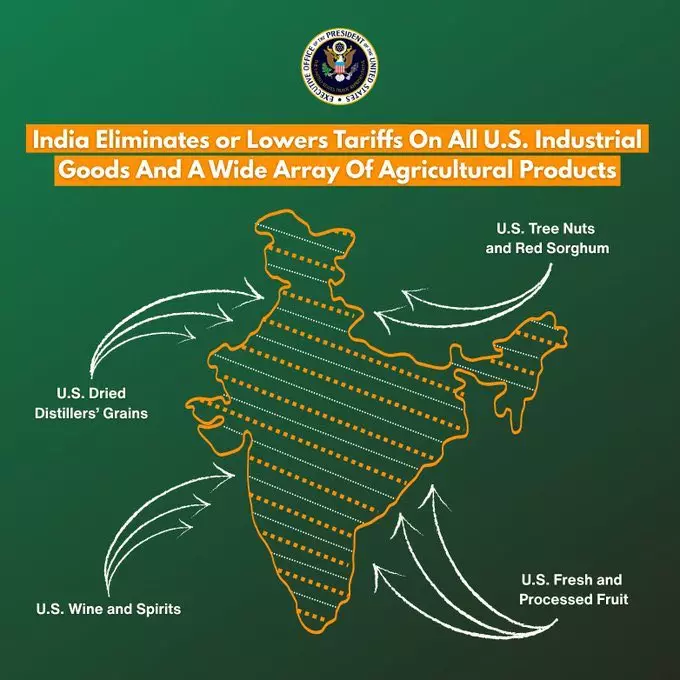
As New Delhi and Washington unveiled the framework for an interim trade agreement on Saturday, an unexpected detail drew immediate attention – a map of India released by the Trump administration that quickly circulated online.
Also read | India-US trade deal: Zero tariffs on gems, pharma, farm produce, says Goyal
Alongside the trade announcement, the office of the US Trade Representative shared a map depicting the entire Jammu and Kashmir region, including Pakistan-occupied Kashmir (PoK), as part of India. The map also showed Aksai Chin within Indian territory, an area claimed by China.
US depiction breaks precedent
The release signalled that the US leadership appears to align itself with India’s official political map, implicitly rejecting contested territorial narratives. This is not to suggest that India’s sovereignty required validation from Washington. New Delhi has consistently maintained that Jammu and Kashmir is an inseparable part of the country. Still, the move marks a notable shift from earlier US positions. Whether intentional or inadvertent, the message to Pakistan was unmistakable: the current US leadership is not distancing itself from India’s territorial claims.
In the past, maps issued by the US government or the State Department typically marked PoK separately, reflecting Pakistan’s sensitivities. The latest map, however, departs from that practice and openly disregards Islamabad’s claims.
India’s Ministry of External Affairs has long objected to what it calls inaccurate portrayals of its borders, particularly Jammu and Kashmir and Arunachal Pradesh, by US agencies and international organisations. This latest depiction appears to address those objections for the first time.
Diplomatic signals amid reset
The timing of the move is equally significant, coming as India and the US recalibrate relations under the unpredictable leadership of Donald Trump after a turbulent phase. During the trade standoff, Trump had imposed steep 50% tariffs on Indian goods, the highest applied to any US ally. Under the new interim agreement, these tariffs have been reduced to 18%, the lowest among Asian countries. At the same time, Trump has revived rhetoric that seems to re-hyphenate India and Pakistan, reversing the policy of de-hyphenation initiated under George W Bush and followed by subsequent administrations.
For Islamabad, the episode has been deeply embarrassing. Pakistan has recently made concerted efforts to rebuild ties with Trump, with Prime Minister Shehbaz Sharif and Army chief Asim Munir, who now holds the rank of field marshal, making repeated visits to Washington to lobby American decision-makers.
Also read | Trump lifts 25% tariff on India over Russian oil imports after trade deal
Those efforts, however, appear to have fallen short, failing to persuade the US to endorse the territorial narratives Pakistan has promoted for decades. Islamabad’s recent diplomatic push has also highlighted shifting power dynamics within Pakistan, with Munir increasingly projecting himself as the country’s real centre of authority, sidelining the elected government.
No substitute for India
However, US strategic interests in Pakistan remain intact, particularly in areas such as rare earth minerals and defence sales. But these interests, it seems, do not extend to accepting what Washington views as untenable territorial claims. The message from the US is clear on that front.
The larger message appears to be that while Pakistan may continue to figure in US strategic calculations, it cannot substitute India, a global partner whose geopolitical relevance remains paramount. In effect, Washington has delivered a diplomatic setback that is likely to reverberate through the highest levels of Pakistan’s power structure.