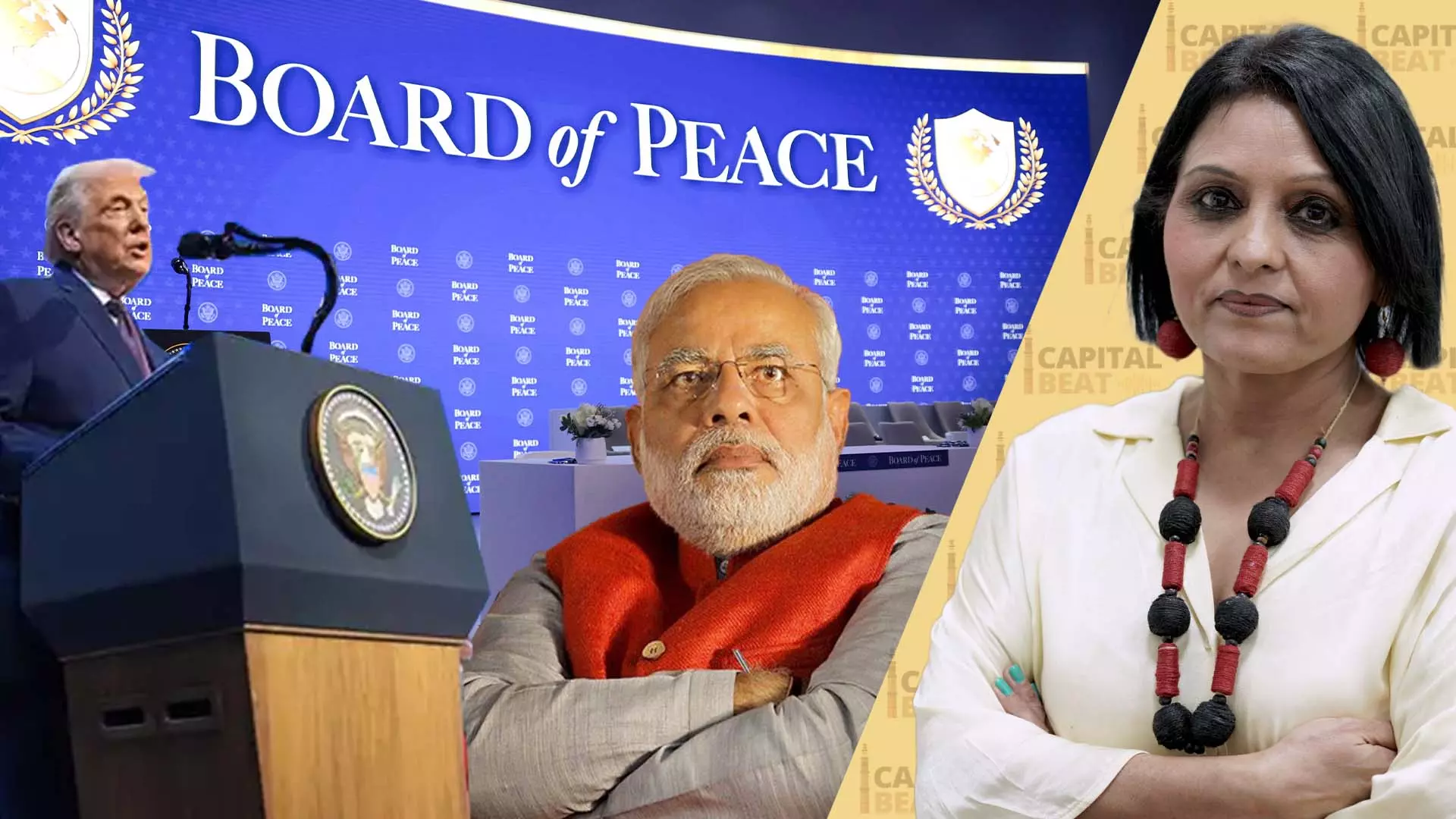
The panel focused on India’s wait-and-watch approach, the structure and intent of the proposed board, and the diplomatic implications of India’s absence.
Trump’s Board of Peace: Why New Delhi chose caution over optics
The panellists noted that the decision not to send any representative reflected caution over the proposal’s scope, composition, and implications for India’s long-standing foreign policy positions

A Capital Beat episode examined India’s decision to stay away from the launch of US President Donald Trump’s proposed Board of Peace, an initiative unveiled in Davos with a stated focus on Gaza. The discussion featured Gulshan Sachdeva, Professor at the Centre for European Studies, Jawaharlal Nehru University, and Kallol Bhattacharya, Assistant Foreign Affairs Editor at The Hindu. The panel focused on India’s wait-and-watch approach, the structure and intent of the proposed board, and the diplomatic implications of India’s absence.
India did not send any representative to the ceremony despite a direct invitation extended to Prime Minister Narendra Modi. The episode noted that the decision followed internal deliberations and reflected caution over the proposal’s scope, composition, and implications for India’s long-standing foreign policy positions.
The discussion also unfolded against the backdrop of Donald Trump withdrawing Canada’s invitation to the Board of Peace and publicly targeting other leaders, reinforcing concerns over the political signalling associated with participation in the initiative.
Why India did not attend the launch
Gulshan Sachdeva stated that India’s position was not an outright rejection. “India has not declined the invitation,” he said, adding that several other countries had also chosen not to participate in the initial meeting. He noted that only a small number of countries had formally joined the board so far.
Sachdeva pointed out that Spain had explicitly refused to join, while France had effectively said no. Other European countries, including the United Kingdom, had not made their positions clear. China and Russia were also yet to signal a firm commitment. He said India’s approach aligned with a broader pattern of caution among major global players.
Also Read: India skips Trump’s ‘Board of Peace’ launch at Davos as Pakistan joins
He identified several concerns discussed internationally, including the board’s leadership structure, its compatibility with the United Nations Charter, and the reported financial requirement of a USD 1 billion contribution for permanent membership. He also highlighted the absence of Palestinian representation despite Gaza being cited as the starting point of the initiative.
Questions over mandate and expansion
Sachdeva underlined that the proposal had expanded beyond Gaza. He said the initiative had moved towards a framework that could intervene in multiple conflicts, oversee reconstruction, and operate with wide discretion.
“Now this has been expanded to everything,” he noted, adding that this raised questions for countries committed to multilateral frameworks.
He emphasised India’s stated belief in multilateralism with the United Nations at its core. The expansion of the board’s scope, he said, complicated India’s decision-making, given its support for existing international institutions.
He also stressed that India’s current relations with the United States differed from earlier phases, making immediate participation less straightforward. He said India would avoid issuing a categorical refusal while remaining cautious about sending political signals through early participation.
Signals and global perceptions
The discussion addressed the optics of Pakistan’s participation, with Pakistan Prime Minister Shehbaz Sharif seated next to Donald Trump at the launch. Sachdeva said participation itself sends signals, not only to the United States but also to the wider international community.
Also Read: Trump withdraws Canada’s invite to Board of Peace after Carney's rebuttal
He stated that India’s stance on the Palestinian issue and its claim to leadership of the Global South meant that other countries were closely watching New Delhi’s choices. He warned that participation without clarity could result in diplomatic embarrassment rather than tangible benefit.
Sachdeva also referred to evolving European responses following disputes involving Greenland, noting that positions could shift rapidly depending on developments in US relations with allies. He said countries were weighing benefits and risks before committing.
Parallel structures and India’s discomfort
Kallol Bhattacharya framed the Board of Peace as a parallel multilateral structure. He said India had long pushed for reform of the United Nations system, and now faced a situation where a new forum was being created without a defined charter.
Bhattacharya said India’s foreign policy on issues such as Palestine, Sudan, Congo, and Afghanistan had been shaped by principles of non-intervention and equal rights of parties. He argued that the proposed board conflicted with those principles.
He drew parallels between the initiative and earlier historical models of trusteeship, saying that the idea of external figures governing Gaza resembled colonial-era approaches. He said this posed a problem for India as a post-colonial state.
Leadership, status, and diplomatic optics
Bhattacharya said the invitation was extended specifically to Prime Minister Modi, not to a lower-ranking representative. He argued that the initiative’s design required leaders of equivalent stature to Trump.
“Trump will not accept anybody less than the status of the prime minister,” he said.
Also Read: Trump’s Board of Peace: Europe stays away; Muslim countries agree to sign on
He pointed out that sending a minister instead of the prime minister could be interpreted internationally as reluctance. Silence, he said, could also be read as negation in a fast-moving information environment.
Bhattacharya noted that India had not publicly accepted or rejected the invitation, leaving its position open to interpretation. He said this ambiguity carried risks in a global political climate driven by optics and immediate reactions.
Trump, the UN, and institutional intent
Responding to Trump’s remarks about working “in conjunction with the United Nations", Sachdeva said Trump’s scepticism of multilateral institutions was well-established. He said Trump had repeatedly expressed distrust of international law and existing global governance structures.
Sachdeva argued that Trump’s careful wording was aimed at attracting broader participation while retaining freedom from institutional constraints.
“He doesn’t want to be restricted by rules and regulations of international governance,” he said.
He said India had to assess whether participation would align with its long-term ambitions, including its bid for a permanent seat on the UN Security Council and its positioning within the Global South.
Pakistan’s presence and India’s calculus
The panel discussed the optics of Pakistan’s visibility at the launch and Trump’s references to India-Pakistan issues. Sachdeva said India should not frame its decisions solely in response to Pakistan’s actions.
He said Pakistan’s choice to participate was driven by its desire to strengthen ties with the Trump administration. India, he argued, had broader considerations and a longer strategic horizon.
Also Read: By widening scope of his Board of Peace, is Trump challenging UN?
Sachdeva emphasised that India needed to consult with other major partners, including BRICS members and European countries, before shaping its response. He said participation decisions should be based on collective alignment rather than immediate optics.
Trade, tariffs, and strategic costs
The discussion examined whether India’s absence could affect trade negotiations with the United States. Sachdeva said there could be costs, but warned against shaping foreign policy solely around transactional benefits.
He said India’s past positions, including on the Ukraine war, reflected consistency even when relations with major powers were strained. He argued that short-term accommodation could undermine India’s credibility.
Bhattacharya added that India’s priority remained safeguarding its overall relationship with the United States, particularly economic ties. He said the Board of Peace was closely associated with Trump personally, raising questions about its longevity beyond his presidency.
Silence, uncertainty, and policy limits
Bhattacharya said no country had a clear formula for dealing with Trump’s approach to global leadership. He described India’s current posture as cautious but uncertain in outcome.
He said the absence of a public explanation left room for speculation, but noted that unpredictability characterised the current international environment. He said India’s choices were shaped by the need to balance principle, pragmatism, and long-term interests.
Also Read: France mocks Greenland move, snubs Board of Peace; Trump warns of 200 pc tariff
The panel concluded without a definitive resolution, reflecting the evolving nature of the issue and the uncertainty surrounding the Board of Peace and its future role in global governance.
(The content above has been transcribed from video using a fine-tuned AI model. To ensure accuracy, quality, and editorial integrity, we employ a Human-In-The-Loop (HITL) process. While AI assists in creating the initial draft, our experienced editorial team carefully reviews, edits, and refines the content before publication. At The Federal, we combine the efficiency of AI with the expertise of human editors to deliver reliable and insightful journalism.)