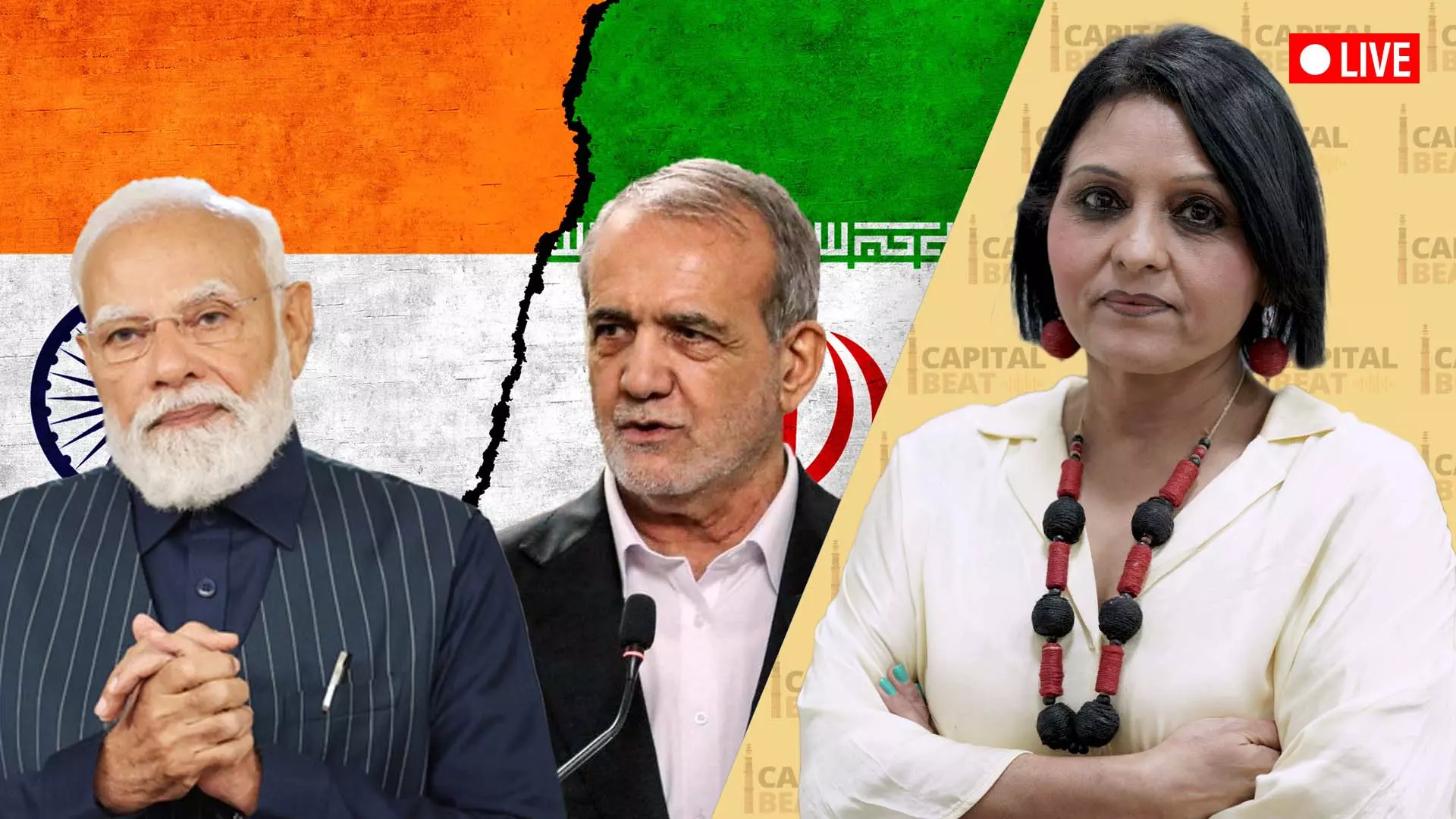
Can India recalibrate its Iran policy without straining US and Israel ties?
India faces a delicate balancing act—maintaining ties with the US and Israel while preserving goodwill with Iran, a key partner in energy and regional connectivity

Despite recent diplomatic missteps, India may still have a “window of opportunity” to repair ties with Iran, but it must move beyond symbolic gestures and take concrete steps to reassure Tehran, Middle East expert Prof Aftab Kamal Pasha said during a discussion on Capital Beat.
The debate comes after Prime Minister Narendra Modi spoke with Iranian President Masoud Pezeshkian nearly two weeks after the killing of Iran’s Supreme Leader Ali Khamenei, even as tensions in West Asia continue to escalate. The Federal spoke to Prof Aftab Kamal Pasha, senior journalist Sanjay Kapoor, and international affairs expert and Consulting Editor KS Dakshina Murthy on whether India can recalibrate its strategic ties with Iran while maintaining its partnerships with the United States, Israel, and Gulf nations.
Contrasting statements
The conversation between Modi and Pezeshkian came amid growing economic anxiety in India linked to disruptions in energy supplies and shipping routes through the Strait of Hormuz — one of the world’s most crucial maritime chokepoints for oil and gas.
Kapoor pointed out that India’s diplomatic response to the crisis appeared delayed and cautious. He noted that New Delhi had neither criticised the attack on Iran by the United States and Israel nor condemned the killing of the Iran's supreme leader.
“India and Iran seem to be speaking in two different languages,” Kapoor said, referring to the contrasting statements emerging from both governments after diplomatic interactions.
Also Read: Trump tells G7 Iran ‘near surrender’, but then Tehran vows retaliation
He added that while India once had close strategic ties with Tehran — including its involvement in the Chabahar port project in the Gulf of Oman — those ties have weakened over the years.
Kapoor argued that India’s growing alignment with Washington and Tel Aviv has complicated its ability to engage Iran effectively in the current crisis.
Iran's assertive posture
The debate gained urgency after comments by Mojtaba Khamenei, who indicated in social media posts that Iran may intensify its military response and seek compensation for wartime losses.
In one of his posts, he warned that if Iran’s demands were not met, it would destroy an equivalent amount of the enemy’s assets.
Panellists said these statements underscore Iran’s increasingly assertive posture in the region and highlight the geopolitical stakes for countries dependent on energy supplies from the Gulf.
Also Read: How West Asia conflict has left India's coastal economy with empty nets
Prof Pasha said the statements should be interpreted as a signal not only to Western powers but also to regional actors.
He explained that Iran’s leadership believes certain neighbouring countries have allowed foreign military bases to operate within their territories, strengthening Western influence in the region.
According to him, the message also indirectly reflects Iran’s frustration with countries that have not strongly condemned the attacks against it.
Strategic balancing
Despite these tensions, Prof Pasha argued that India still has an opportunity to rebalance its foreign policy approach.
He noted that Iran continues to value its economic and strategic ties with India, particularly in areas such as energy cooperation and regional connectivity through the Chabahar port.
“I believe there is still a window of opportunity for India to balance its ties with the United States, Israel, and Iran,” he said.
Also Read: West Asia conflict paralyses South India’s granite exports
Iran, he added, has not closed the door on cooperation and still views India as an important partner for expanding trade and connectivity towards Central Asia. However, Pasha cautioned that India’s close proximity to Israeli policies and its trilateral alignment with Israel and the United States have raised concerns in Tehran.
He also pointed out that Modi’s message following his call with Pezeshkian emphasised peace and stability but did not mention the attacks on Iran or the deaths of Iranian leaders and soldiers.
For Iran, such omissions may signal a lack of solidarity at a time when it expects diplomatic support from traditional partners, he said.
Energy stakes
Another critical dimension of the crisis is the impact on global energy flows. The Strait of Hormuz remains a vital shipping route for oil and gas exports to India and dozens of other countries.
Panellists warned that any prolonged disruption could have serious consequences for India’s economy, including fuel shortages and higher import costs.
Also Read: Congress slams PM Modi's 'silence' on Khamenei's killing
Prof Pasha highlighted that many Indian ships and cargo shipments remain stuck due to security concerns in the region. He added that if Iran decides to further restrict maritime movement through the strait, India could face major energy supply disruptions.
“Eventually, the Gulf will remain the lifeline for India’s energy security,” he said. He also warned that shortage of cooking gas, fertilisers, and other essential supplies could intensify if the crisis continues.
India’s dilemma
Dakshina Murthy said India faces a complex diplomatic challenge as it tries to maintain relationships with multiple rival powers. He explained that India cannot afford to weaken its ties with Iran because the relationship holds long-term strategic importance.
The Chabahar port project, for example, provides India with a route to Afghanistan and Central Asia that bypasses Pakistan.
“At the same time, India cannot ignore the pressure from the United States and its growing defence partnership with Israel,” he said.
Also Read: Sensex, Nifty drop nearly 1 pc as West Asia conflict, surging oil prices rattle stock markets
This delicate balancing act has forced New Delhi to adopt what he described as a “generalist approach” — calling for peace and dialogue without taking clear sides. However, he warned that such ambiguity could undermine India’s credibility among all parties involved.
“If India is not able to take a firm position on key issues, eventually all sides may begin to question its reliability,” he said.
Limited mediation role
Kapoor was more sceptical about India’s ability to play a meaningful diplomatic role in resolving the crisis. He argued that New Delhi’s strategic choices over the past few years have weakened its standing as a neutral actor.
“I don’t think India has much scope to act as an honest broker between Iran and the United States or Israel,” he said.
Kapoor noted that China currently enjoys smoother passage for its shipping through the region due to a long-term agreement signed with Iran in 2023. In contrast, India’s ships have faced greater uncertainty.
He suggested that India may now have to rely more heavily on energy supplies from other partners, including the United States.
Waiting for clarity
Despite their differences, all the panellists agreed that Iran’s priority is managing the ongoing conflict, not responding to India’s diplomatic outreach.
Prof Pasha said Tehran’s priorities include countering military threats and securing its strategic interests in the region. In this context, India may not be a central concern for Iranian policymakers in the short term.
Also Read: Trump may claim victory, but will Iran stop fighting?
Still, he emphasised that the long-term relationship between the two countries remains important. For India, maintaining access to energy supplies and trade routes in the Gulf will remain a critical strategic priority.
As the conflict evolves, New Delhi may have to decide whether to deepen its current alliances or attempt a more balanced diplomatic approach.
For now, analysts say the outcome will depend largely on how the crisis in West Asia unfolds in the coming weeks and months.
(The content above has been transcribed from video using a fine-tuned AI model. To ensure accuracy, quality, and editorial integrity, we employ a Human-In-The-Loop (HITL) process. While AI assists in creating the initial draft, our experienced editorial team carefully reviews, edits, and refines the content before publication. At The Federal, we combine the efficiency of AI with the expertise of human editors to deliver reliable and insightful journalism.)