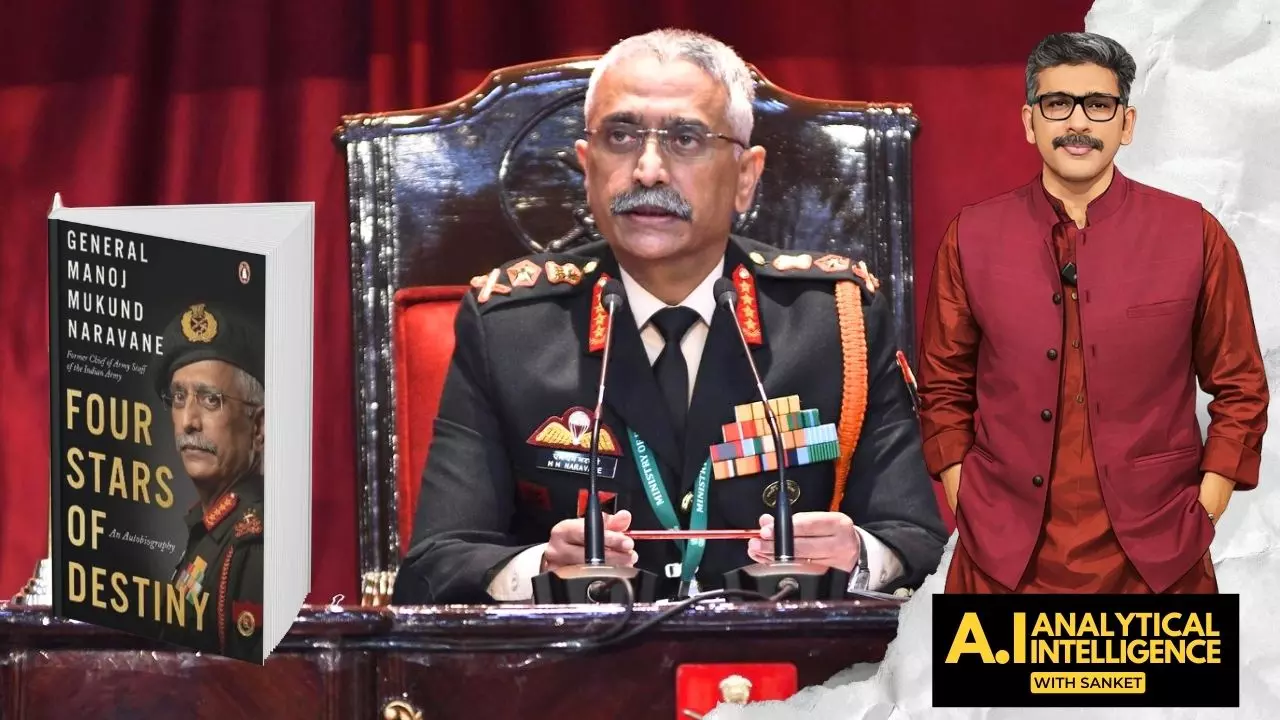
General Naravane's book, scheduled for release ahead of the 2024 Lok Sabha elections, remains unreleased even now, triggering political controversy and institutional discomfort.
Why General Naravane’s silence is raising tough questions
Former Army Chief’s unpublished memoir sparks debate on transparency of decision-making, need for dissent, the delicate balance between security and accountability in a democracy

“Two years is a very long time… the decision has to be taken either this way or that way, but it cannot hang in fire.”
That blunt observation from Major General Sanjay Soi (Retd) summed up the growing unease over former Army Chief General Manoj Mukund Naravane’s unpublished memoir, Four Stars of Destiny. The book, scheduled for release ahead of the 2024 Lok Sabha elections, remains unreleased even now, triggering political controversy and institutional discomfort.
On AI with Sanket, The Federal spoke to defence experts Maj Gen Dr Yash Mor (Retd) and Maj Gen Sanjay Soi (Retd) to unpack the implications of the former Army Chief’s continued silence and the Ministry of Defence’s decision to withhold publication.
The silence debate
The core issue is not merely the book’s contents but General Naravane’s silence amid the controversy.
Host Sanket Upadhyay framed the dilemma sharply: when excerpts of an unpublished memoir enter the public domain and create political uproar, can a “studied silence” from the former Army Chief suffice?
Also Read: With Naravane backing Penguin, Rahul pivots to India-US trade deal
Maj Gen Soi defended Naravane’s restraint.
“Silence means that… as an army man, I would not like to get into any political controversy,” he said.
According to him, since the book has not been officially published, “nobody has the right to discuss it.” He described Naravane’s approach as dignified, and consistent with military ethos.
Agniveer scheme, Galwan crisis
Maj Gen Mor took a broader view. While respecting the individual, he shifted the focus to institutional learning.
“Army chief is army chief… highly respected,” he said, noting that reaching the rank of Chief of Army Staff is rare and historic. Memoirs, he argued, are not just personal narratives but national documents.
“Ninety-five per cent of the book will be his life… which everyone must read, not only defence aspirants but the country as a whole.”
But beyond personal anecdotes, Mor highlighted two critical themes reportedly touched upon in the leaked excerpts: the Agniveer scheme and the Galwan crisis.
Also Read: Delhi police probe global leak of Naravane's memoir before govt clearance
On Agniveer, Mor noted that Naravane allegedly had reservations about the 25 per cent retention model.
On Galwan, he raised a deeper concern: “Very little is known in the public domain… What happened? Why did Colonel B Santosh Babu and 19 other brave hearts lose their lives?”
For Mor, these are not partisan issues but matters of national introspection.
Security red lines
Maj Gen Soi acknowledged the importance of writing, but stressed limits.
“There are certain things which are totally red flags,” he explained — operational plans, strategies, tactics, terrain details, deployment patterns, intelligence matters. Such details, he said, are absolutely restricted.
However, Soi also conceded that two years is excessive.
Also Read: Rahul's speech: Brutal truth or 'bundle of lies'?
“Somewhere… addition or deletion… but the decision has to be taken. Indecision is the worst thing.”
He suggested that if certain portions were sensitive, editing could have resolved the issue, as is common practice with films and books cleared by Army Headquarters.
Decision-making transparency
Mor pushed the argument further, drawing parallels with post-Kargil reforms.
After the 1999 Kargil conflict, India conducted deep institutional introspection, leading to structural reforms including the creation of the Defence Intelligence Agency and eventually the post of Chief of Defence Staff.
“Have we done any study like this on the Galwan crisis?” he asked.
He emphasised that no one is demanding operational secrets. What is needed, he argued, is clarity on higher defence management and civil-military decision-making — the roles of the Chief, Army Commander, Corps Commander, the National Security Adviser, Raksha Mantri, and the Prime Minister.
“These discussions are healthy,” Mor said. “If you want to groom young officers… they need to read our writings.”
Institutional discomfort
The delay has also raised uncomfortable optics.
Upadhyay pointed out that the same Ministry of Defence that trusted Naravane to handle a crisis on the China front now appears unwilling to clear his memoir.
Mor defended Naravane’s integrity, calling it “gold standard". He suggested the onus lies more with the system than the individual.
Also Read: Naravane book FIR: Illegal leak, copyright violation, or coercion? Experts explain
“We must show a large heart,” he said, urging acceptance of dissent and criticism within institutions.
Soi agreed that delaying the publication of the book indefinitely damages credibility.
“You cannot keep it hanging,” he reiterated.
Publisher’s role
The debate also touched upon the role of Penguin, the publisher.
Mor questioned how excerpts reached media platforms if the book was not officially cleared. He suggested that the publisher’s actions deserve scrutiny, arguing that Naravane, the government, and the Army are under the spotlight, but “nobody is saying something about these publishers".
However, Upadhyay countered that sending advance copies for review is standard publishing practice.
The precise circumstances of the leak remain unclear.
Need for discussion
A key question framed during the discussion was whether it would be against national interest for General Naravane to address specific concerns — including alleged pressure during Galwan, China’s salami-slicing strategy, or whether territory was occupied.
Mor’s response was measured.
“That is for him to answer,” he said.
Also Read: As MM Naravane’s memoir sparks interest, his thriller makes it to Amazon bestseller lists
But he stressed that as a nation, India must eventually confront such questions to strengthen its institutions.
The escalation during Galwan, including tank deployments and near-war conditions, marked a historic rupture in India-China military relations. Understanding how the situation deteriorated, Mor argued, is essential for future preparedness.
Morale factor
Underlying the entire debate is morale.
Upadhyay observed that while citizens may doubt politicians or journalists, “this country still loves and respects men in uniform".
If a former Army Chief is seen as being “left hanging out to dry", it could generate sympathy and erode confidence in institutional processes.
Both panellists agreed on one point: the issue has become a needless controversy.
Also Read: FIR filed over circulation of Gen Naravane's unpublished memoir
“I wish we could do without it,” Mor said, urging mature handling of the matter and eventual release of the book in a manner that safeguards national security while preserving the dignity of the office.
For now, General Naravane has limited himself to a brief tweet stating the book’s status. Whether he chooses to speak further remains uncertain.
But as the panel discussion made clear, the debate is no longer just about a memoir — it is about transparency, institutional confidence, and the delicate balance between security and accountability in a democracy.
(The content above has been transcribed from video using a fine-tuned AI model. To ensure accuracy, quality, and editorial integrity, we employ a Human-In-The-Loop (HITL) process. While AI assists in creating the initial draft, our experienced editorial team carefully reviews, edits, and refines the content before publication. At The Federal, we combine the efficiency of AI with the expertise of human editors to deliver reliable and insightful journalism.)