ECI’s internal dissent: What does the law say, and what happens next? | Capital Beat
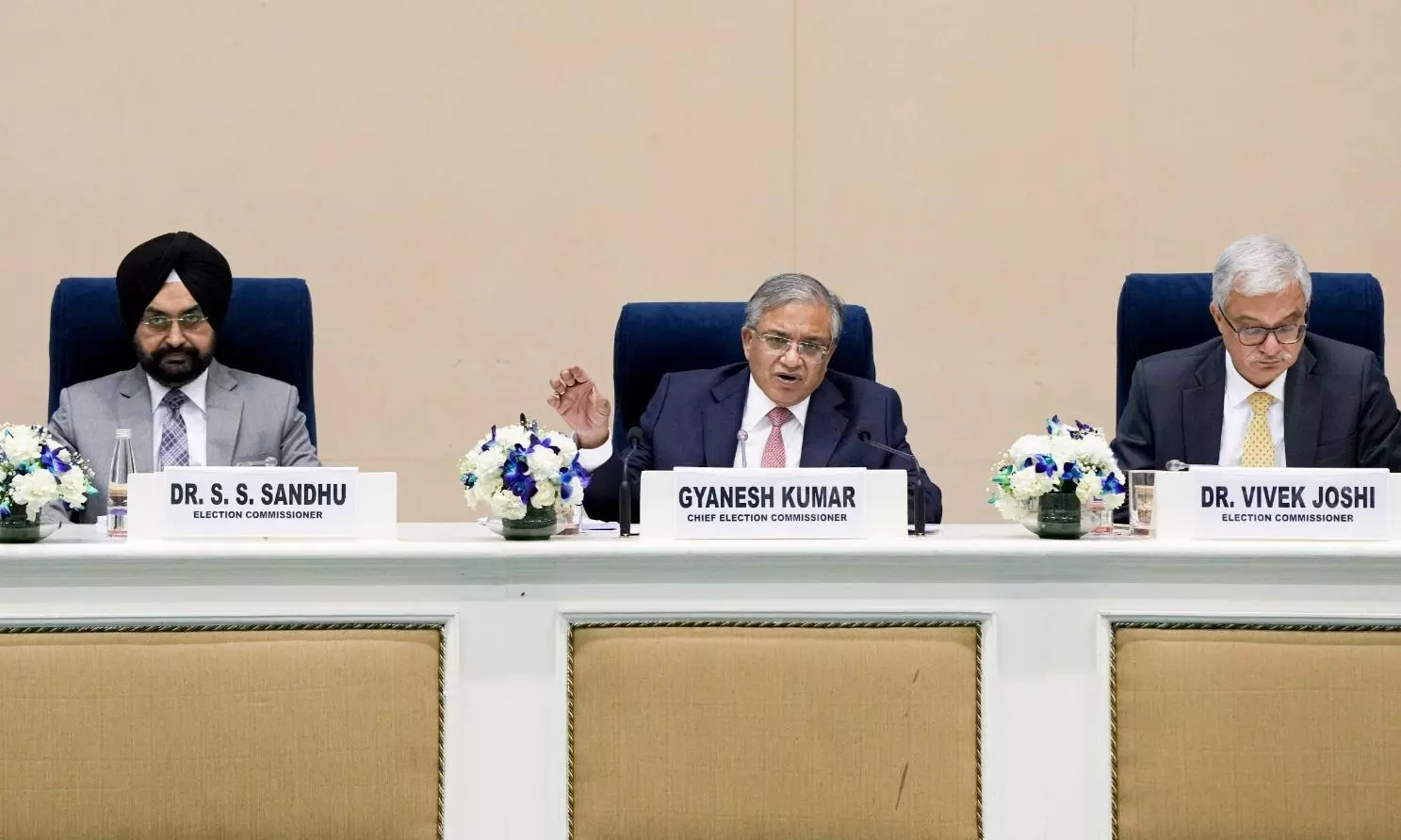
Election Commissioners Sukhbir Singh Sandhu and Vivek Joshi’s objections were related to the addition and deletion of voters, Form 6, and functioning of ECI’s technology systems

The controversy over two Election Commissioners formally objecting to decisions taken by the Chief Election Commissioner has triggered a wider debate over how decisions are being taken within the Election Commission of India (ECI), particularly when two of its three members have recorded objections.
The Opposition parties have called for the Supreme Court’s intervention after an investigative report by The Indian Express highlighted that the two Election Commissioners had formally objected at least 14 times over 10 months to decisions taken without their knowledge.
'Possibility of fresh elections'
In this episode of Capital Beat, constitutional expert and Supreme Court lawyer Sanjay Hegde told The Federal, “If an election were found to have been seriously affected by problems with the electoral rolls, the legal system provides procedures through which the issue could be examined, including the possibility of fresh elections.”
Hegde pointed out that the broader lesson was that constitutional institutions must find a way to restore credibility if public confidence in an electoral process is seriously damaged. He also recalled the political developments of the 1970s, when protests over elections in Gujarat contributed to the ordering of fresh polls.
Also read: EC SIR row: INDIA bloc gets ammunition, but Modi govt may brazen it out
Social activist Tara Rao said the apex court now has an opportunity to examine the questions raised by the investigation. She argued that the issue involves the functioning of a constitutional body and therefore requires scrutiny beyond political statements.
Sandhu and Joshi's objections
The Election Commissioners Sukhbir Singh Sandhu and Vivek Joshi’s objections were related to the addition and deletion of voters, Form 6, and the functioning of the ECI’s technology systems.
Their concerns also extended to ECINet, the Commission’s centralised technology system, including instances in which local election officials were unable to record decisions on the system.
IT expert Madhav Arvind Deshpande said the technology-related questions were significant because electoral databases can potentially interact with other databases. He argued that centralised systems could allow rules to be applied across large datasets and affect millions of records.
Also read: EC denies SIR dissent report; Oppn calls for CEC’s removal, arrest, fresh polls
According to the report, in Goa, 97 voters who had met the requirements before the Electoral Registration Officer were unable to have those decisions recorded because of the software system. It also reported concerns over the centralisation of control over electoral-roll data.
For Deshpande, the larger question is not only technical but constitutional. He said that if electoral rolls change substantially between elections, the authorities and courts would have to address which roll should be considered valid.
Another key concern was the issue of Form 6. The Indian Express report highlighted that a new declaration was added to the form, asking first-time voters whether their names, or those of their parents or grandparents, appeared in an electoral roll from the previous SIR held in the early 2000s. The two commissioners objected to the change, with Sandhu describing it as unauthorised and illegal.
Question of judicial review
Hegde highlighted the concern about how the three-member Commission is expected to take decisions. Referring to the Supreme Court’s earlier ruling in the TN Seshan case, he said the Chief Election Commissioner is the “first among equals” and that decisions of the Commission are to be taken collectively.
According to Hegde, if the two Election Commissioners disagree with the CEC, the issue should be formally placed before the Commission and decided through the prescribed process. He said a decision by the CEC alone cannot be treated as a decision of the Commission.
Also read: Why 2026 Assembly polls were about Opposition vs BJP plus CEC Gyanesh Kumar
He argued that the developments reported make it important for the commissioners to hold formal meetings and record decisions. If that does not happen, he said, such decisions could become subject to judicial review.
SIR debate
The SIR has already become a major point of political and legal contention. Policy expert Pushparaj Deshpande argued that the latest revelations point to what he described as “massive disquiet” within the bureaucracy.
He said the disclosures should prompt scrutiny of how the SIR is being implemented and how electoral institutions are functioning. He also argued that political parties and civil society groups should consider wider forms of mobilisation.