



EC rejects report claiming dissent by Election Commissioners on SIR; Oppn asks SC to take note
An Indian Express report claims that ECs Sukhbir Singh Sandhu and Vivek Joshi flagged ‘arbitrary’ decisions in SIR exercise at least 14 times in 10 months

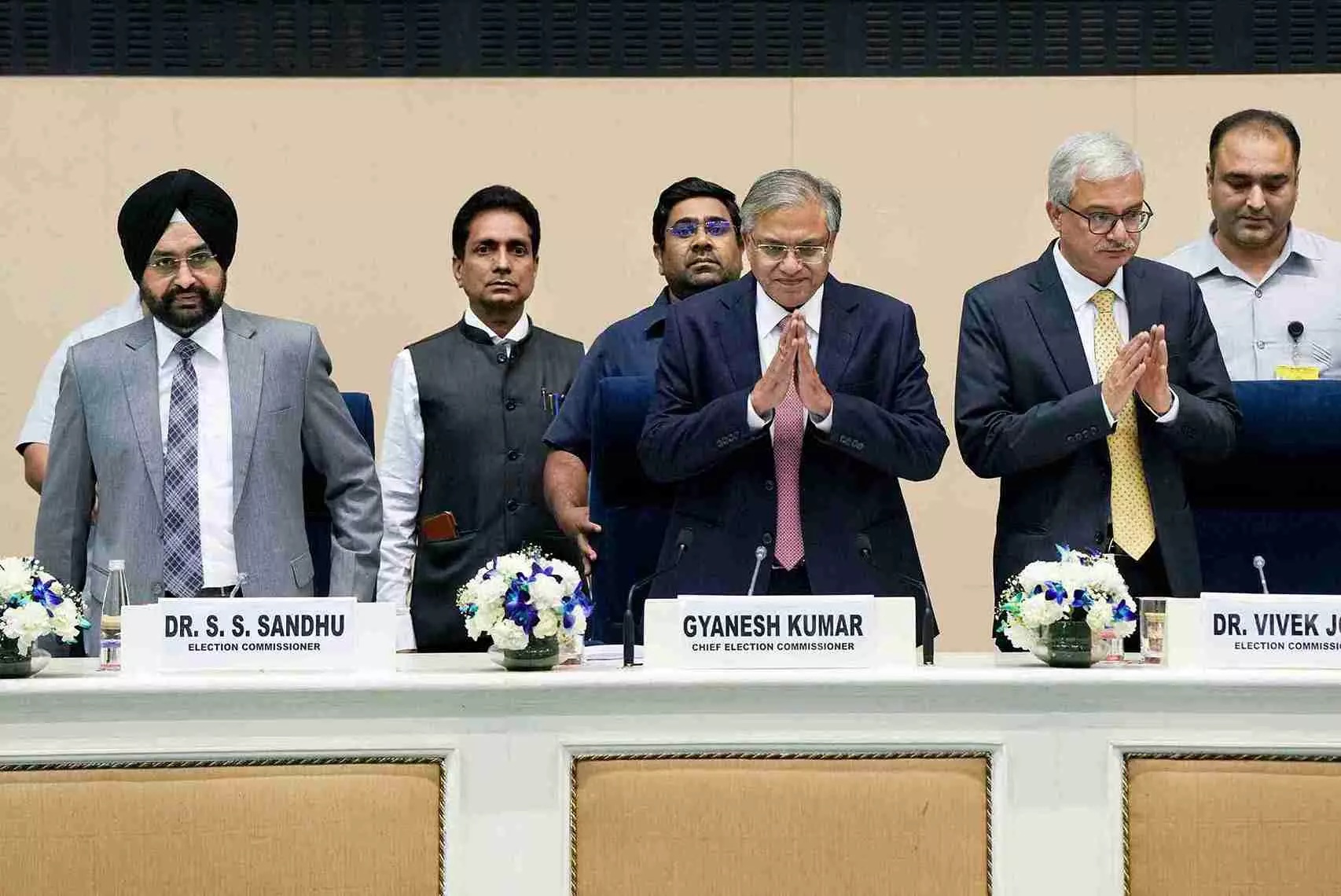
Election Commissioners Sukhbir Singh Sandhu and Vivek Joshi had registered their objections at least 14 times over the last 10 months, including four times in a single day, regarding key decisions related to the Election Commission (EC)’s Special Intensive Revision (SIR) of electoral rolls, which has seen the deletion of over 13 crore voters across the country since it took off last year, says an investigative report by the Indian Express.
The expose has sparked a furore in political circles, with Opposition parties alleging an “arbitrary” functioning of the EC and demanding the Supreme Court to take note of the allegations. The EC in a prompt clarification, has said that even though the two commissioners had flagged decisions related to deletion of voter names in various states, all final decisions of the commission have been unanimous and taken with the approval of both the Election Commissioners and the Chief Election Commissioner (CEC).
ECs decry “unauthorised” decisions
According to the IE report the objections by the two Election Commissioners pertained to new voter registration, deletion and restoration of voters in the rolls, filing of appeals against orders restoring voters in the SIR exercise, and the custody and security of the entire electoral roll itself.
In one of the objections, the IE report says, Election Commissioner Sandhu complained that the commission acted against his and Joshi’s advice in an “unauthorised and illegal” manner.
The two commissioners also recently wrote separate letters to the Cabinet Secretary complaining about changes in work allocation which they alleged removed a “layer of oversight of the IT backbone for the electoral rolls”. They asserted in their letters that these changes have been implemented without their knowledge and that they had struck them down, the IE report said.
Contentious Form-6 question
The SIR exercise which began in June 2025 in Bihar, as a routine clean-up of voter rolls, ended up deleting names of over 13 crore voters with Bihar and Maharashtra witnessing maximum deletions.
Form-6, which citizens are required to fill to be listed as voters under the SIR, popped up a new question in July this year – it asked if the new voter or their parents/grandparents “exist” in the “electoral roll of last SIR.” Applicants who didn’t know the answer couldn’t finish filling up the form without answering the question.
The IE report says that the question was included in Form-6 even though Joshi in May had warned that a file in the form could not be changed arbitrarily without the government amending the rules. Sandhu had seconded him.
Sandhu in August had called this change “unauthorised and illegal” and recommended its immediate removal.
Who asked to file appeals seeking voter deletions?
The SIR was conducted in West Bengal in the run up to the Assembly polls that saw the BJP wrest power from the TMC and secure a historic win. The exercise saw deletion of the names of 91 lakh voters from electoral rolls in the state. The EC last week told the Supreme Court that 38 lakh appeals were pending before the tribunals of which 22.21 lakh were filed by deleted voters.
However, the other 16.10 lakh appeals were filed seeking deletion of names of voters who were included by judicial officers.
Sandhu in August had flagged the latter type of appeals, asking commission officials who authorised them to file these appeals on behalf of the EC, the IE report says.
He mentioned in the letter that neither he nor Joshi nor the current Chief Electoral Officer of West Bengal had been informed about the basis or process of filing the appeals.
‘Centralisation’ of electoral roll database
In the 10-month period, both the election commissioners have repeatedly flagged the inability of the Electoral Registration Officers (ERO) – statutory authorities on the ground, responsible for preparation and control of a constituency’s voters’ list – to access the software ERONet and its succesor ECINet where the list is uploaded and maintained whether their access to the list has been restricted, the IE report said.
According to the report, Joshi in May this year had alleged the “gradual centralisation of the electoral roll database” while proposing an audit to certify that “no one, except the concerned statutory authorities, had credentials to make any change in the (voter) database.”
A similar allegation was made by Sandhu in August, where he claimed that state-level election officials were reporting that they “don’t have proper and complete access” to the ERONet portal.
Can CEC make unilateral decisions?
This bring us to the question – is the Chief Election Commissioner powerful enough to make unilateral changes even if the two commissioners disagree?
The answer is no. Article 324, under which the commission has been constituted, gives equal powers to the CEC and the two commissioners. The CEC, at best, is the first among equals and does not have the power to decide alone.
Section 18 of the Chief Election Commissioner and Other Election Commissioners (Appointment, Conditions of Service and Term of Office) Act, 2023, says that all business of the commission “shall, as far as possible, be transacted unanimously.” It says that if the commissioners differ in any way, the matter “shall be decided according to the opinion of the majority.”
All decisions unanimous: EC
Reacting to the IE report and the resultant criticisms against the EC, the commission has said that even though Sandhu and Joshi had flagged multiple issues, including deletion of names, in various states during the voter roll cleanup, the poll body was unanimous in its decisions related to SIR.
Responding to queries, EC officials on Wednesday (September 23) said law governing the functioning of the EC and a Supreme Court judgment underline that as much as possible, decisions should be taken unanimously and if need be, majority view should prevail.