



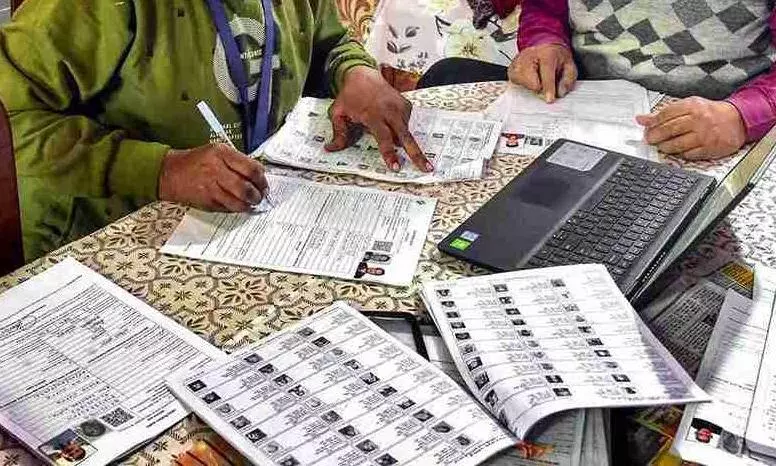
The Chief Election Commissioner has made it clear that no software will be used to flag duplicates in Phase 2 of the SIR, now underway across 12 states. In contrast, the West Bengal election authority has signalled it may introduce Artificial Intelligence-based verification during the revision exercise. File photo
EC to SC: Scrapped ‘ineffective' deduplication software, 'manual search superior'
EC said it scrapped software strongly endorsed in March 2023, claiming computer-based detection was variable in accuracy; relies on citizens not to register twice

Even as Parliament decided to debate on electoral reforms, the Election Commission of India (ECI) appears to have done a key turnaround in connection with its deduplication software deployed to weed out duplicate entries in its ongoing nation-wide Special Intensive Revision (SIR), describing it as “ineffective” and "flawed".
The electoral body also claimed that it found the software so bad that it has scrapped it.
In a counter-affidavit in the Supreme Court on November 24, 2025, the ECI told the apex court that its deduplication software was so bad it discontinued its use after 2023, and has not deployed it in the nation-wide SIR that began in Bihar in June 2025.
Sharp reversal
Notably, an article in The Reporter’s Collective highlighted that this admission is in sharp contrast to the confidence the ECI had reposed in the software in 2023. At that time, the ECI had directed officials across the country to run the software in ‘campaign mode’ across the entire voter roll to identify duplicate entries ahead of the 2024 Parliamentary elections.
In fact, the ECI’s 2023 Manual for electoral rolls emphatically endorsed the use of deduplication software in “campaign mode”, the report pointed out. Curiously, the ECI’s 2023 manual, binding on election officials, remains in force and has not been withdrawn, reported Ayushi Kar for The Reporters’ Collective.
This means the software that was strongly endorsed in March 2023 was abandoned just months later, ostensibly because it proved deeply flawed.
Also read: What nation wants to know as govt, Opposition debate electoral reforms
Telling the court that it has permanently discarded the software, the ECI told the court, “The strength and accuracy of the results were variable and large numbers of suspected DSE (demographically similar) entries were not found to be duplicates. The said technology was last used in 2023.”
The ECI further told the court that its approach in the Bihar SIR, relying on citizens to avoid registering twice, was more reliable than computer-based detection, which it dismissed as a “random search by software”.
2018 software
In 2018, ECI had introduced a new software that used machine learning to identify duplicate entries. This software was also available to state election officials as well, incorporated into ECI’s IT interface for Electoral Officers, called ERONET.
According to ECI’s presentations, the application could flag suspect entries that were demographically similar, could even catch duplicate names, relatives’ names, addresses, and ages, and even cross-check photographs on voter IDs (EPIC) to zero in on potential fraud and duplication.
The software was deployed multiple times during annual voter list revisions. However, by the time the SIR was announced, the ECI had quietly discontinued its use.
Bihar experience
Although the SIR exercise was touted as a way to “completely purify” voter rolls, local officials in Bihar told The Reporters’ Collective they were relying on voters to self-report or on booth-level officers to manually detect duplication.
The Bihar experience has, however, shown that there are several duplicate entries remained on the rolls used in the recently concluded assembly elections.
Also read: Govt sets December 9-10 debate on electoral reforms amid SIR logjam
In court, the ECI argued that voters were required to declare they held only one voter ID when filling out the SIR enumeration form. Any false declaration, it said, would make the individual liable under the Representation of the People Act.
But the Bihar’s SIR manual process failed because the ECI’s system assumes voters will be truthful when filling out enumeration forms, even if they previously created duplicate voter IDs.
Instead, duplication checks are left to booth-level officials or Electoral Registration Officers (EROs), who only have access to rolls at the booth or constituency level. They cannot cross-check against millions of voters across the state, let alone identify those registered in multiple constituencies.
Clearly, manual checks are insufficient, the report stated.
According to The Reporters’ Collective and ADR, Bihar SIR failed to detect duplications ranging from half-a-million to nearly 1.5 million.
No software
For the SIR, however, the commission opted for a rushed month-long process without providing any baseline list of suspect voters.
Also read: 5.5 lakh votes polled in 2024 LS elections were not counted, claims ADR report
Despite this, the Chief Election Commissioner has made it clear that no software will be used to flag duplicates in Phase 2 of the SIR, now underway across 12 states. In contrast, the West Bengal election authority has signalled it may introduce Artificial Intelligence-based verification during the revision exercise.
According to sources close to the West Bengal CEO’s office, the report stated that the AI tool would help detect cases where the same photograph has been used to register multiple voters. At the latest hearing, the ECI told the court it was open to adopting technological tools wherever they proved most effective and was working to improve existing systems.
However, no audits or public disclosures of these tools are available, nor has the ECI outlined the process it follows to decide when such technologies will be deployed, concludes the report.
Several questions remain, however, over the scrapping of this software. For one, when did the EC arrive at this decision after endorsing it earlier, and why did it not issue a press note on this?