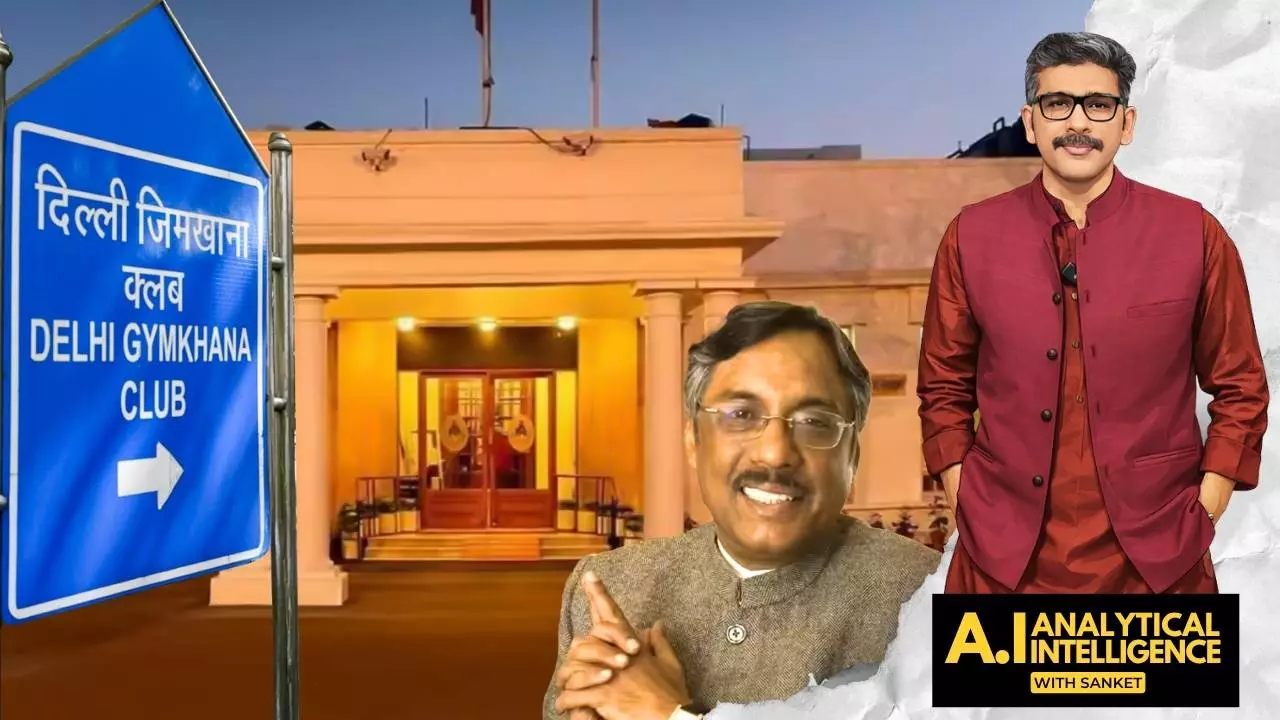
Delhi Gymkhana Club debate: 'Should MPs' bungalows also go?' | AI With Sanket
Former diplomat and ex-MP Pavan Varma says if the Gymkhana Club is the beginning of a larger mission against inequality and elitism, then the govt should certainly proceed, but it should not stop with one target alone

“Why target only the Gymkhana Club? If elitism and subsidised land are the yardsticks, then the entire Lutyens’ Delhi zone should be examined,” former Rajya Sabha MP and diplomat Pawan Verma said while reacting to the Centre’s move against the Delhi Gymkhana Club.
The 113-year-old Delhi Gymkhana Club has found itself at the centre of a political and public debate after the government asked it to vacate its premises in central Delhi. Critics argue that the club symbolises colonial-era elitism and enjoys prime public land and subsidised facilities, while supporters say it is a heritage institution that should be reformed, not dismantled.
In this episode of AI With Sanket, The Federal spoke to Pawan Verma, who is also a member of the club, about the controversy, elitism, colonial hangovers, and whether the government is selectively targeting one institution.
What are your opening comments on the government’s move against the Delhi Gymkhana Club?
The government is the unquestioned landlord of all leased land, and it unquestionably has the right to recover that land. Let us accept that as the basis.
But in the case of the Gymkhana Club, the government has acted somewhat peremptorily, with very short notice, to take it over entirely on grounds of security and public good.
My only question is that perhaps there should be greater transparency about how public good is being served by taking over an institution that is more than a century old. It is in that context that I felt this matter requires reconsideration.
What do you say to the argument that the club represents elitism?
The argument of elitism has not officially been given as the reason to take over the club, but perhaps it could be a motivation. The club does stand as a colonial institution and there is little doubt that it was initially, and perhaps even now to some extent, an English-speaking elite bastion where membership is difficult to obtain.
It stands on very expensive land, and yes, a relatively small number of people use a large amount of space. That may be a concern in the eyes of some people.
Also Read: Delhi Gymkhana Club row: 'Public purpose isn’t govt’s will' | Interview
But if elitism is the argument, then what exactly is elitism? All clubs and many institutions operate on the basis of inclusion and exclusion. You see signs outside restaurants too saying "rights of admission reserved". In premier institutions, some level of exclusion exists. You have to qualify to become a member.
You can question the criteria. You can say there should be greater democratisation. But all clubs operate on the basis that some belong and some do not. The Gymkhana Club has done that as well.
How is the club structured in terms of membership?
The way Gymkhana Club was initially conceived, and even today by its structure, 50 per cent of membership is reserved for civil servants and armed forces personnel, serving or retired. The remaining 50 per cent is open.
Yes, because it is a premier institution, there is a long waiting list, so the elite tag becomes more pronounced. But that may not be an inherent feature of the club.
In fact, the club could expand, but there has been a freeze on increasing membership, which I believe was imposed by the courts. Otherwise, many more members could have joined.
Like all matters of supply and demand, when demand exceeds supply, the premium attached to membership rises.
If elitism is the issue, should the same standard apply elsewhere too?
That is precisely my point. If elitism is to be applied as the standard for public good, then why stop at the Gymkhana Club?
Why not examine the entire Lutyens’ Delhi zone? Here you have ministers, MPs, judges, bureaucrats, senior military officers, and others living in sprawling bungalows occupying three to five acres for one family.
Also Read: Delhi Gymkhana Club moves High Court against Centre’s eviction order, hearing tomorrow
This is happening in a city where nearly 50 per cent of Delhi has officially been designated as slums.
If the idea is redevelopment for social good, then by all means take over the Gymkhana Club. But apply the same principle uniformly across a zone where expensive land could perhaps be used more optimally for the public.
Are there other elite institutions that should then also come under scrutiny?
Certainly. Why target only the Gymkhana Club?
You have the India International Centre next to Lodhi Gardens. You have the India Habitat Centre. You have the Delhi Golf Club. You have the Defence Services Officers Institute at Dhaula Kuan, which is also a golf course occupying dozens of acres. You have the Air Force Club. You have the Constitution Club in the heart of Delhi.
All these institutions are based on some degree of exclusivity.
I say this not only because I am a member. Let me disclose the fact that my father was also a member. But there are things in the club that deserve reform. I have myself criticised the somewhat insular attitude of the club.
You mentioned you personally experienced that insular attitude. What happened?
I was once stopped from entering because I was wearing formal Indian attire — starched white pyjamas and a silk kurta. I was asked to add a Jawahar jacket, while I saw others in jeans, gola shoes, and T-shirts being allowed in.
I strongly objected to this. I summoned the club secretary. At that time, I was just a junior officer in the Foreign Service.
Also Read: Delhi Gymkhana Club eviction: Bulldozing the ballroom
The then club president, Admiral Tahiliani, later wrote to me agreeing with my point of view, and the dress code rules were revised.
In a country like India, with such sartorial diversity, there are many definitions of formal wear. You cannot simply insist on colonial definitions of acceptable dress.
Do you believe the club still carries a colonial hangover?
Yes, certainly. Many colonial-era clubs carried deeply discriminatory practices.
The Bengal Club in Kolkata did not allow Indian presidents until 1959. It took seven more years after that for an Indian to become its president. In Bombay too, there were clubs where signs effectively read "Dogs and Indians not allowed". All this needed to change.
When I visited Tollygunge Club, I was again stopped for wearing what I considered formal Indian attire — a silk kurta and pyjama.
These attitudes must evolve further. The club can include more programmes celebrating Indian culture and civilisation. I fully agree that the colonial hangover requires scrutiny because colonisation is not only about physical subjugation, but also colonisation of the mind.
Do you think there was a culture where fluency in English influenced acceptance?
All this needs to go. I have written about this in my book Becoming Indian: The Unfinished Revolution of Culture and Identity.
But despite all these shortcomings, I still believe that if public good is the objective, then the government must define it more comprehensively.
Unless public good and security are clearly defined, why single out this institution?
What about the security concerns raised due to the club’s proximity to the Prime Minister’s residence?
As far as the Prime Minister’s residence is concerned, several committees had previously examined whether the Gymkhana Club posed a threat. None of them found it did. Moreover, the Prime Minister himself is shifting from there.
So I believe the government could still preserve this venerable institution while introducing changes through dialogue and transparency.
Critics say the club survives on subsidised land, cheap food, and subsidised alcohol for the super elite. Why should that continue?
Also Read: Delhi HC issues summons over Delhi Gymkhana Club takeover, Centre assures due process
The land is leased land, and thousands of institutions function on leased land for public purposes.
Public spaces are also part of a city’s landscape.
Take Lodhi Gardens, for example. It is a remarkable public park that deserves preservation. But largely, who uses it? People from surrounding elite neighbourhoods.
If you begin applying the logic of subsidised benefit, then you must ask — what is not subsidised?
These colonial bungalows in Lutyens’ Delhi today stand on astronomical land values, yet people continue to occupy them with sprawling gardens while paying nominal amounts. So should MPs and ministers also give up their bungalows if the same logic is applied? I think so.
If the Prime Minister’s vision is of a more egalitarian India — and I fully support that vision — then it cannot end with one symbolic gesture. You cross the Ring Road and see congestion, overcrowding, lack of water and public space. Yet within the privilege zone of Lutyens’ Delhi, there is enormous space and greenery.
Also Read: Delhi Gymkhana Club eviction order triggers panic, uncertainty for 600 employees
If you paid market rent for those bungalows, half the corporate world would want them.
I know ministerial bungalows with mini golf courses. MPs who have occupied such homes for years have converted them into epitomes of luxury. When I was a member of Parliament, I too was allotted a lovely bungalow on Amrita Sher-Gil Marg opposite Lodhi Garden. What I paid, compared to its actual value, was certainly subsidised.
So if subsidised privilege is the concern, then apply the principle uniformly.
Do you believe the Gymkhana Club has become a soft target?
Yes, that is my concern. If you genuinely want to reduce inequality, then that is a laudable objective. But do not take one soft target without dialogue and transparency.
There should be discussion about what exactly the government wants and whether there can be a middle path instead of a binary choice between demolition and survival.
Why do you think only the Gymkhana Club has been singled out?
I cannot claim to know the government’s motivations beyond what has officially been stated.
But one thing is clear to me — the elitism associated with the Gymkhana Club is hardly comparable to the parallel elites that exist elsewhere in India. There are clubs like Chambers, Belvedere, or the Camellias Club in DLF that ordinary people cannot even dream of accessing.
Yes, the government can increase subscriptions, reduce subsidies, demand better financial management — all of that is possible. But to say the alternative is complete extinction is too extreme.
Do you believe inequality in India is the larger issue here?
Absolutely. Today, one per cent of India owns 40 per cent of the GDP. Mumbai itself is officially around 50 per cent slum.
At the same time, there are enormous mansions and displays of wealth that ordinary people can only stand outside and look at — with both envy and hope.
Also Read: Imperial days to eviction: All you need to know about Delhi's Gymkhana Club
This inequality is real. It needs to change.
My only point is this: if the Gymkhana Club is the beginning of a larger mission against inequality and elitism, then certainly proceed. But do not stop with one target alone.
(The content above has been transcribed from video using a fine-tuned AI model. To ensure accuracy, quality, and editorial integrity, we employ a Human-In-The-Loop (HITL) process. While AI assists in creating the initial draft, our experienced editorial team carefully reviews, edits, and refines the content before publication. At The Federal, we combine the efficiency of AI with the expertise of human editors to deliver reliable and insightful journalism.)