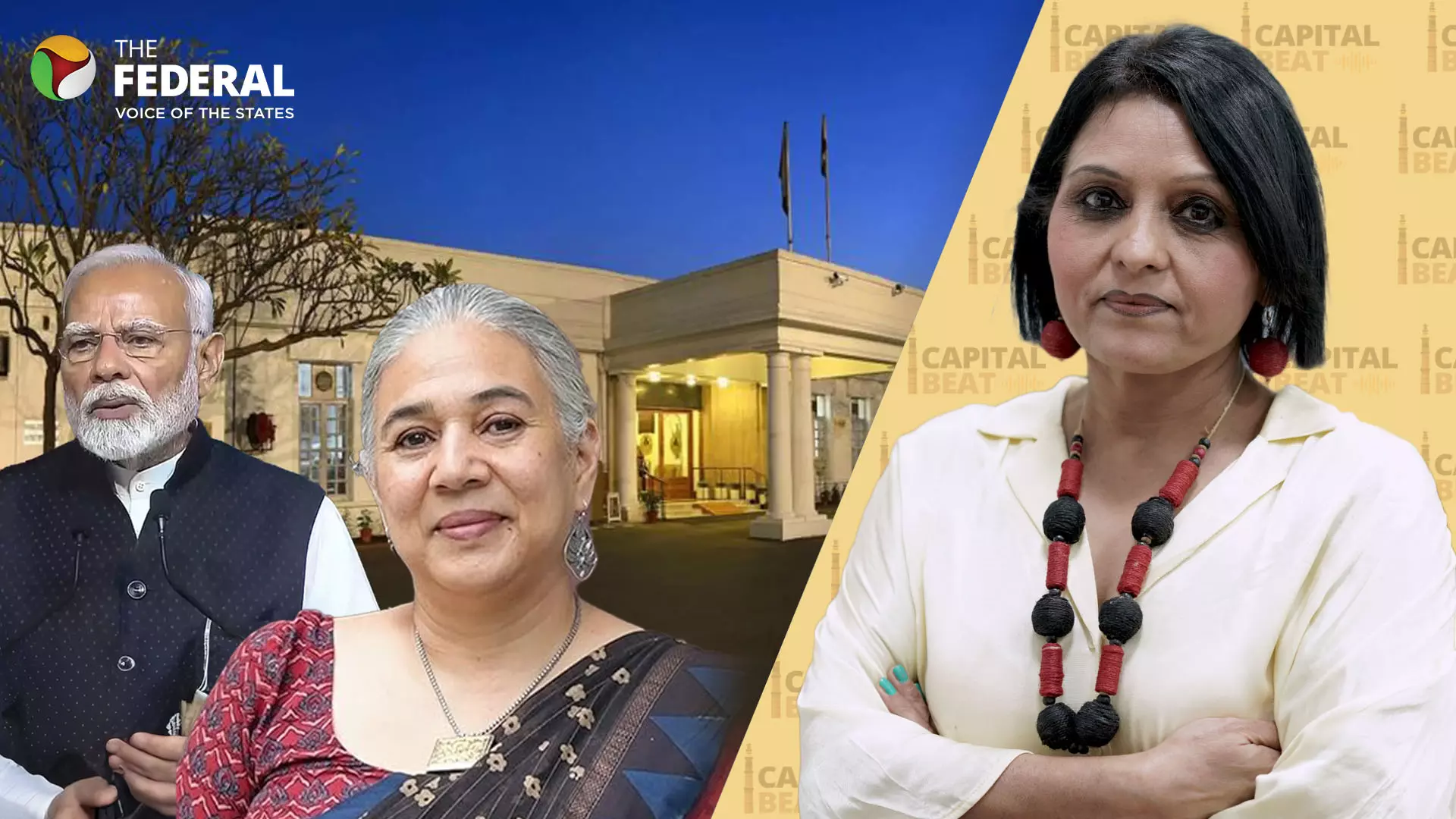
Delhi Gymkhana Club row: 'Public purpose isn’t govt’s will' | Interview
Historian Swapna Liddle says heritage, green spaces, and public dialogue must matter in the Delhi Gymkhana Club controversy

Even as the Centre assured the Delhi High Court that no forcible eviction of the Delhi Gymkhana Club would take place and due process would be followed, the larger debate over heritage, privilege, public access, and redevelopment continues to intensify.
Also read: HC sets aside stay on eviction notice to Delhi Race Club
In this episode of Capital Beat, The Federal spoke to Swapna Liddle, Indian historian and author, about the historical significance of the club, the debate over elitism versus preservation, the environmental implications of redevelopment, and whether institutions like the Delhi Gymkhana Club need reform instead of displacement.
Do you see the court’s observation as a respite for the Delhi Gymkhana Club?
Yes. As a historian, I like to start at the beginning.
The club was formed in 1913 and was intimately linked with the transfer of the capital from Calcutta to Delhi. When Delhi became the capital of India, a huge bureaucratic apparatus also got located here. Initially, the club itself was located in the Civil Lines area, which functioned as the temporary capital.
Later, when what we today call the NDMC area started getting constructed, this particular building was also built. Construction happened mostly through 1928, and in 1929, the club opened here. So, it has a historic background to it.
But I would also like to say that its historic character has not been unchanging. After Independence, important changes came about. Even before Independence, Indians had started being admitted to the club. Initially, it was a very British elite club, but Indians started being admitted.
Another important change was that after Independence, the name changed from the Imperial Gymkhana Club to the Delhi Gymkhana Club. Heritage changes. Institutions evolve.
Also read: Delhi Gymkhana Club eviction: Bulldozing the ballroom
People argue that if the Gymkhana Club is being questioned over privilege, then many other institutions in Lutyens’ Delhi should also be examined. Is that a valid argument?
Yes, that is a very valid argument.
When we talk about privilege, mere membership of a club is automatically being equated with privilege. We should examine that more carefully. There are retired Army officials, bureaucrats, and others associated with the club. Yes, if you compare them with the broader population of the country, there is privilege. But as you rightly said, there is privilege in the Lutyens’ bungalows as well.
There is a lot of nuance here.
But another issue that we must talk about is that we are not only discussing the institution of the club. We are also talking about its buildings and campus, which are part of its heritage.
The campus and buildings are protected heritage structures under the Delhi building bylaws’ heritage clause. The NDMC notified them as heritage buildings in 2010. There is a gazette notification to this effect. So this is legally recognised heritage.
And when we talk about the campus, we are also talking about a large number of trees and green open spaces. That matters greatly today.
As somebody interested in heritage, I am not only interested in individual buildings. I am deeply interested in the NDMC area as a whole.
Do you see this as an attack on civic legacy?
Yes, of course.
But let me put it differently. It is easy to dismiss New Delhi as merely colonial heritage. But it has not been colonial for a very long time. The British lived in this city for a relatively short period. For much longer, this has been the capital city of independent India.
The NDMC heritage area plays a very important role within Delhi today. Yes, it houses bureaucrats, ministers, and major government institutions. But it also houses important cultural institutions, sports institutions, and public spaces.
The Gymkhana Club has significant sports facilities. Similarly, the Golf Club and other institutions are important to the city even today. They have a long legacy but also contemporary relevance.
More importantly, we should resist the temptation to keep redeveloping parts of New Delhi repeatedly. This is a very green area in the middle of our city.
But the government says the land is needed for public purpose, possibly even for a defence-related project. How do you counter that argument?
That is why I am talking about the environmental and green value of these spaces.
The NDMC area has large, mature trees that are crucial for a city dealing with pollution and rising temperatures. Every old tree that we cut down adversely affects these outcomes.
We have seen that redevelopment projects in the NDMC area have often led to tree loss. If you look at Kidwai Nagar redevelopment, Nauroji Nagar redevelopment, and similar projects, more and more trees were cut down.
Is there any indication that redevelopment here would be different? I have my doubts.
Even if we only look at heritage value, natural heritage, and environmental impact, preserving these spaces makes sense.
Vir Sanghvi argued that if privilege is the issue, then ministers in Lutyens’ bungalows should also be questioned. How much of this controversy is driven by propaganda?
Many of the points he makes are valid.
It becomes easy to attack a club because it is seen as a privileged space. Then people start asking: what about the Golf Club, what about Chelmsford Club, and so on?
If there is a policy concern, then there should be a well-thought-out policy.
If the concern is access and privilege, then perhaps institutions like the Gymkhana Club could become more open. Maybe some facilities could be made accessible to more people. It has a wonderful library, event spaces, and sports facilities.
Perhaps there can be different tiers of membership so that more people can benefit from those facilities.
Institutions can be questioned and reformed. That is possible.
Does this controversy suggest that the government is uncomfortable with club culture itself?
I would not be in a position to say what the government thinks.
But even if you look at those aspects, the Gymkhana Club is a very benign space. It is not as though there is something deeply seditious happening there.
I feel rhetoric around privilege becomes very convenient in such cases. The more prominent a place is, the easier it becomes to make sweeping pronouncements about it.
Do you think the controversy will die down, especially after the court proceedings?
Legally, people like Abhishek Manu Singhvi are best placed to comment.
But I want to focus on the idea of “public purpose”. Have we become so conditioned that we think public purpose simply equals the government’s will?
That cannot be the be-all and end-all of public purpose.
Who is the public involved in this process? What conversations have taken place about how this institution could better serve the public?
There has not even been a debate about how this space can be used more effectively for the public good. It becomes easy to simply say that because the government wants it, it automatically becomes public purpose.
How do you view the larger debate around elitism and exclusivity associated with the club?
I am not fully familiar with all the internal controversies and membership rules.
But institutions evolve. Heritage does not mean institutions cannot change. Institutions must evolve and respond to society.
So yes, reforming the club, revisiting policies, and making it more inclusive are worthwhile conversations.
But these changes should happen through dialogue, not government fiat.
These institutions may have originated in a colonial context, but they have changed over time and can continue changing.
Should there be a wider audit of clubs and heritage institutions in the area?
I would not leave that entirely to the government.
There are public issues involved, certainly. But the government should take broader public opinion into account. That includes members, potential users, experts, and other stakeholders.
How do you see the government’s intervention in this matter?
The government may be looking at it from a narrow legalistic perspective — that this is leased land and therefore can be taken back.
Governments can sometimes legally do things. But the more important question is: should they do it?
That is where my objection lies.
There are also concerns over the livelihoods of around 600 employees and uncertainty for nearly 14,000 members. How significant is that aspect?
That is absolutely significant.
This idea that everyone associated with the club is elite is a myth. Yes, there are retired bureaucrats and Army officials. But for many of them, this is a social space in a city where social spaces are extremely expensive.
These are people who spent their careers in government service, not in the private sector. Private sector professionals can often afford other kinds of spaces more easily than someone living on a pension.
Relocating the club far away would fundamentally affect its viability and character.
If the club is shifted to somewhere like Ghaziabad, would that effectively end this culture?
Yes, certainly. It would have a huge impact and it would not really remain viable in the same way.
(The content above has been transcribed from video using a fine-tuned AI model. To ensure accuracy, quality, and editorial integrity, we employ a Human-In-The-Loop (HITL) process. While AI assists in creating the initial draft, our experienced editorial team carefully reviews, edits, and refines the content before publication. At The Federal, we combine the efficiency of AI with the expertise of human editors to deliver reliable and insightful journalism.)