



Congress says India cannot 'pollute its way to prosperity', seeks year-round action
Jairam Ramesh says rising pollution must not be price for growth, cites studies showing air pollution is linked to rising deaths in India

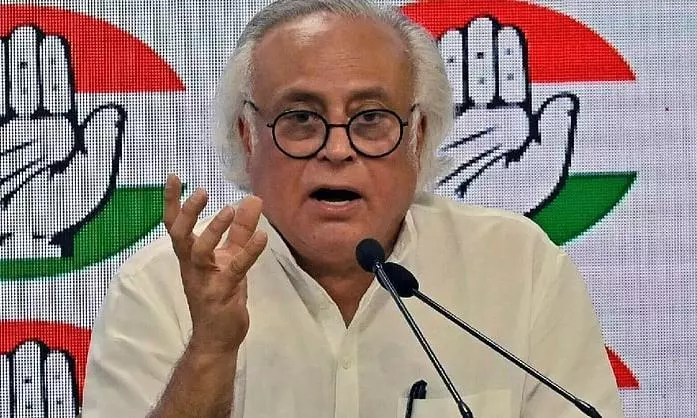
Asserting that India simply cannot afford to pollute its way to prosperity, the Congress on Monday (December 15) said rising pollution need not — and must not — be the price citizens are forced to pay for accelerated economic growth.
Also Read: Toxic smog blankets Delhi, AQI hits season's worst at 431
The Opposition party also emphasised that the Graded Response Action Plans (GRAPs) should not remain the primary focus of clean-air initiatives.
Year-round action to curb pollution
In a statement, Congress general secretary (communications) Jairam Ramesh said these plans are largely reactive, placing greater weight on crisis management rather than preventing a crisis altogether.
"We need tough multi-sectoral actions with scale and speed round the year and not just in the winter October-December months," Ramesh said.
On December 9, the Modi government declared in the Rajya Sabha that "there is no conclusive data available in the country to establish direct correlation of death/disease exclusively due to air pollution", he said.
"This is the second time that it has shown shocking insensitivity by denying that air pollution contributes to mortality or morbidity. It had previously made the same claim on 29th July 2024 also in the Rajya Sabha," Ramesh said.
Air pollution deaths rising
The most recent publicly available scientific evidence reveals that in early July 2024, a study published in the prestigious Lancet journal showed that 7.2 per cent of all deaths in India are associated with air pollution — about 34,000 deaths each year in just 10 cities.
The evidence also reveals that in August 2024, a study by the Mumbai-based International Institute of Population Sciences used government data from the National Family and Health Survey (NFHS V) to show that in districts where air pollution exceeds National Ambient Air Quality Standards (NAAOS), there is a 13 per cent increase in premature mortality for adults and around 100 per cent increase in mortality for children, Ramesh said.
Also Read: India sets own norms, says global air quality rankings carry no official sanction
"In December 2024, a study published in The Lancet Planetary Health estimated that long-term exposure to polluted air contributes to roughly 15 lakh additional deaths in India each year compared with a scenario in which the country met the World Health Organization's (WHO) recommended safe-exposure limits," he said.
In November, a report prepared by the Institute of Health Metrics and Evaluation at the University of Washington, USA found that about 2 million deaths in India were linked to air pollution-a 43 per cent jump since the year 2000, Ramesh said.
PM 2.5 levels exceed WHO guidelines
About 70 per cent of chronic obstructive pulmonary disease deaths were on account of air pollution, the Congress leader said. The National Ambient Air Quality Standards (NAAQS) were last promulgated in November 2009 after wide consultations, Ramesh said.
"They were considered progressive then. But today it needs to be updated and, more importantly, ruthlessly enforced. The present standard for PM2.5 is 8 times the WHO guideline for annual exposure and 4 times the guideline for 24-hour exposure," he said.
Also Read: Why Delhi moms across economic and social groups are losing out to a common fear
Despite the launch of the National Clear Air Programme (NCAP) in 2017, PM2.5 levels have continued to rise and every single Indian lives in areas where these levels far exceed the WHO guidelines, he said, adding that the NCAP itself needs an overhaul.
"The Graded Response Action Plans (GRAPs) cannot remain the dominant focus of clean-air action. These plans are essentially reactive, with the emphasis being on crisis management and not crisis avoidance," Ramesh said.
Delhi smog turns severe
"We need tough multi-sectoral actions with scale and speed round the year and not just in the winter October-December months. The Air Pollution (Control and Prevention) Act, 1981 that was more than adequate for four decades now, may itself need to be revisited since a public health emergency was not the background to the enactment of that law," he said.
Also Read: Stubble burning drops over 90 per cent in Punjab, Haryana; Delhi air improves
The National Green Tribunal (NGT) established in October 2010 by an Act of Parliament with the support of all political parties has, sadly, been emasculated over the past decade and needs a fresh and renewed lease of life, Ramesh claimed.
He said emission norms that have been relaxed for power plants and other changes made in laws and regulations need to be rolled back.
"India simply cannot afford to pollute its way to prosperity. Increased pollution need not and must not be the price the people of the country are compelled to pay for faster growth," Ramesh said.
Delhi choked under a thick blanket of smog on Monday, with the Air Quality Index (AQI) settling at 498, which falls in the higher spectrum of 'severe' category.
(With agency inputs)