



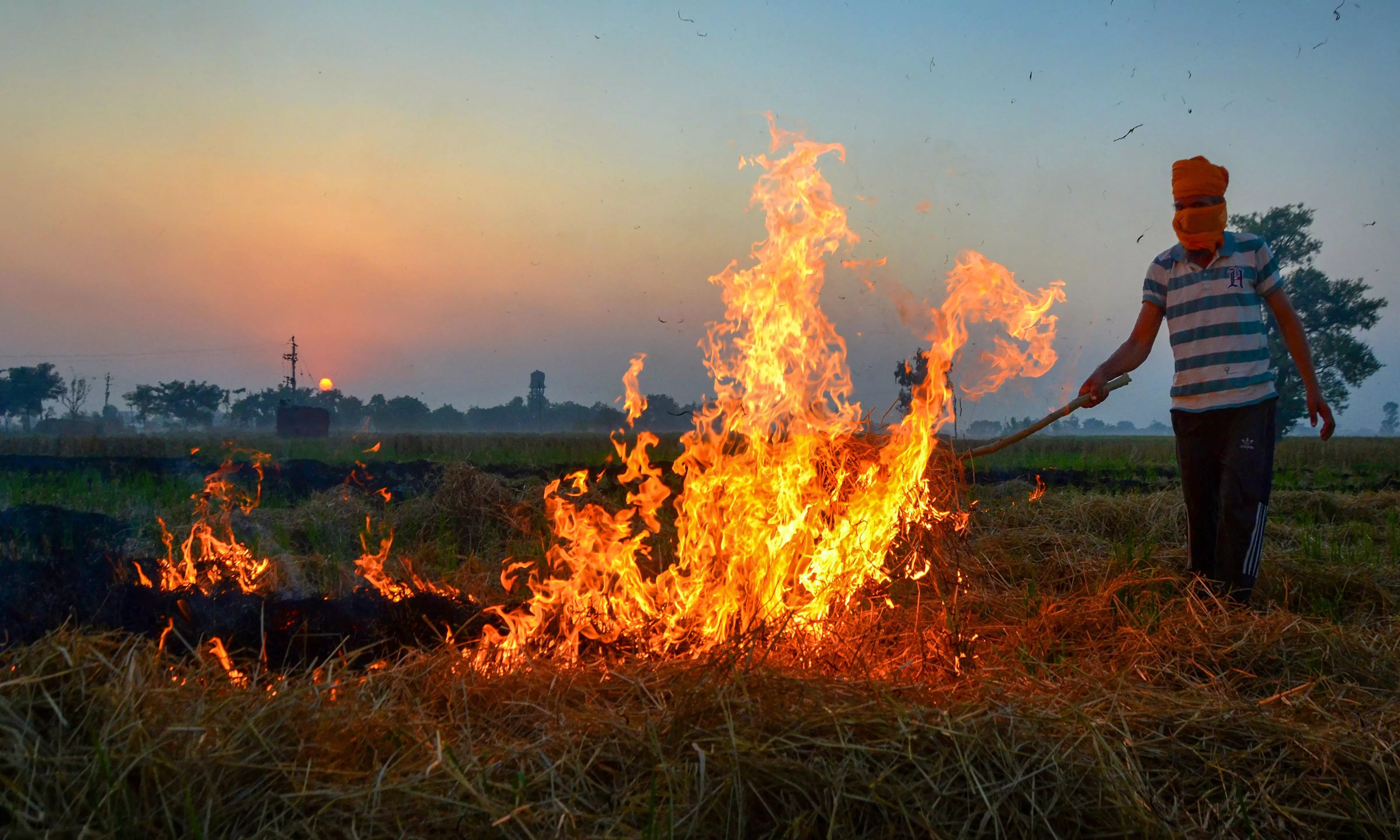
Stubble burning drops over 90 per cent in Punjab, Haryana; Delhi air improves
Punjab and Haryana recorded a sharp drop in stubble burning, leading to clearer skies and better air quality in Delhi-NCR

Stubble burning has sharply decreased in Punjab and Haryana this year, with data from the Commission for Air Quality Management (CAQM) showing that Punjab recorded 5,114 farm fire cases in 2025, a 93 per cent dip compared to 2021, and Haryana reported 662 cases, recording a 91 per cent decrease. This has led to clearer skies and better air quality in the Delhi-NCR region.
57 per cent drop in paddy straw burning
A 57 per cent drop from 42,962 cases in 2023 to 18,457 in 2024, in paddy straw burning has been recorded in satellite data from the Consortium for Research on Agroecosystem Monitoring and Modelling from Space (CREAMS) laboratory.
Also Read: Delhi’s air quality nears ‘severe’ mark as pollution crosses 400 in several areas
According to a government statement, several districts showed significant improvement. While Sangrur reported a 60 per cent drop, with 693 cases in 2025, Ferozepur saw a 59 per cent reduction, and Muktsar a 55 per cent reduction in stubble burning incidents.
Tarn Taran, with 685 farm fires, and Bathinda ,with 368, also registered a significant decline in cases compared to previous years.
Situation in Haryana
As for Haryana, most cases were from Jind (47), Fatehabad (28) and Kaithal (27). With fewer farm fires, Delhi-NCR's air quality improved significantly.
The number of days with an Air Quality Index (AQI) below 200 increased from 110 days in 2016 to 200 days in 2025, according to data.
Also Read: Delhi in ICU, green crackers just a greenwash: Environmentalist Vimlendu Jha
According to experts, the improvement is the result of government policies, awareness among farmers, use of new farming methods and private-sector initiatives, the statement said.
Waste-to-energy firms are helping farmers use crop residue to produce renewable power instead of burning it in the fields, it added.
Centre for Science and Environment study
The reduction in stubble burning in Punjab and Haryana was earlier highlighted in a study by the Centre for Science and Environment (CSE). The assessment notes that crop-residue fires were “significantly subdued,” partly due to flood-related disruptions in the crop cycle.
Also Read: Punjab records 484 stubble burning cases, Tarn Taran tops list
For most of the early winter period, farm fires contributed less than 5 per cent to Delhi’s pollution levels. On certain days, the share rose to 5-15 per cent, peaking at 22 per cent on November 12-13, but remained far below the extreme intrusions recorded in earlier years.
According to the CSE analysis, the sharp reduction in stubble-burning incidents helped prevent severe pollution spikes, even though it did not substantially improve daily air quality in Delhi. With fewer agricultural fires in the region, winter pollution was shaped overwhelmingly by local sources.
PM2.5 remains the dominant pollutant
PM2.5 remained the dominant pollutant, followed by PM10, ozone and CO, underscoring the heavy influence of traffic emissions, industry, waste burning and domestic fuel use.
Despite reduced firecracker pollution and a lower farm-fire contribution, overall air-quality trends showed minimal progress, revealing the limited impact of stubble-burning reductions when local emissions continue at high levels.
(With agency inputs)