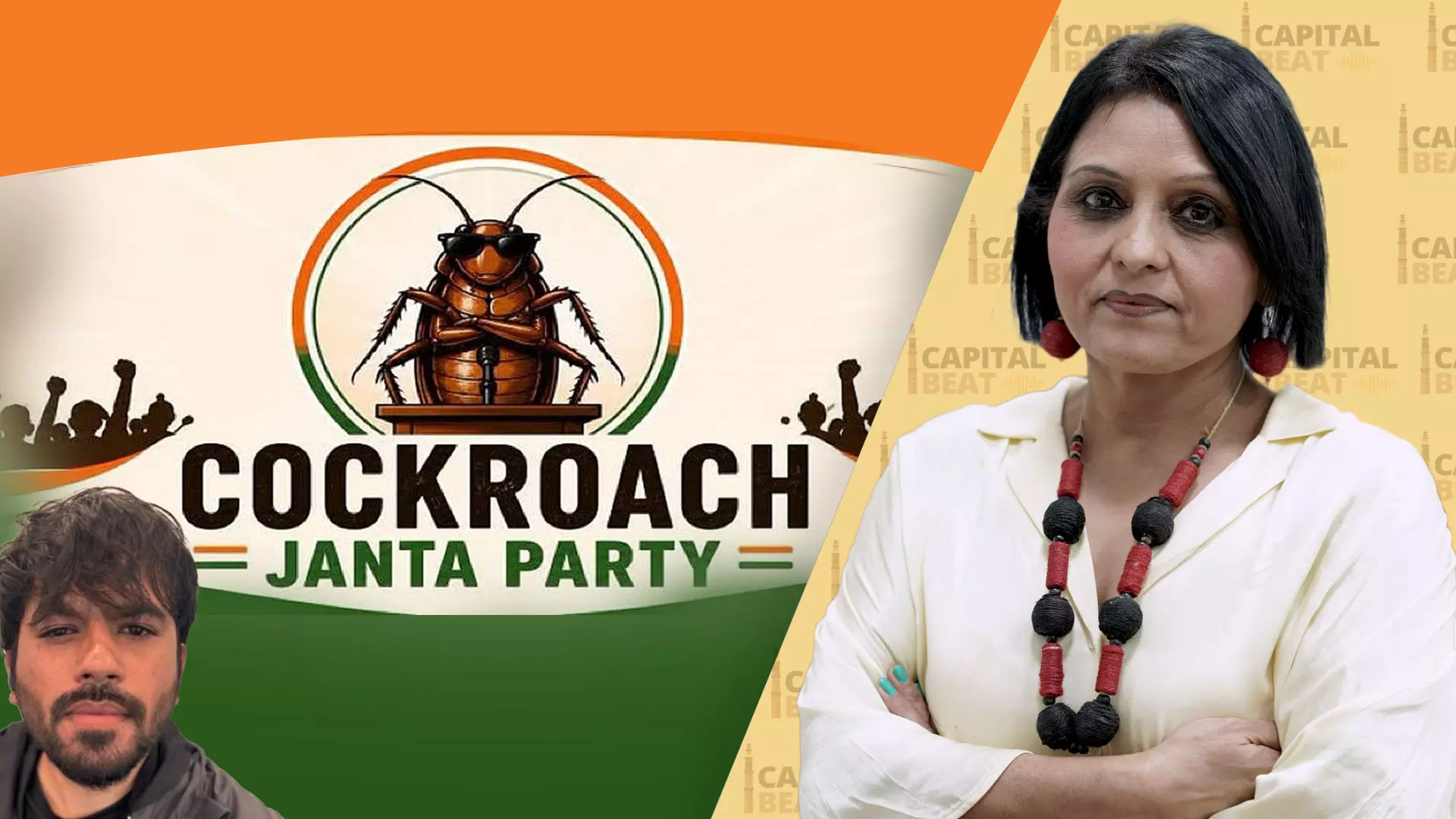
Cockroach Janata Party: How a satire became Gen Z’s latest political movement | Capital Beat
From meme to movement, how an impulsive social media post evolved into a viral political phenomenon with over 40,000 members

In this episode of Capital Beat, The Federal spoke to Abhijeet Dipke about how an impulsive social media post evolved into a viral political phenomenon, why Gen Z is resonating with it, and whether the movement could eventually move beyond the internet.
Did the idea for the Cockroach Janata Party come immediately after the CJI’s remarks, or was this something already in the works?
To be honest, there was no planning at all. It was completely impulsive and instinctive. The moment the CJI made the remark, the idea came up. We never anticipated this kind of response. Today we have more than 45,000 members, and in my wildest dreams I never expected something like this.
Also read: Amid row over CJI remarks, TMC MPs Mahua Moitra, Kirti Azad join ‘Cockroach Janta Party’
It has been overwhelming. For the last 48 hours, I’ve barely slept because I’ve been responding to people who want to engage with us or join us. This kind of support cannot be created artificially. It is completely organic and unprecedented.
How exactly did the idea take shape?
I stay chronically online. When the CJI made the comment, I simply tweeted from my personal account: “What if all the cockroaches come together?”
That tweet received around 700 to 800 reposts, mostly from Gen Z users and college students. Everyone started saying, “We should come together.” That made me feel there was an opportunity to do something creative and funny. Initially, it was never meant to become a movement or a political platform.
Many people see the Cockroach Janata Party as a meme or parody account. But your manifesto and membership criteria seem unusually detailed. Is this really just satire?
It is dark humour based on the current political situation in India and the condition of institutions.
If you look at the judiciary, there are serious questions being raised about its credibility and neutrality. We repeatedly see retired judges receiving government posts after retirement. Naturally, people begin to question whether there is a quid pro quo arrangement.
Similarly, when we talk about “Godi media” or channels owned by large corporate houses, India’s press freedom ranking speaks for itself. The concern is that much of the media no longer represents citizens but instead represents governments and corporations.
Also read: How TN poll campaign turned performative in battle to attract Gen Z voters
So yes, the comments were satirical, but they were also addressing deeper issues that people genuinely feel strongly about.
Several prominent names, including politicians and lawyers, seem to be engaging with the movement. Who has joined or supported the platform so far?
We’ve been followed by more than 20,000 people on Instagram alone. Prominent lawyer Sanjay Hegde has followed us. Historian Ramachandra Guha has also engaged with the platform.
Politicians like Kirti Azad and Mahua Moitra have publicly welcomed the idea. Several journalists and activists are also supporting us.
We are thankful because this platform is meant for the youth, and young people have long felt ignored by mainstream politics.
Do you think this could evolve into a larger youth movement?
We definitely hope so. It started as a joke, but it is no longer a joke. The kind of response we’re receiving shows that people are looking for a platform.
We want to channel this energy into political awareness and encourage young people to become more politically active and informed.
Some people are comparing this to movements like India Against Corruption in 2011. Do you see similarities?
One similarity is public frustration. The India Against Corruption movement emerged because people were deeply frustrated with the government at the time.
Also read: Deleted Gen Z op-ed triggers backlash and political debate in Pakistan
Today, after more than a decade of the current government, many people are again frustrated and looking for change. If that frustration didn’t exist, we would not have seen tens of thousands of people joining overnight.
You now have a website and social media platforms. Are you planning to expand further?
Yes, we are planning to expand onto YouTube and other platforms as well. The goal is to engage with people wherever they are active online.
Is there an organisation behind this, or are you operating alone?
Initially, it was just me. Two close friends helped me build the website. There was no organised group behind this.
But after the first tweet went viral, many people from different backgrounds started reaching out. Now, we are planning to create a volunteer structure so that members can actively help run the movement.
You’ve said all you need today is a smartphone and Wi-Fi to build resistance. Is that why the phone is your proposed election symbol?
Exactly. Today, a smartphone and internet connection are enough to express dissent and organise people. That is why our election symbol would be a phone.
Are you seriously considering contesting elections in the future?
It’s too early to say. We’ll see how the movement evolves. Right now, it’s premature to discuss electoral politics.
What was your reaction to Justice Surya Kant’s clarification on his remarks?
I found the clarification problematic as well. Since when does someone need a formal degree to express an opinion? The Constitution gives every citizen the right to speak.
When the Chief Justice says people with fake or bogus degrees are spreading opinions online, it raises troubling questions. Does that mean people without formal education are lesser citizens?
India still has a massive rural population that may not have access to higher education. Does that mean they cannot criticise the system or participate in public discourse? That logic is dangerous.
Also read: Then Bangladesh, now Nepal: How youth is pushing out regimes in South Asia
You also spoke about the rise of social media-driven politics. Did Tamil Nadu actor-politician Vijay’s campaign influence your thinking?
Absolutely. Politics is changing because technology is changing. The way voters consume information has transformed.
Traditional media is losing ground, while platforms like Instagram and YouTube are becoming primary sources of information. Vijay’s campaign showed that social media can shape political narratives very effectively.
Do you think future elections could be decided almost entirely online?
Yes, I think social media will increasingly shape public opinion.
In 2014, Facebook played a major role. By 2019, Instagram became more influential. Tomorrow it could be another platform entirely. But one thing is clear: traditional media is no longer the only force shaping public opinion.
Do you believe mainstream political parties are still struggling to adapt to this new reality?
Traditional parties still carry legacy systems and established methods. They continue to rely heavily on rallies, press conferences, and television coverage.
But newer movements have the flexibility to experiment digitally. Vijay demonstrated that a new political entrant can build enormous momentum online without relying on traditional campaign structures.
You’ve said you expect resistance or even coercive action against the movement. Why?
Because anyone who speaks against the system eventually faces consequences. We have seen that pattern repeatedly.
Given the kind of response we are getting, we fully expect there could be attempts to suppress or discredit us.
Would you ever align with an opposition party or accept support from political parties?
We will not align with any political party, especially not the BJP.
If opposition leaders want to support us publicly, that is fine. But we are not interested in becoming attached to any existing party structure. The idea is to create an independent platform for young people.
What is the next step for the Cockroach Janata Party?
The next step is to directly engage with our members. We want to ask them what issues matter to them, what kind of politics they want, and what future they envision for India.
Based on that feedback, we will decide our roadmap.
If this eventually becomes a serious political outfit, would you consider changing the name “Cockroach Janata Party”?
No. We are not changing the name.
The youth connect with it. The word “cockroach” symbolises resilience and survival. If that is how the system sees us, then why not own that identity?The content above has been transcribed from video using a fine-tuned AI model. To ensure accuracy, quality, and editorial integrity, we employ a Human-In-The-Loop (HITL) process. While AI assists in creating the initial draft, our experienced editorial team carefully reviews, edits, and refines the content before publication. At The Federal, we combine the efficiency of AI with the expertise of human editors to deliver reliable and insightful journalism