







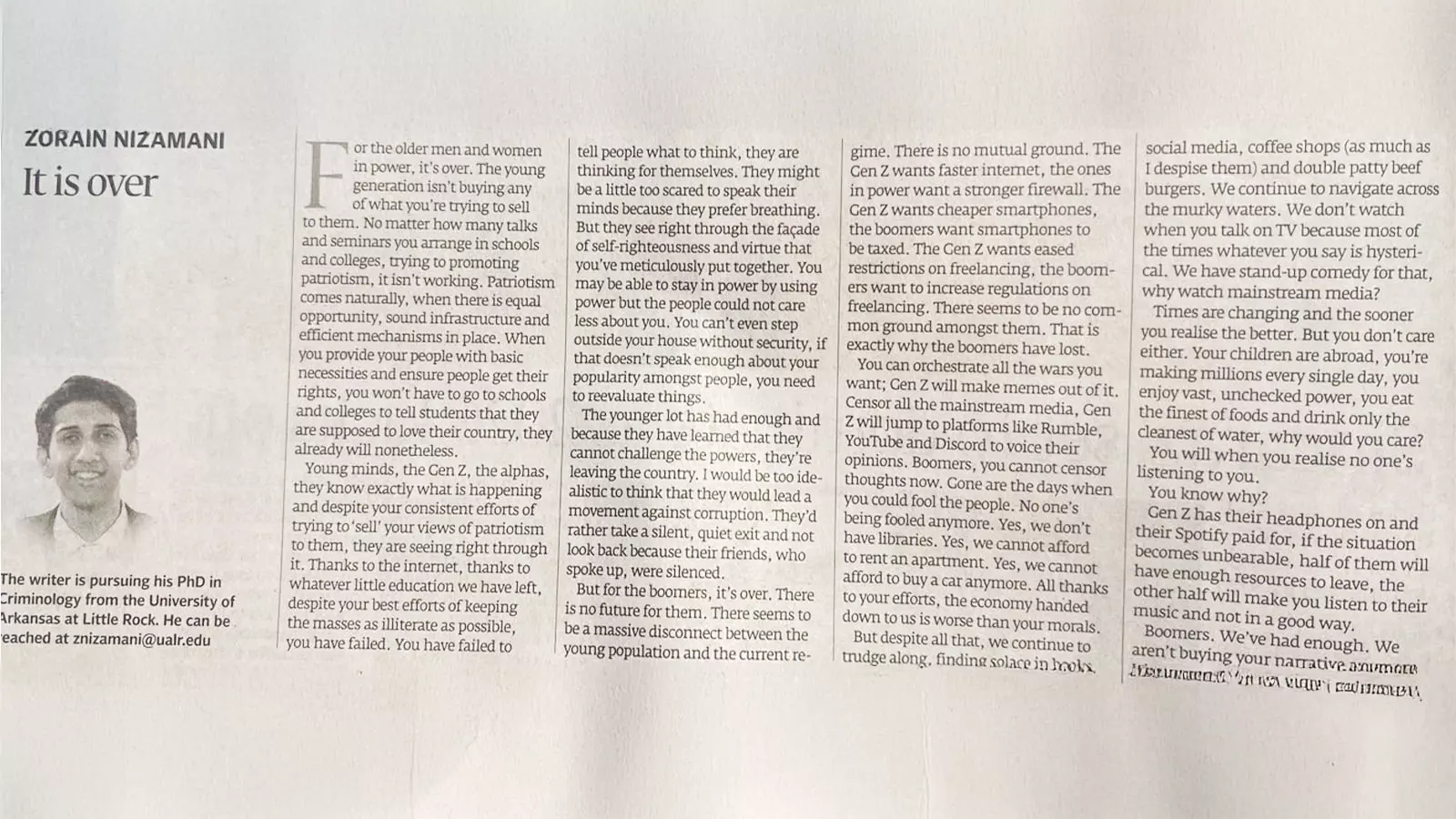
Deleted Gen Z op-ed triggers backlash and political debate in Pakistan
The op-ed titled 'It is over', which argued that the youth are weary of state-led patriotism campaigns, was removed amid alleged military pressure

A now-deleted article on Generation Z sentiment has triggered a storm in Pakistan. The removal of the piece, published in the prominent Pakistani daily The Express Tribune on January 1, has sparked widespread controversy.
Also Read: Gen Z fury over education reforms sparks PoK protests against Sharif govt
The article divided opinion across the country, with many praising it for articulating the sentiments of Gen Z, while critics dismissed it as an “overrated perception”.
Gen Z op-ed sparks controversy
The flashpoint was an op-ed by a young Pakistani academic arguing that the country’s younger generation (Gen Z) has grown weary of taking orders from entrenched power structures.
Titled It is over, the article was written by Zorain Nizamani, a Pakistani PhD scholar based in the United States. The piece was taken down within hours of publication, allegedly following pressure from Pakistan’s military establishment.
The removal of the op-ed, widely believed to have been ordered by the army, provoked online outrage, with Nizamani quickly being hailed by supporters as a “national hero”.
Screenshots of the article soon circulated widely on social media, as Pakistanis accused the state of censorship and rallied behind Nizamani, the son of actors Fazila Qazi and Qaiser Khan Nizamani.
Patriotism cannot be imposed
In the article, Nizamani, who is pursuing a PhD in criminology at the University of Arkansas at Little Rock, argued that Pakistan’s ruling elites have lost their grip over the country’s younger generations.
He wrote that repeated state-sponsored lectures, seminars and campaigns aimed at promoting patriotism no longer resonate with young people.
“For the older men and women in power, it’s over. The younger generation is not buying what you are trying to sell. No matter how many talks and seminars you organise in schools and colleges to promote patriotism, it isn’t working,” he wrote.
Also Read: The rumbling rage that erupted on Nepal's streets: Deep dive into Gen-Z protests
Without explicitly naming the army, Nizamani argued that patriotism cannot be manufactured through speeches or slogans, but develops naturally when citizens are given equal opportunities, reliable infrastructure, functioning systems and guaranteed rights.
“Patriotism emerges when there is equal opportunity, sound infrastructure and efficient mechanisms in place. When people are provided basic necessities and their rights are protected, there is no need to tell students they must love their country, they already will,” he wrote.
Frustrated youth
The article focused heavily on Gen Z and Gen Alpha, asserting that these generations are acutely aware of political realities.
“Young minds, Gen Z and the Alphas, know exactly what is happening. Despite repeated attempts to ‘sell’ a version of patriotism, they see through it. Thanks to the internet and whatever little education remains, efforts to control public thinking have failed,” he wrote.
Nizamani further argued that increased access to information has weakened traditional methods of shaping public opinion, with frustration among young people reaching a tipping point.
“The younger generation has had enough. Having learned they cannot challenge entrenched power, many are leaving the country. They choose a quiet exit rather than speaking out, having seen what happens to those who did,” he added.
Takedown triggers outrage
The takedown of the article prompted a strong backlash across Pakistan’s political and media circles.
The Canadian wing of former Prime Minister Imran Khan’s Pakistan Tehreek-e-Insaf (PTI) said the removal of the piece only reinforced its argument that forced patriotism no longer works.
“Zorain Nizamani’s article It is over being removed only confirms its truth. University talks and forced patriotism have failed. Gen Z sees corruption, inequality and hypocrisy clearly. Without justice, jobs and dignity, propaganda collapses. Old control methods are dead—the youth have moved on,” the party said in a post on X.
Threat to free expression
Pakistani activist Mehlaqa Samdani wrote that the article’s disappearance from The Express Tribune’s digital edition was “exactly the kind of censorship” the author had warned against.
“He is right. It really is over for those who believe they can continue to get away with such crude tactics,” she added.
Also Read: Imran Khan slams ‘military-style trial’, seeks mass uprising after 17-year jail verdict
Former Pakistani minister Moonis Elahi described the article as a “reality check for the generation shaping policy”.
Pakistan’s Human Rights Council also criticised the takedown, calling it a troubling sign of shrinking space for free expression.
“The removal of Zorain Nizamani’s column from The Express Tribune is a regrettable example of the increasing restrictions on freedom of expression in Pakistan,” the council said, adding that it amounted to a violation of constitutional rights and journalistic freedom.