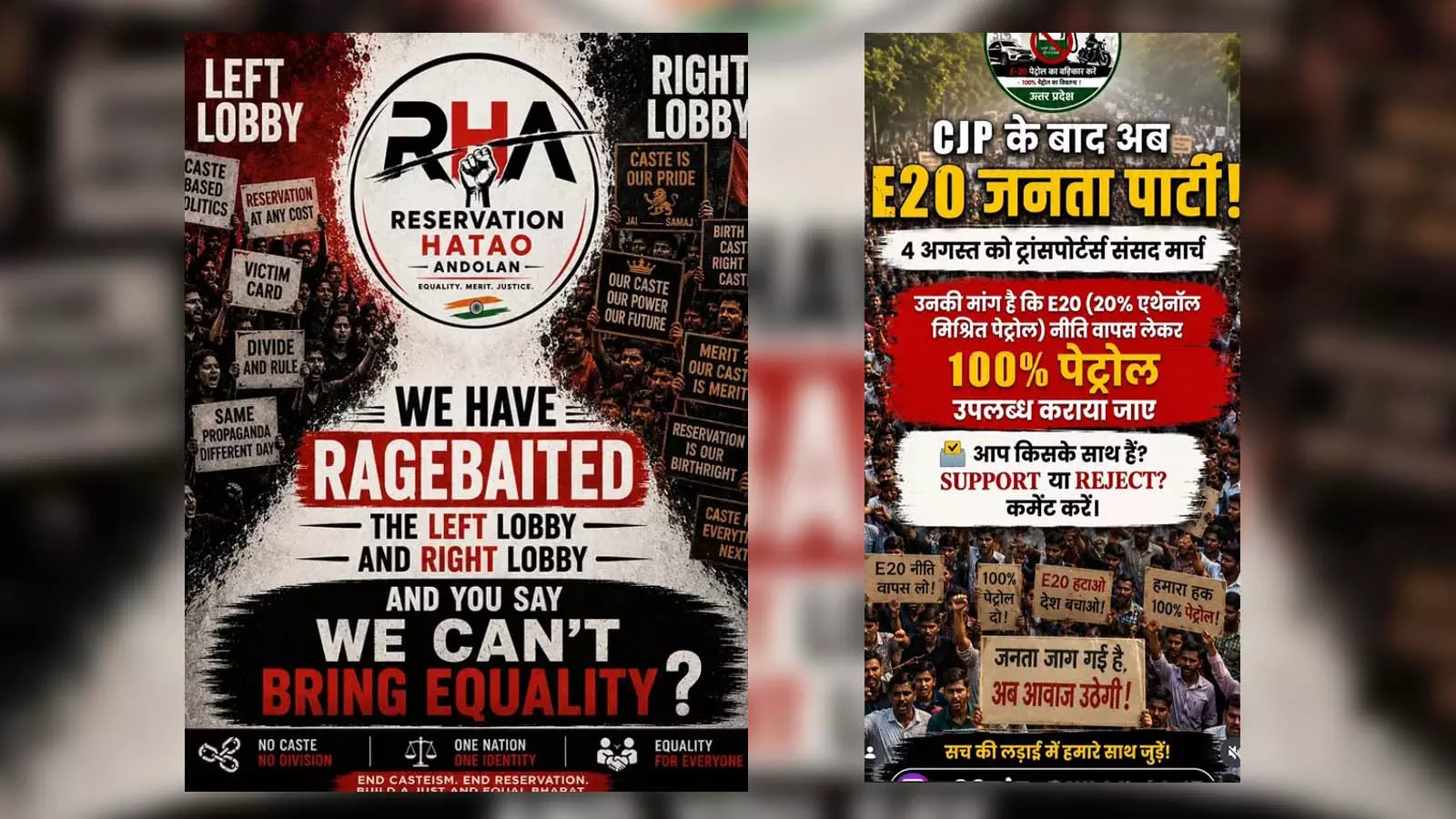
Take the case of new movement, 'E20 Janta Party', which is targeting an issue that has triggered a lot of debate of late – ethanol-blended fuel. This online group, which has picked up 100,000 followers in a matter of days, is even seeking transport minister Nitin Gadkari’s resignation.
Another handle 'Reservation Hatao Movement', which appears to be a still-developing online movement, has quickly picked up traction with 4.3 million followers.
Its core demands are ending caste-based reservation, removing caste identity from public life, and replacing it with what it frames as equal treatment for all citizens. Claiming to be a purely-citizen led movement, experts say, it's probably the modern Instagram-native version of the 1990 anti-Mandal protests, but has got a boost with the CJP's youth mobilisation playbook. The CJP became an overnight sensation as their youth protest drew a massive response around the country and led the BJP-led government to agree to their demands.
Inspired by CJP protests, similar campaigns are emerging online.
What E20 Janta Party wants
A non-political movement, E20 Janta Party has launched an online campaign demanding the right to choose the petrol of their choice.
With fuel stations now selling only E20, users say they've lost the option to choose — and that's exactly what this new "Janta Party" wants back.
Targeting Union transport minister Nitin Gadkari's ethanol-blended petrol initiative that has drawn mixed reactions in the country, the social media pages of ‘E20 Janta Party’ are getting noticed and followed by many, though the identity of its founder remains a mystery.
They claim to be a people-powered movement demanding transparency, accountability, and the right of every Indian to know how the E20 (20 per cent Ethanol Blended Petrol) policy affects their vehicles, wallets, and consumer rights, the group said in another post on microblogging site X.
E20 fuel is a blend of 20 per cent ethanol and 80 per cent petrol, promoted to cut crude oil imports, lower vehicle emissions, and support farmers. However, there is not enough clarity on the damage it can cause vehicles, the higher risks older models, lower fuel efficiency, and high water usage for crop production.
Choice to buy the fuel we want
Its demand is simple: it is not seeking subsidies, free fuel or a rollback of ethanol-blended petrol — only the choice to buy the fuel they prefer. It wants government to bring back 100 per cent petrol as an option alongside the government-mandated E20 ethanol blend.
The humour masks real frustration. With fuel stations now selling only ?E20, consumers say they've lost the choice altogether — and getting it back is the movement's entire platform. Borrowing CJP's meme-driven playbook, E20 Janta Party is betting that satire, once again, can force the government's hand.
Protest march
A separate account of the same name, with around 28,000 followers, announced a Parliament March on August 4 — with taxi, tourist, and commercial vehicle owners from across India, led by Sanjay Samrat, gathering to protest E20 petrol and the mandatory GPS and panic-button mandate.
The Delhi Taxi and Tourist Transporters and Tour Operators Association has said they will march to Parliament on August 4 over E20 petrol. The association has cited concerns related to fuel efficiency, maintenance expenses and vehicle performance, particularly in older vehicles.
It is still not clear whether the August 4 march will gain real traction, and whether these outfits will be taken as seriously as CJP was, remains to be seen.
AAP also plans to hold national town hall against E20 fuel at Constitution Club on Saturday, with party chief Arvind Kejriwal asking people to share their views.
Other demands
The E20 Janta Party's other demands included ensuring transparent fuel labelling, publishing clear and accessible data on the costs, benefits, and impacts of different fuel blends, independent studies to be conducted on mileage, engine performance, emissions and maintenance costs, and making the findings public.
Another post demanded Nitin Gadkari's resignation: "Nitin Gadkari ji must Resign!" Meanwhile,
Gadkari, approached the court seeking injunctions against social media posts and deepfake content depicting him as personally responsible for the E20 programme and that his family has financially gained from it are being circulated by unknown persons.Also read: ‘CJP’s decision to suspend agitation a tactical mistake’
The suit further stated that the allegations are false, malicious and grossly defamatory without any truth adding that such content is aimed at creating a false impression that Gadkari has misused his public post for private profit which has maligned his image.
Similarities with CJP
Just like the CJP, the E20 Janta Party is also presented as a non-traditional, citizen-led endeavour using social media for mobilising support. Their initial posts are more meme-driven and echo the same tone that made the Abhijeet Dipke-led outfit a national phenomenon.
Sharing a post by Dipke dated May 16, the E20 Janta Party wrote, "What if all bike/car owners come together?" In his post, Dipke wrote, "What if all cockroaches come together?"
The E20 Janta Party is not a structured organisation yet with a founder, charter, or street presence comparable to that of the CJP. It is a digital protest handle that emerged in the aftermath of CJP's win with Dharmendra Pradhan's resignation.
It also urged people to ignore speculation about who runs the movement, saying "such speculation only takes attention away from the real issue," and summed up its ask as accountability, transparency, and consumers' right to be heard.
What the E20 fuel row is about’
E20 fuel has become India's default petrol since April 1, 2026. The government says the shift will cut crude oil imports, boost sugarcane farmers' incomes, lower emissions, and strengthen energy security, and maintains that pure petrol is still available at a premium.
Critics disagree. They cite an 8–15 per cent drop in mileage, higher engine wear and repair costs in older vehicles, and shrinking access to lower-blend petrol. Some have also raised questions about fuel infrastructure and alleged conflicts of interest involving Union Minister Nitin Gadkari's family — allegations that the minister has denied.
While ethanol-free fuel is available in India in the form of 100-octane premium petrol, it is sold only at select fuel stations and is priced significantly higher. In Delhi, the premium fuel costs around Rs 169 per litre, compared with Rs 102.12 per litre for standard E20 petrol, limiting its accessibility for most consumers.
Government defends E20 fuel
The government maintains there's no evidence of widespread problems with ethanol-blended fuel. Responding to a Parliament question last week, minister of state for petroleum Suresh Gopi said no "widespread or substantiated" complaints had been received about ethanol-blended petrol hurting vehicle performance.
On why India moved faster than Brazil — which took decades to build its ethanol ecosystem — the ministry pointed out, according to reports, that ethanol has been used as fuel globally for over a century. It also noted the blending push predates the current government: a pilot launched in 2001, formal rollout in 2004, E5 blending across several states by 2006, and the policy framework notified in the Gazette of India in January 2013 under the previous UPA government.
Reservation Hatao Movement
Meanwhile, the Reservation Hatao Andolan (RHA) appears to be a spin-off riding that same Gen-Z energy but targeting caste quotas, and not the broader CJP agenda.
Describing itself as a citizanden-led initiative focussed on reservation policy rather than party politics, its stated position is that supporters expected reservation reform from the BJP-led government but instead saw quotas continue to expand rather than shrink.
The movement's Instagram account has crossed one million followers very quickly, and is now currently at over 4 million.
Core demands
It core demands are ending caste-based reservation, removing caste identity from public life, and replacing it with what it frames as equal treatment for all citizens.
Comments circulating on social media in support of the page echo a familiar argument in India's anti-reservation camp: that students from wealthier families within reserved categories get admission over financially struggling students in the general category, and that this should change.
This directly reopens old fault lines that the reservation system exists because of documented, persistent caste discrimination (the Rohith Vemula case, the IIM-Bangalore protests, student suicides due to caste oppression), while critics argue quotas have become disconnected from actual need and unfairly block deserving general-category and even other backward-caste applicants.
The account makes it clear that it is not backed by any political party, with its stated motto: "Backed by citizens who believe reform deserves a voice — Educate, Agitate, Organize."
One video features a young man arguing reservation should prioritise financial need over caste. Another claims that fields like the judiciary and armed forces have no reservation quotas precisely because they're too critical for anything but merit-based selection.
Heavy support
Like CJP before it, the page is drawing heavy support online — including, notably, from some commenters who identify as OBC, SC, or ST, and who say they too back scrapping caste-based reservation in education.