How songs of resistance have bound protestors at Jantar Mantar with generations of past dissenters
The music at Jantar Mantar underlines a truth as old as organised dissent: every movement has its soundtrack. Speeches articulate demands and slogans energise crowds, but songs create memory, forge solidarity and outlive the moment that gave birth to them. Long after protest sites have been dismantled, the songs continue to travel — from one movement to another, one generation to the next.

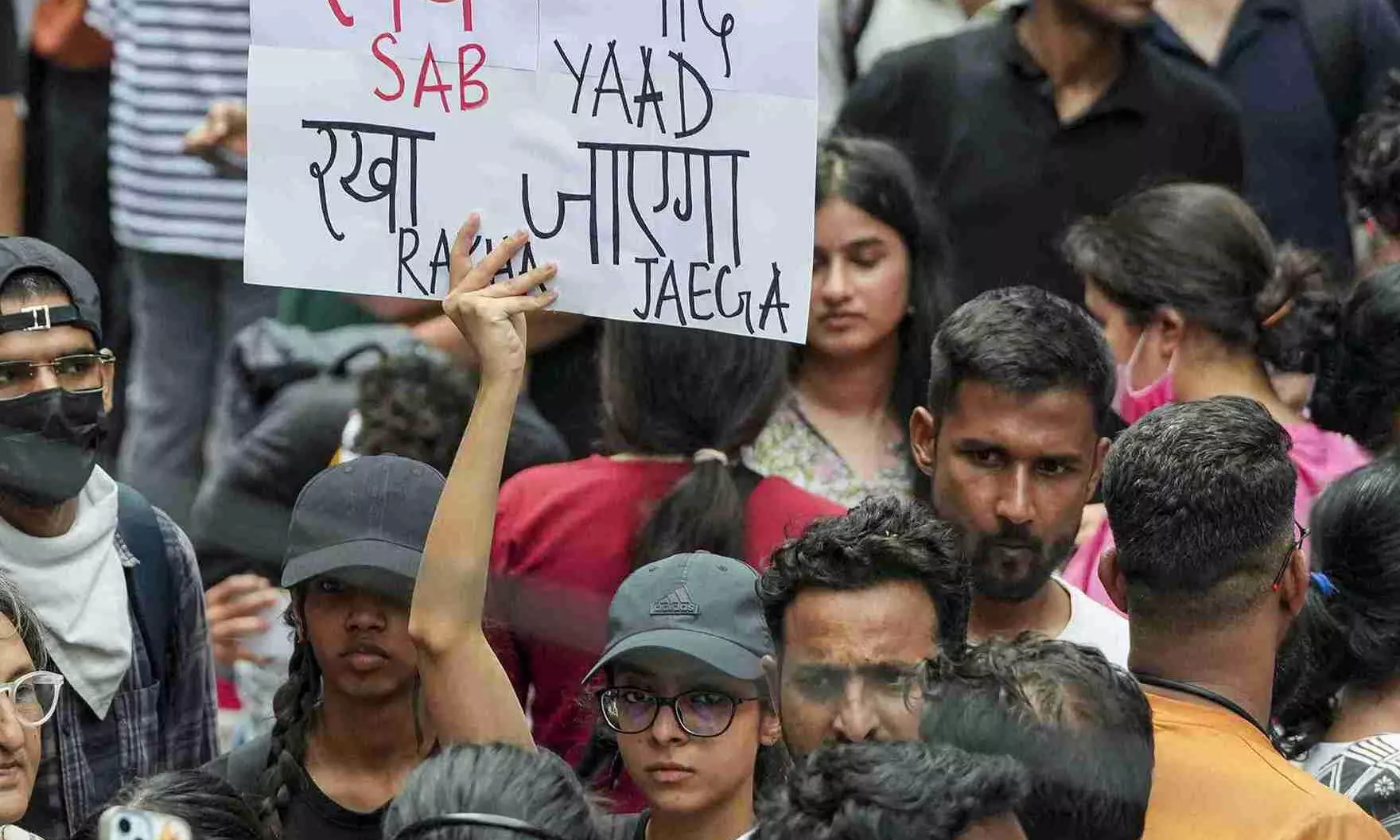
A protester at Delhi's Jantar Mantar this week. PTI Photo
Hours after thousands of young protesters were driven back from Parliament on July 20 — lathi-charged, tear-gassed and hemmed in by a wall of security personnel — they regrouped at Delhi’s Jantar Mantar.
Among them was 17-year-old Mihika Yadav. Unhurt, but visibly shaken. She wondered aloud how and why merely demanding a fair and equitable future had become an act worthy of “punishment”.
Then someone in the crowd began singing: Sarfaroshi ki tamanna ab hamare dil mein hai/Dekhna hai zor kitna bazu-e-qatil mein hai (The yearning for martyrdom now stirs within our hearts; let us see how much strength the executioner’s arm truly possesses).
Within moments, dozens of voices joined in.
Written by revolutionary poet Bismil Azimabadi and immortalised during India’s freedom struggle by Ram Prasad Bismil, the century-old anthem transformed a bruised gathering into a determined one. As Mihika turned her phone camera towards the singers and then back to herself, her fear had given way to a smile of steely resolve. “They can’t and won’t break us,” she said, joining others around her in their clarion call: “Ladenge! Jeetenge!!” (We will fight, we will win.)
Win they did on Saturday (July 25), at least in a measure, when Union education minister Dharmendra Pradhan announced his resignation. That he accepted accountability for the National Eligibility Cum Entrance Test (NEET) examination paper leak (which came to light in May, forcing a re-examination) and stepped down was one of the demands with which the ongoing protest at Jantar Mantar had started — speareheaded by the Cockroach Janata Party, which begun as a satirical online movement against remarks attributed to Chief Justice of India (CJI) Surya Kant, likening "some unemployed youth" to “cockroaches”. In the past weeks, the protest has ignited a sustained youth uprising across the country for wider educational reforms.
Yet beyond the dramatic visuals and political messaging, another story has been unfolding at the protest site. The rediscovery of songs — some over a century old, others written only recently — that are binding together thousands of young people.
A group of collegians who have come to Delhi all the way from Kothrud, Pune to be at the Jantar Mantar protest sang in Marathi: Saanga amhala Ambani, Adani, Tata kutha haay ho?/Saanga dhanacha saatha na aamcha vaata kutha haay ho? (Tell us where the wealth of the corporates lies. Tell us where our share of it has disappeared).
Protestors at Jantar Mantar. File photo
The verses moved effortlessly from corporate concentration of wealth to farmers’ labour, fugitive businessmen and the disappearance of subsidised grain. The lyrics were witty, biting and unmistakably tore into an India where prosperity has steadily flowed upwards, enriching a privileged few while leaving millions treading water despite claims of economic growth.
The scene at Jantar Mantar underlined a truth as old as organised dissent itself: every movement eventually discovers its soundtrack. Speeches may articulate demands and slogans may energise crowds, but songs do something deeper. They create memory, forge solidarity and outlive the moment that gave birth to them. Long after protest sites have been dismantled, it is often the songs that continue travelling — from one movement to another, one generation to the next.
Songs that refuse to die
Few people understand this better than veteran revolutionary balladeer Shahir Sambhaji Bhagat, who has spent more than three decades performing at workers’, Dalit, farmers’ and Adivasi movements across Maharashtra.
“Power always seeks to impose one cultural narrative,” he says. “People’s movements remind society that there are many cultures, many identities and many ways of expressing resistance. Songs become the language through which these suppressed identities speak.”
Bhagat believes India’s tradition of resistance music stretches back at least six centuries. Much of it, he argues, survives despite systematic attempts at erasure. “Brahmanical dominance denied these traditions documentation and legitimacy. But Dalit and Adivasi communities preserved them orally. I’ve met elderly women who cannot read or write but can sing hundreds of such songs from memory. They are living archives, as we could see some of these timeless inspirations work as songs of resistance even today.”
For Bhagat, songs endure because they belong to communities rather than individuals. They are constantly adapted to new struggles without losing their emotional core. He also credits Dr BR Ambedkar with recognising culture as a political instrument long before many modern activists did. “Babasaheb often said that ten speeches could not equal the impact of one powerful song sung by a shahir before ordinary people. Writers like Annabhau Sathe, Namdeo Dhasal and Narayan Surve inherited that understanding.”
Bhakti or dissent
Sociocultural historian Mukund Kule traces the genealogy of resistance songs even further back, to the Bhakti movement.
“What we today recognise as protest poetry emerged from questioning social hierarchy,” he says. “Beginning in the Tamil region and spreading through Karnataka, Maharashtra and North Indian Indo-Gangetic plains, Bhakti poets challenged caste discrimination, ritual authority and religious exclusivity.”
Saint-poets such as Ravidas, Kabir, Namdev, Chokhamela, Tukaram and Eknath remain central to anti-caste cultural movements because they attacked Brahmanical orthodoxy in language accessible to ordinary people. Yet Kule also points to a paradox. “They were eventually accepted into the religious canon precisely because their dissent largely remained within the sacred framework. Unlike later Dalit literature, which openly demanded structural change and often adopted militant tones, Bhakti poetry negotiated with religion — often indulging in a dainty waltz — even while challenging it.”
That distinction, he argues, partly explains why medieval dissent could be absorbed into mainstream tradition while later anti-caste movements were viewed as more politically threatening.
Bhagat sees continuity rather than contradiction. “The language changes. The music changes. But the impulse remains the same, to question injustice, restore dignity and imagine a more equal and equitable society.”
Bengal’s long tradition of protest
If Maharashtra nurtured one powerful stream of resistance music, Bengal developed another.
Retired sociology professor and author Dr Binayani Rai points out that Bengal’s protest songs cannot be separated from its political history. “The Vaishnav tradition itself questioned social hierarchy. Then came the Bengal Renaissance, when literature and music increasingly challenged accepted norms. Kolkata, being the colonial capital, became the epicentre of political mobilisation.”
The most famous being Bankim Chandra Chattopadhyay’s Vande Mataram, which evolved from a literary composition into one of the defining anthems of India’s anti-colonial movement.
The anti-Partition movement of 1905 generated another wave of songs, processions and public performances. Around the same time, Rabindranath Tagore composed Amar Sonar Bangla, originally as an expression of cultural resistance against Bengal’s Partition. Decades later, it would go on to become the national anthem of Bangladesh.
Security personnel baton charge at a protest rally by Students Federation of India and Cockroach Janata Party supporters in Kolkata on July 24. PTI Photo
According to the Dibrugarh (Assam)-based Rai, Bengal’s protest music never remained confined to local issues. It constantly absorbed global struggles.
The devastation of Hiroshima and Nagasaki inspired anti-war songs such as Hemanga Biswas’ Sankhachil, while the Vietnam War galvanised an entire generation of Left activists. Chants like “Amar naam, tomar naam, Vietnam, Vietnam!” echoed through student movements, linking distant geopolitical struggles with local demands for justice.
By the mid-1970s, as resistance to the Emergency gathered momentum, Bengal’s musical vocabulary had become noticeably sharper. “Songs were no longer merely inspirational,” says Rai. “They became openly confrontational.”
That trajectory, from spiritual questioning to anti-colonial nationalism, international solidarity and domestic political resistance, reveals how protest music continually reinvents itself while remaining rooted in collective memory.
If the young protestors at Jantar Mantar instinctively reached for “Sarfaroshi ki tamanna” after facing police batons, they were participating in a much older tradition. Across centuries and regions, India’s songs of resistance have never belonged to a single movement. They have simply waited for the next generation to find its own reasons to sing them.
If Bengal’s songs of resistance found their vocabulary in anti-colonial nationalism and Left politics, similar traditions evolved elsewhere in India, each rooted in its own social history, yet united by a common impulse: giving voice to those pushed to the margins.
Punjab’s pride
In Punjab, songs of resistance are not a genre; they are the state’s conscience set to music. From the Sufi defiance of Baba Farid, Shah Hussain and Bulleh Shah and Guru Nanak’s fiery assault on caste and orthodoxy, to the ballads of the Ghadar movement (started in the early 20th century by expats to overthrow the British rule in India), peasant struggles, the pushback to alleged state-sponsored violence during the insurgency years of the ‘80s and the farmers’ protests, every generation has found a new melody to challenge power.
As Punjabi ideologue Pammi Lalomazara puts it, “Punjab’s music has always sung for those denied a voice. The tune changes, the rebellion doesn’t.”
That lineage finds a powerful contemporary expression in compositions like Lehmber Hussainpuri’s Putt chamaran de, a song that transforms a caste slur into a badge of pride and celebrates Dalit assertion with unapologetic confidence. In Lalomazara’s words, “From Bulleh Shah to Putt chamaran de, Punjab’s music has never stopped asking the same question: Who decides whose dignity matters?”
Voices from the streets
Few people embody that tradition of resistance better than Rajasthan’s Shanker Singh, a founding member of the Mazdoor Kisan Shakti Sangathan (MKSS) alongside Aruna Roy and Nikhil Dey. For nearly four decades, Singh has used street theatre, puppetry, songs and satire to demystify governance and empower rural communities.
“The point is to communicate complex issues in a language people recognise as their own,” says the septuagenarian. “If all you do is shout slogans or deliver fiery speeches, people eventually stop listening. Music and theatre make difficult conversations engaging without diluting their political message,” he says, echoing Bhagat.
For Singh, humour and melody are not embellishments to activism but essential democratic tools. They allow movements to sustain themselves emotionally through long struggles, creating moments of joy even amid hardship.
Singh’s sentiment finds an echo over 1,800 kilometres away in Karnataka.
A protest by Cockroach Janata Party Supporters in Bengaluru. PTI Photo
Writer and activist Devanuru Mahadeva believes songs often travel farther than speeches because they belong to the people who sing them. “A song succeeds only when it borrows the imagery, idiom and rhythms of the community whose struggles it seeks to represent," the Mysuru resident says. “Otherwise it remains performance, not participation.”
He argues that Karnataka’s tradition of resistance extends far beyond the familiar literary canon. While contemporary poets such as Kotiganahalli Ramaiah, Mudnakudu Chinnaswamy, Subbu Holeyar, Anusuya Kamble and Hulikunte Murthy have written stirring songs of social justice, he believes the contributions of 12th-century non-Brahmin women vachana poets such as Kadiremmevve, Aydakki Lakkamma and Sule Sankavve deserve equal recognition. “Their voices challenged hierarchy centuries before the language of modern democracy existed,” he insists. “We have still not accorded them their rightful place in our cultural memory.”
Kerala’s socialist soundtrack
If Karnataka’s songs drew strength from literary traditions, Kerala’s resistance music acquired a distinctive political edge after the state elected the world’s second democratically elected Communist government in 1957.
Singer-composer Sunil Koshy traces that history through both political movements and Malayalam cinema. “The narrative of the oppressed confronting the oppressor became central to Kerala’s cultural imagination,” he says. “The songs soon moved seamlessly from public meetings to the silver screen.”
He points to Balikudeerangale, written by Vayalar Ramavarma and composed by G Devarajan, as an early landmark. The legendary lyricist-composer duo would go on to shape an entire generation of Malayalam film music where socialist ideals and workers’ struggles became recurring themes.
Films such as Thulabharam, Punnapra Vayalar, Mooladhanam, Ningalenne Communistakki and Anubhavangal Paalichakal transformed movement songs into popular culture. The lyrics of these songs celebrated workers’ solidarity, sacrifice and collective resistance while remaining commercially successful.
“The remarkable thing,” Bangalorean Koshy says, “is that many of these songs outlived the films themselves. They continue to be sung at rallies and public meetings decades later. In that sense, resistance music completed a full circle, from the streets to cinema and back to the streets.”
Though he is more than 2,000 kilometres away from Jantar Mantar, Koshy says the “tyranny of distance” has done little to dull his connection with the youth gathered there. As he watched the images streaming in earlier this week, he found himself unable to remain a spectator. “As an artist, I felt compelled to respond,” he says. “The restlessness became a song. In less than two hours, I had composed and sung it for India’s youth, who are fighting the good battle on behalf of all of us.”
“Qaid kiyā hai andheron ne, chalo subah ko chhuḍā ke lāyen/Jāgo apne haq ke liye, chalo phir se buland āwāz uthāyen/Ḍatey raho morche pe jab tak laut ke ghar pe subah na āye (Darkness has taken our dawn captive—come, let us set it free. Awaken, claim what is rightfully yours; come, let our voices rise once more. Hold your ground upon the frontlines until the dawn finds its way back home.)
Maharashtra: people’s theatre
Maharashtra developed an equally vibrant culture of political performance through its kalapathaks — travelling cultural troupes that combined music, theatre and satire. Women’s rights activist and Stree Mukti Sanghatana founder Jyoti Mhapsekar grew up immersed in that world. “My socialist parents raised me in a commune where entertainment, political education and social commitment were inseparable,” she recalls. “The songs questioned exploitation, mocked inequality and reached people who would never attend a political meeting.”
A protest rally in Mumbai. PTI Photo
It is hardly surprising that Mhapsekar would later write and perform songs for the women’s movement while creating the landmark play Mulgi zhaali ho (A daughter is born).
She believes the enduring strength of resistance music lies in its ability to reinvent itself. “Our songs changed as society changed. Every generation finds new injustices. It is a natural corollary then that songs evolve with them,” Mhapsekar says.
Music that responds to its moment
For celebrated vocalist Shubha Mudgal, music has always carried responsibilities beyond aesthetics.
“For decades, I’d be invited to perform at events supporting different social causes,” she recalls. “That forced me to ask myself difficult questions. Should I simply sing my most popular songs? Or should I perform something that speaks directly to the issue people have gathered around?”
That reflection gradually led her to develop a repertoire centred on poetry of dissent. Among the many poems she has performed, one by Dushyant Kumar remains especially resonant: Tera nizam hai sil de zuban shayar ki/Ye ehtiyat zaruri hai is bahar ke liye (Every regime seeks to silence the poet; perhaps it believes spring itself depends upon that silence).
Written during the Emergency, the verse continues to find new listeners whenever democratic freedoms appear under strain.
Its enduring relevance was evident once again at Jantar Mantar, where another of Dushyant Kumar’s best-known poems frequently rose above the din of protest: Sirf hungama khada karna mera maqsad nahin,/Saari koshish hai ki ye surat badalni chahiye (My purpose is not merely to create an uproar. Every effort is directed towards changing the existing order).
For Mudgal, that is precisely what distinguishes enduring protest music from fleeting political rhetoric. “Art survives because it speaks not only to a moment but to a condition,” she says.
New sounds, old struggles
Resistance music has never remained trapped within traditional forms. Contemporary musicians are increasingly carrying its themes into rock, rap, fusion and independent music.
One such experiment is Dhamma Wings, a Buddhist rock band founded by Kabeer Shakya.
Raised in a Buddhist household and deeply influenced by both Gautama Buddha and BR Ambedkar, Shakya sought to reinterpret those philosophies through a contemporary musical language. “Young people don’t necessarily connect with conventional forms,” he says. “Rock became my way of making ideas of equality, compassion and dignity accessible.”
Echoing this sentiment, Nagpur-based street theatre actor and rap artiste Vinod Waghade, better known as ‘Garam Kalakar,’ whose every new release garners millions of views, says he consciously ensures his music never separates compassion from resistance.
“I speak about humanity,” he says. “But let's not forget that humanity also demands standing up to injustice. Peace should never be mistaken for submission.” He has been in touch with the CJP since their founding days and had a “gut instinct” that they were on to something.
“I collaborated with them to create “Kyu paper hua leak? Koyi toh batao. Melody khao khud jaan jao”. The response showed I’d tapped into a great reservoir of anger.”
The work of both Shakhya and Waghade illustrates a broader shift. Today’s protest music draws as comfortably from hip-hop, electronic music, rock and even rap (which we’ve been hearing a lot at Jantar Mantar) as earlier generations drew from bhajans, folk traditions and powadas. The genres may have changed; the questions remain remarkably similar.
The lingering refrain
Back at Jantar Mantar, the young protesters who sang “Sarfaroshi ki tamanna” were separated by more than a century from the revolutionaries who first made the song famous. Yet the emotional distance was almost non-existent.
That perhaps explains why songs have remained the most durable companions of social movements. Speeches are tied to leaders, manifestos to organisations and slogans to specific campaigns. Songs, however, escape those boundaries. They travel across languages, ideologies, generations and geographies, gathering new meanings without surrendering their old ones.
Actors Shabana Azmi and Prakash Raj with the protestors at Jantar Mantar. PTI Photo
Earlier this week, as actor Shabana Azmi saw protesting students being met with tear gas and lathi-charge, she leaned against a truck to recite one of her father’s, poet Kaifi Azmi’s most enduring couplets: Elān-e-haq meiñ ḳhatra-e-dār-o-rasan toh hai/Lekin savāl ye hai ki dār-o-rasan ke baad?
Later, she took to social media to contextualise its meaning: “The verse acknowledges the price of speaking truth to power while asking a deeper question: can those who wield punishment ever truly silence the truth? The gallows may claim lives, but not the ideals for which they are sacrificed.”
Whether Pradhan’s resignation on Saturday marks the beginning of the end of this students’ uprising is yet to be seen. What can be said with more certainty is that long after this crowd disperses, someone, somewhere, someday, will sing again. And another generation will discover that resistance has always had its music of expression.