







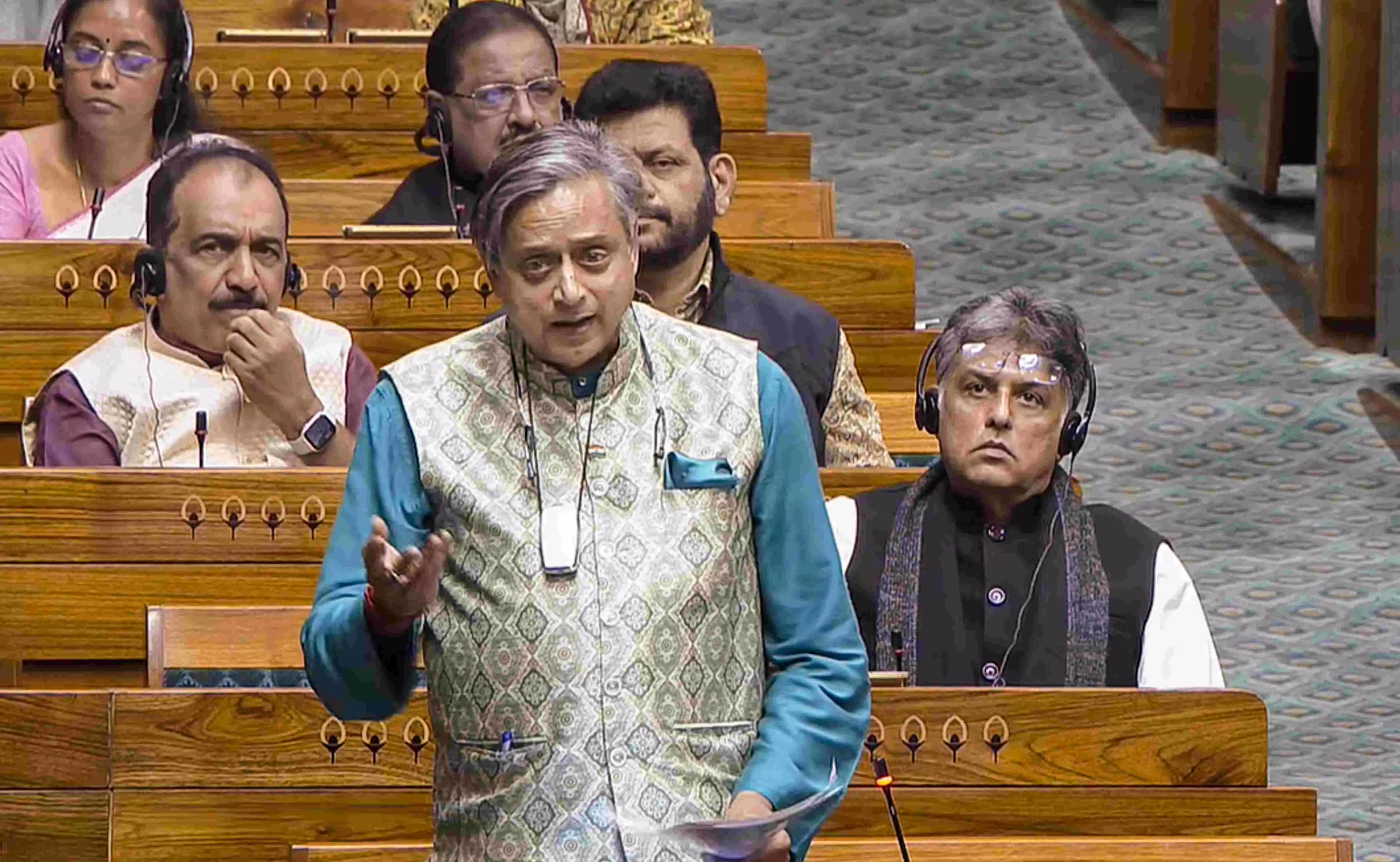
Tharoor said that Gandhi's vision of Ram Rajya was never a purely political project. Photo: PTI
Bangladesh crisis biggest strategic challenge for India since 1971: Panel
A parliamentary panel warns Bangladesh’s political upheaval is India’s biggest strategic challenge since 1971, citing rising Chinese and Pakistani influence

A parliamentary committee, headed by Congress MP Shashi Tharoor, has said the prevailing situation in Bangladesh following the ouster of Sheikh Hasina's Awami League government poses the "greatest strategic challenge" for India since the neighbouring country’s Liberation War of 1971.
Elaborating further, the committee in its report stated that although the situation "will not descend into chaos and anarchy," India needed to handle it carefully.
‘Intensifying Chinese and Pakistani influence’
The committee in its recommendations traced the development of the unrest in Bangladesh to a combination of increasing influence of “Islamic radicals” along with "intensifying Chinese and Pakistani influence" and the "collapse of the dominance of Sheikh Hasina's Awami League".
Also Read: India shuts two visa centres in Bangladesh over security concerns
"While the challenge in 1971 was existential, a humanitarian and a birth of a new nation, the latter was of a graver, a generational discontinuity, a shift of political order, and a potential strategic realignment away from India," stated the committee as quoted by NDTV.
Cautioning the government, the committee stated that if India fails to deal with the situation properly, then it would risk “losing strategic” place in Dhaka to irrelevance.
"If India fails to recalibrate at this moment, it risks losing strategic space in Dhaka not to war, but to irrelevance," it added.
Concern of Dhaka’s ties with Islamabad, Beijing
Elaborating further, the committee expressed concern about Bangladesh’s increasingly close ties with Pakistan and with China’s growing footprint in the neighbouring country concerning infrastructure, development of ports and defence.
Also Read: India summons Bangladesh High Commissioner after threat to High Commission in Dhaka
The panel, according to media reports, cited projects such as the expansion of Mongla Port, Lalmonirhat Airbase, and the submarine base at Pekua, which has the capacity to accommodate eight submarines, although Bangladesh has only two.
The panel further stated that China was also engaging with all sections in Bangladesh, including the Jammat-i-Islam,i with the outfit even visiting China.
‘Prevent foreign influence in Bangladesh’
The panel recommended that the government carefully monitor the situation in Bangladesh, ensuring that any foreign power is unable to get a foothold in Bangladesh and offer Dhaka a comparative advantage in development, connectivity and port access, reported NDTV.
The panel also pointed out that the Jamat-e-Islami, which was earlier banned in Bangladesh, had its electoral registration reinstated, enabling it to contest the upcoming general elections.
"The continuing ban on the Awami League will obviously call into question the inclusiveness of any future elections in Bangladesh," stated the panel.