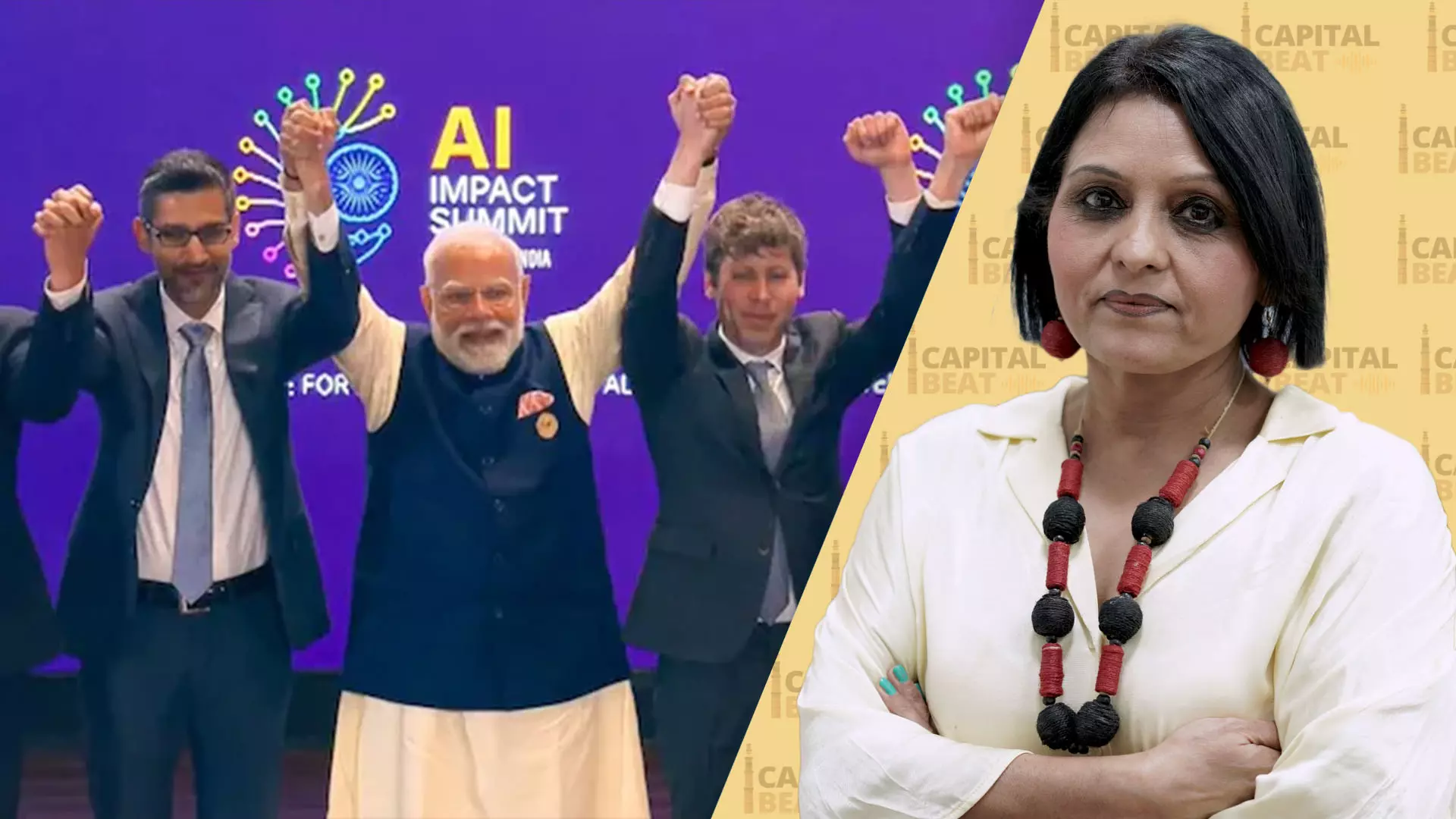
AI Summit: Have controversies dented India’s credibility? | Capital Beat
Goof-ups, mismanagement, embarrassing no-shows, India's prestigious AI Summit has had a rough ride. PM Modi's 'Manav Vision' is meant to salvage it, but has it come too late?

Prime Minister Narendra Modi, addressing global leaders on Day 4 of the India AI Impact Summit 2026 in New Delhi, declared that India was not just part of the AI revolution but “leading and shaping it”. Yet, questions persisted over whether the summit’s controversies had dented India’s credibility.
On Capital Beat, Salman Soz, Congress leader; Sanjay Kapoor, international affairs expert and veteran journalist; and KS Dakshina Murthy, international affairs expert and The Federal's Consulting Editor, unpack the political, diplomatic, and economic implications of the summit.
Also read: Top things that global leaders said at India AI Impact Summit 2026
“Optics have overtaken substance yet again.” That was Soz’s sharpest criticism of the AI Summit amid controversies ranging from alleged mismanagement to the absence of Microsoft founder Bill Gates.
Early setbacks
The summit, envisioned as a major global platform on artificial intelligence, quickly ran into trouble. Reports of mismanagement, allegations involving Galgotias University over a robotic dog demonstration, and plagiarism claims linked to Dalhousie University created a stream of negative headlines.
Also read: Galgotias’ robodog row: Blaming, philosophy, clarification, but no apology
Soz said that while hosting such a summit was “welcome” and important for India, the execution was flawed. “Optics during Prime Minister Modi’s tenure have constantly been elevated above substantive issues and discussions,” he remarked.
He argued that crucial debates—particularly about AI’s impact on employment in a labour-surplus country like India—were sidelined by distractions. Artificial intelligence, he noted, is fundamentally a “labour-replacing technology,” and India must urgently confront the consequences.
Gates controversy
The biggest controversy revolved around Gates’ absence. Reports from international media outlets suggested that Gates did not deliver the keynote address amid renewed scrutiny over the Epstein files.
Also read: AI Impact Summit: Modi holds bilateral meets with 7 PMs, presidents, 2 CEOs
Murthy described the summit as a “double-edged sword”. Large-scale events, he said, can either go very well or “badly wrong”. In this case, successive controversies—including the Gates issue—kept drawing unwanted attention.
“If things had gone fine in the first three days, perhaps the risk would have been taken,” Murthy observed, suggesting that organisers likely chose caution to avoid further embarrassment.
Soz added that if the government had concerns, it should have clarified them well in advance. “If you are going to have an AI summit… you have to think through the implications of your organisational strategy,” he said, arguing that the confusion reflected poor planning.
Diplomatic discomfort
Kapoor said the summit “got the wrong press” despite attracting global tech leaders. He questioned whether India’s rhetoric about “democratising AI” would translate into policy.
Also read: PM Modi calls for human-centric AI, cautions against 'directionless' use
He warned of a growing push for India to embrace the “American stack” in AI infrastructure, raising concerns about data sovereignty. Referring to comments made in Washington, he suggested that the US expects India to align with its AI ecosystem.
“If we are going to embrace the American stack, there’s no freedom at all,” Kapoor argued, adding that India risks losing control over its data. He echoed Congress leader Rahul Gandhi’s recent parliamentary remarks that data sovereignty is central to India’s future.
Russia’s oil remark
In the middle of the summit, another geopolitical wrinkle emerged. Russian Foreign Minister Sergey Lavrov stated that there was no change in India’s purchase of Russian oil, contradicting speculation that India might scale back under Western pressure.
Kapoor described the situation as complex. While India may have reduced purchases compared to peak levels, Russia’s statement appeared intended to signal continuity.
Also read: All you need to know about Sarvam AI, the AI Summit ‘rockstar’
He suggested that India faces pressure from multiple directions and questioned whether it was asserting itself strongly enough in foreign policy decisions. Russia, he said, would be “deeply disappointed” if India appeared to prioritise US ties over long-standing relations.
Modi’s vision
In his address, Prime Minister Modi outlined a “human-centric” vision for AI, unveiling the acronym “MANAV”—Morals and ethical systems, Accountable governance, National sovereignty, Accessible and inclusive, and Valid and legitimate.
Murthy said the speech read well but lacked operational clarity. “It was a little bit of a fluff talk,” he remarked, suggesting that broad principles were not matched by detailed policy roadmaps.
He added that AI requires “far deeper understanding and working knowledge”, pointing out that countries like the US and China are fundamentally transforming industries through frontier AI technologies, while India still trails behind.
Acronyms vs action
Soz was blunt in his response to the MANAV framework. He dismissed it as “drama bazi”, arguing that acronyms cannot substitute for accountability or strategic clarity.
He questioned the government’s record on morality, inclusivity and accountability, citing the absence of consequences for missteps. “We have no accountability in this government,” he said.
More fundamentally, Soz stressed that the US and China are investing “hundreds of billions of dollars” in AI. India, he argued, needs a coherent national framework involving the Centre, states, private sector and civil society to carve out space in a rapidly consolidating global landscape.
Jobs at risk
Both Soz and Kapoor expressed deep concern about job losses. Kapoor noted that India is a labour-surplus country and may not benefit from rapid automation without adequate safeguards.
He referred to projections that AI could trigger “colossal job losses”, echoing warnings in policy documents. Without a clear strategy to absorb displaced workers, the social consequences could be severe.
Soz added that, unlike previous technological revolutions, AI directly threatens professional classes as well. If doctors, lawyers, and other skilled workers face automation risks, the ripple effects across the economy could be profound.
Balancing ambition and reality
Despite the controversies, Kapoor acknowledged that the summit did attract top global talent and business leaders. That, he said, indicates India’s importance in the AI ecosystem.
However, the panellists agreed that the event highlighted a gap between ambition and preparedness. From data governance to employment safeguards, key questions remain unanswered.
As the summit concluded, the broader issue lingered: can India move beyond high-profile announcements and acronyms to build durable institutions and policies for the AI age?
The AI Summit 2026 may have showcased India’s aspirations. But as the panel discussion made clear, the harder work lies ahead—ensuring that artificial intelligence becomes not just a slogan of inclusion, but a strategy grounded in accountability, sovereignty and economic realism.
(The content above has been transcribed from video using a fine-tuned AI model. To ensure accuracy, quality, and editorial integrity, we employ a Human-In-The-Loop (HITL) process. While AI assists in creating the initial draft, our experienced editorial team carefully reviews, edits, and refines the content before publication. At The Federal, we combine the efficiency of AI with the expertise of human editors to deliver reliable and insightful journalism.)