



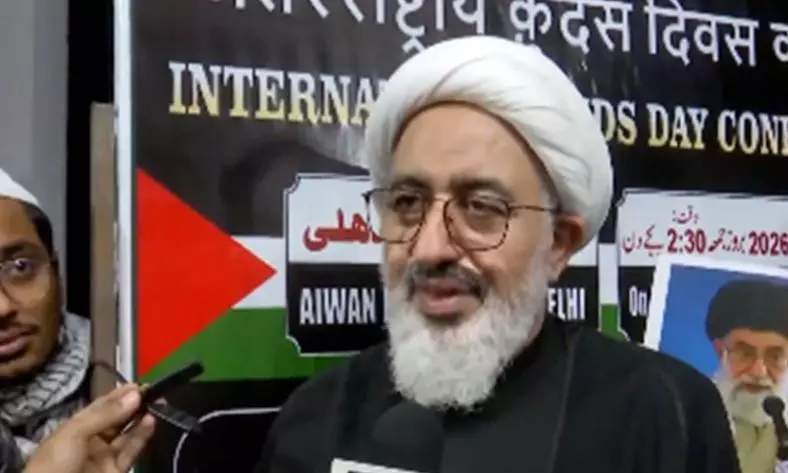
Ilahi said that world leaders should exert pressure on US President Donald Trump to immediately stop the attack on Iran. Screengrab: ANI
Strait of Hormuz not closed, some ships still passing: Khamenei’s representative
Iran’s Supreme Leader’s representative in India says the Strait of Hormuz remains open even as tensions escalate in the Israel–US–Iran conflict

Iran has not closed the strategically crucial Strait of Hormuz, and some ships are still passing through, Dr Abdul Majid Hakeem Ilahi, representative of Iran's Supreme Leader in India, said on Friday ( March 13).
Speaking to ANI, Ilahi said that world leaders should exert pressure on US President Donald Trump to immediately stop the attack on Iran, adding that people across the world are suffering due to the rising oil prices.
"Iran has not closed the Strait. It remains open; however, due to current conditions and circumstances, ships are unable to pass through the Hormuz. Otherwise, Iran never wanted the Strait to be closed or blocked. Some (ships) are still passing through," said Ilahi.
Khamenei hints at Hormuz leverage
His comments come days after Iran's new Supreme Leader, Mojtaba Khamenei, indicated Tehran was keen on using the closure of the Strait as a pressure tactic.
Also Read: Trump tells G7 Iran ‘near surrender’, but then Tehran vows retaliation
"Dear fighter brothers! The desire of the masses of the people is the continuation of effective and regret-inducing defence. Furthermore, the leverage of blocking the Strait of Hormuz must certainly continue to be used," he had said.
West Asia conflict enters day 13
The ongoing conflict in West Asia entered its 13th day on Friday, with hostilities continuing between Israel and the US on one side and Iran on the other.
Also Read: Four crew members dead in US KC-135 crash in Iraq, military rules out hostile fire
The current round of fighting began on February 28 and intensified after 86-year-old Iran’s Supreme Leader Ayatollah Ali Khamenei was killed in joint US and Israeli strikes.
In response, Iran targeted Israeli and US-linked assets in several Gulf countries and inside Israel, disrupting maritime movement and unsettling global energy markets.
Iran warns of retaliation
Amid rising tensions, Iran’s Military Headquarters, Khatam al-Anbiya, warned of severe retaliation if its energy facilities are attacked.
Also Read: Trump may claim victory, but will Iran stop fighting?
"The slightest attack on Iran's energy infrastructure and ports will result in our crushing and devastating response. In the event of such an attack, all the oil and gas infrastructure in the region, in which the United States and its Western allies have interests, will be set on fire and destroyed,” it said.
Possible new fronts
A spokesperson for the military said Tehran had identified locations it considers vulnerable to potential strikes by the Islamic Republic.
"Studies have been conducted regarding the opening of additional fronts in areas where the enemy has negligible experience and would be highly vulnerable, and their activation will be carried out if the state of war persists and in accordance with the observance of interests," he said.