



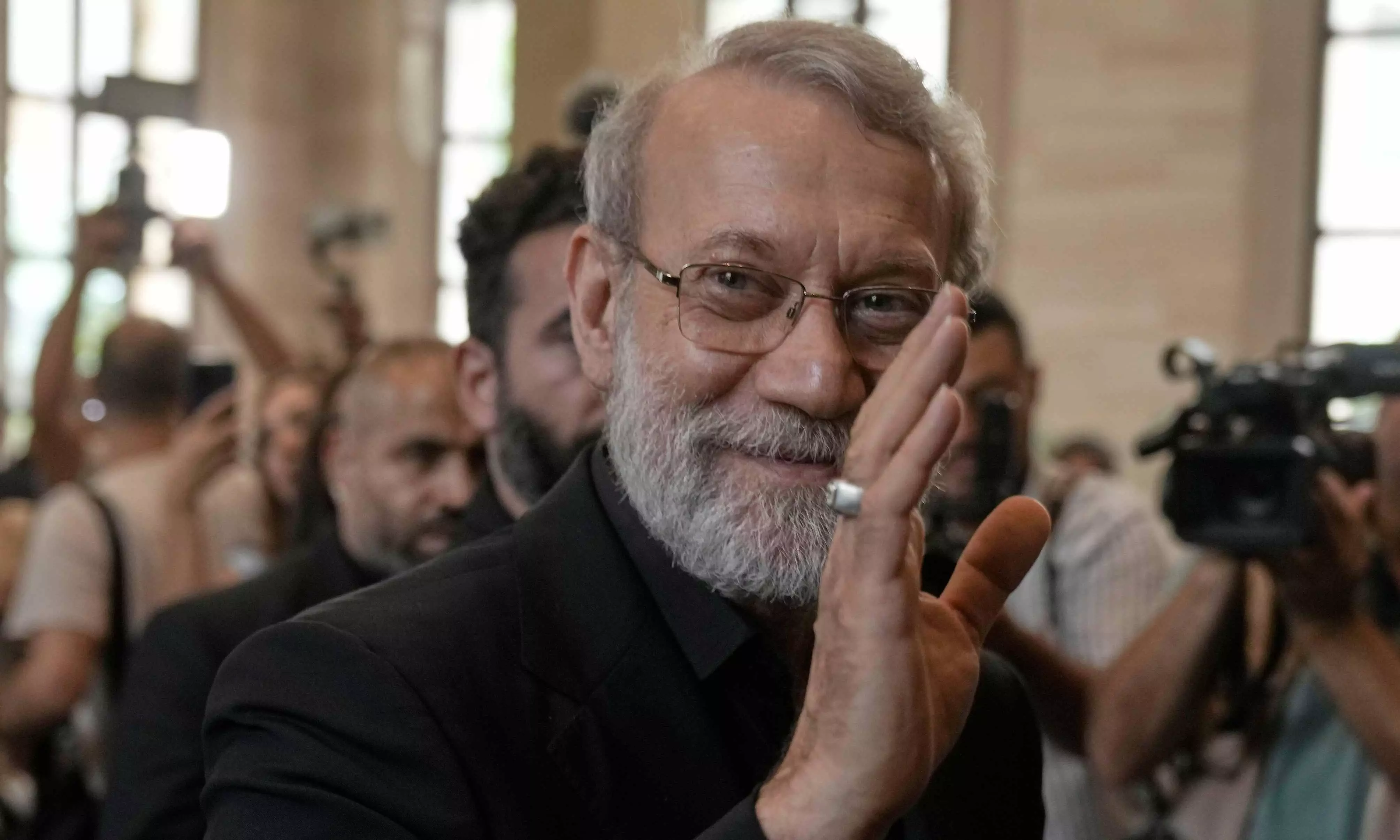
Ali Larijani: philosopher, nuclear negotiator, parliament speaker and the man who predicted the war that ultimately killed him. Photo: PTI
Who was Ali Larijani, Iran's security chief killed by Israel?
Larijani was the one figure in Tehran who could talk to the West and still command the hardliners. Now he's dead

On the night of March 17, nineteen days into the US-Israel war on Iran, Israeli airstrikes killed Ali Larijani, the 67-year-old secretary of Iran's Supreme National Security Council and the Islamic Republic's most powerful decision-maker since the Supreme Leader Ayatollah Khamenei's assassination on day one of the war.
Also read: As ‘friends’ trump Donald on Hormuz, is the bully all alone now? | AI With Sanket
Israeli Defence Minister Israel Katz confirmed the strike, thanking air force pilots, intelligence officers, and "our American partners". Iranian state media confirmed the loss. He was the most senior Iranian official killed since Ayatollah's assassination.
Who was Larijani?
Born in 1958, Larijani was shaped by two worlds as his brothers held positions in both the legislature and judiciary of Iran that rarely overlap. He held a mathematics degree from Sharif University and a doctorate in Western philosophy from the University of Tehran, his thesis written on German philosopher Immanuel Kant.
Also Read: Israel claims Iran's security chief killed, hours after handwritten note surfaces
He was a commander in the Iran-Iraq war, Culture Minister under the late former Iranian President Akbar Hashemi Rafsanjani, head of state broadcaster IRIB, Iran's chief nuclear negotiator under Khamenei, and finally Parliament Speaker for a record 12 consecutive years. No other figure in Iran had moved so fluently across its military, clerical, legislative, and diplomatic institutions.
What Larijani was managing
When Khamenei was killed on February 28, Larijani stepped immediately into the vacuum. He appeared on state television the next morning, coordinating Iran's wartime security strategy, nuclear posture, and the back-channels still theoretically open to diplomacy.
He was the public face of Iran's transitional leadership, eclipsing the new Supreme Leader, Mojtaba Khamenei, who has not appeared in public since taking power. He even attended the Al-Quds Day rally in Tehran on March 13, standing visibly beside President Masoud Pezeshkian despite a USD 10 million American bounty on his location.
Loyalty and pragmatism
Western diplomats who negotiated with Larijani described him as "sophisticated and formidable". He had championed the 2015 nuclear deal as Parliament Speaker, made repeated visits to Moscow to cultivate Russia as a counterweight to American pressure, and architected the 2021 Iran-China 25-year cooperation agreement.
Alan Eyre, a former US State Department official, captured him precisely in his statement to Middle East Eye: "He was a moderate when he chose to be, and a hardliner when it suited him better. A highly functioning mix of pragmatism and opportunism."
Also Read: Leaked audio details how Mojtaba Khamenei escaped Israel-US strike
Most strikingly, Larijani had seen the war coming and said so, 20 years before it arrived. In an interview with three Guardian journalists in his Tehran office, he was asked whether Western concerns over Iran's uranium enrichment were genuine. He didn't hesitate. "Sir, I think you know the answer to that question. If it was not the nuclear matter, they would have come up with something else… the pressure they are putting us under is reason enough for us to be suspicious."
He also warned, almost in passing, that oil prices would skyrocket in any conflict and raised the spectre of a closed Strait of Hormuz. It reads, in retrospect, like a man quietly calling his own shot.
What happens now
Iran's Foreign Minister Abbas Araghchi moved quickly to project calm, telling Al Jazeera that "the presence or absence of a single individual does not affect this structure." But analysts are less sanguine.
Without Larijani, power is likely to shift towards the IRGC, which governs through coercion rather than consensus. As Hamidreza Azizi of the German Institute for International and Security Affairs told CNN, "figures with such diversified experience are not easy to replace."
Also read: Iran thanks India for sending medical aid
His death could also push Mojtaba Khamenei towards seriously exploring nuclear weapons development, a threshold Larijani had, until now, helped manage.
Isolated and alone
The killing comes as the US finds itself diplomatically stranded. After pressing NATO allies to send warships to reopen the Strait of Hormuz, US President Donald Trump received a collective refusal. Germany's Chancellor Friedrich Merz said the conflict has "nothing to do with NATO." The UK, France, Australia, Japan, and South Korea all declined. Financial Times has taken to calling what Trump is assembling the "Coalition of the Unwilling".