







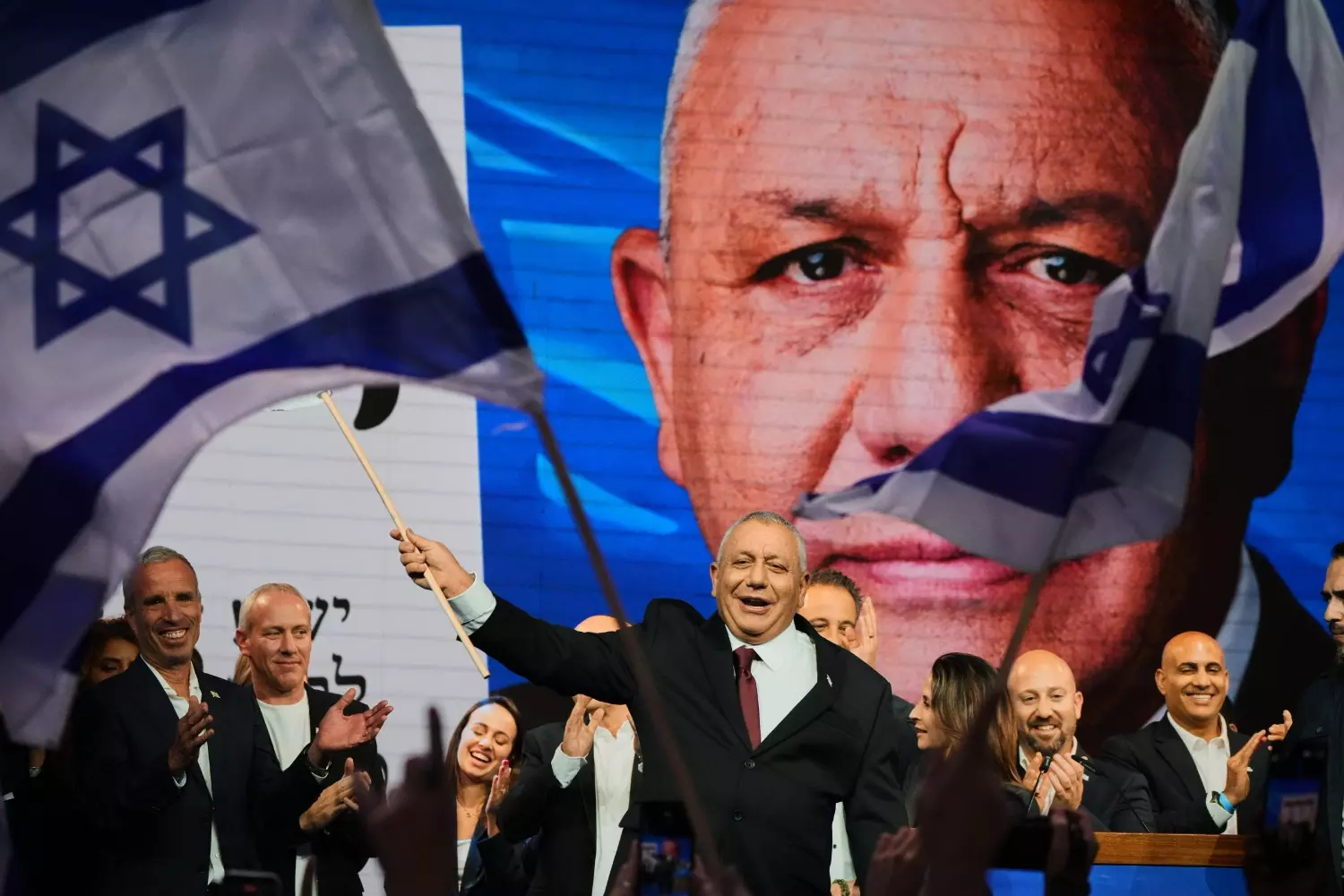
Who is Gadi Eisenkot, Israeli ex-military chief seeking to replace Netanyahu?
Who is Gadi Eisenkot? What can his rise mean for Israel and India? From his military career and differences with Netanyahu, here is what you need to know

Gadi Eisenkot has spent much of his life in Israel’s military and security establishment. Now the retired general is at the centre of one of the country’s most consequential political contests in years. Following the October 27 parliamentary elections, which left Israel with a hung parliament, Eisenkot has emerged as the principal challenger to Prime Minister Benjamin Netanyahu.
On Sunday (November 8), President Isaac Herzog gave Eisenkot the first opportunity to form the next government (the official ceremony is slated to be held at 5 pm local time, which is 8.30 pm IST). The decision came after factions representing 67 members of the Knesset recommended him for the task, compared with 46 who backed Netanyahu.
A former chief of staff of the Israel Defense Forces (IDF), Eisenkot is no outsider to Israeli politics or its security establishment. He served as the country’s top military commander between 2015 and 2019 and has also served as an observer in Netanyahu’s wartime cabinet following the October 7, 2023, Hamas attacks.
How his political run began in 2022
Eisenkot’s political entry came after four decades in the Israeli military. He joined the IDF’s Golani Brigade in 1978, and rose through the ranks, holding several senior command positions, before becoming the IDF’s 21st chief of staff in February 2015. He held the position until January 2019, when he retired after 41 years of military service, according to the IDF’s official biography.
His transition to politics began in 2022, when he joined Benny Gantz’s centrist National Unity alliance. He entered the Knesset as part of the alliance’s parliamentary contingent.
The October 7 attacks pulled him back into Israel’s national security decision-making. After Hamas launched its unprecedented assault on southern Israel, killing around 1,200 people and taking hostages, Netanyahu formed an emergency unity government with opposition leader Benny Gantz. Eisenkot joined the government as a minister without portfolio and became an observer in its war cabinet in November 2023.
As a former military chief, he brought real experience to Netanyahu’s government deciding Israel’s response in Gaza. His son, Gal Eisenkot, was also killed while serving in Gaza in December 2023.
Also read: Three years after October 7 Hamas attack, has Israel become any safer?
By June 2024, however, Eisenkot had decided to leave the emergency alliance alongside Gantz. In his resignation letter to Netanyahu, he accused the war cabinet of being unable to make decisive decisions because political considerations had entered its deliberations.
He wrote that the cabinet had been prevented from making decisions needed to achieve the war’s objectives and improve Israel’s strategic position. “Outside considerations and politics infiltrated into the discussions,” he said, as reported by The Times of Israel.
Eisenkot established his own political platform in September 2025, Yashar, positioning himself as a challenger to Netanyahu.
His disagreements with Netanyahu
Eisenkot’s opposition to Netanyahu mainly reflects disagreements over accountability, military strategy, domestic governance and the country’s international relationships.
1. Accountability for October 7
One of Eisenkot’s most consistent demands has been an independent State Commission of Inquiry into the October 7 attacks. He believes the investigation must examine failures across the political and military leadership, including the decisions and intelligence assessments that preceded the Hamas assault.
According to ynetnews, in November 2025, Eisenkot said the ultimate responsibility for the security failure rested primarily with the political leadership. “This responsibility cannot be divided or transferred,” he said, calling on Netanyahu and his cabinet to accept responsibility.
Netanyahu, meanwhile, has resisted calls for an independent state commission of inquiry, favouring an alternative mechanism with broader political agreement.
2. The conduct and endgame of the Gaza war
Eisenkot’s criticism of Netanyahu also centres on the absence of a clear political strategy to accompany military operations in Gaza.
He has questioned whether the government’s military campaign has translated into its stated strategic objectives. In an interview with The Jerusalem Post, he argued that only one of the war’s objectives had been achieved: the return of hostages. He also claimed that Netanyahu had initially opposed making the release of hostages an explicit war objective, saying he had pushed for its inclusion on the ninth day of the war.
While his overall stance against Hamas is similar to the Netanyahu bloc, he also believes military operations alone cannot resolve the conflict and that the government needs a credible plan for what follows them.
This includes deciding who will govern Gaza, how Hamas’s influence will be removed, and what political arrangements can prevent the territory from becoming a continuing security threat. The difference lies largely in execution and effectiveness.
3. Conscription of ultra-Orthodox Jews
A major domestic fault line between Eisenkot and Netanyahu concerns the military exemptions enjoyed by ultra-Orthodox Jewish communities, known as Haredim.
Eisenkot supports universal military service and wants ultra-Orthodox men to be included in compulsory conscription. He argues that the burden of military service should not fall disproportionately on sections of Israeli society while large sections remain exempt.
Netanyahu, however, depends on ultra-Orthodox parties, including Shas and United Torah Judaism, for the survival of his coalition. These parties have historically opposed compulsory military service for their communities.
Eisenkot has made the issue a central part of his political platform. In an interview with The Times of Israel, he said everyone must serve, including Haredim, while proposing national service arrangements for Arab citizens.
4. Netanyahu’s far-right coalition partners
Eisenkot has also criticised Netanyahu’s dependence on far-right political partners, especially National Security Minister Itamar Ben-Gvir, who leads Jewish Power, and Finance Minister Bezalel Smotrich, leader of Religious Zionism.
He believes their influence over key government decisions has undermined Israel’s security interests and governance.
He has been critical of the allocation of responsibilities in the occupied West Bank, where Smotrich has gained substantial authority over civil administration and Ben-Gvir oversees the police.
In an interview with The Jerusalem Post, Eisenkot argued that Netanyahu had handed important responsibilities to the two ministers, undermining the authority of the military’s Central Command. He also said he would reverse the current arrangements if he entered office.
5. Israel’s international relations
Foreign policy is another point of divergence. Eisenkot believes Netanyahu’s approach to the Gaza war and his political dependence on far-right partners have contributed to Israel’s growing diplomatic isolation.
Eisenkot has argued that Israel cannot afford to isolate itself from the international community or rely on economic self-sufficiency as a substitute for diplomatic relationships.
“We do not want to be ‘a people that dwells alone’,” he told The Jerusalem Post, arguing that Israel should remain a strong country while maintaining its place among the community of nations.
Also read: Netanyahu warns future US president could be hostile, calls for ties with India
He is keen on rebuilding relations with Western countries. He has also stressed the importance of preserving the peace agreements with Egypt and Jordan, saying these relationships cannot be taken for granted.
6. Judicial independence and democratic institutions
Eisenkot’s political camp has also opposed Netanyahu’s judicial overhaul, which sought to curb the powers of Israel’s judiciary and alter the balance between the executive, legislature and courts.
The proposed changes triggered widespread protests across Israel in 2023, with critics warning that they would weaken judicial independence and democratic checks on government power.
Eisenkot has advocated reversing measures that weaken independent state institutions, including changes to judicial appointments and the powers of the attorney general.
In his recent campaign, he promised to repeal the judicial selection changes and other measures that he believes have placed independent institutions under greater political control.
7. West Bank settlement violence
Another area of disagreement concerns the government’s handling of violence by extremist Jewish settlers against Palestinians in the occupied West Bank.
Eisenkot has criticised the government’s approach in ending the use of administrative detention against Jewish extremist suspects.
In July 2024, he described the decision as a “grave and dangerous mistake”, warning that it could contribute to an escalation in the West Bank.
He has proposed restoring administrative orders against violent Jewish extremists and strengthening enforcement by security agencies.
Will Eisenkot replace Netanyahu?
Despite receiving the mandate from President Herzog, Eisenkot faces a difficult parliamentary arithmetic. Israel’s Knesset has 120 seats, and a government needs the support of at least 61 lawmakers to secure a majority.
Also read: Israel President tasks Netanyahu rival Gadi Eisenkot with forming government
The final election results left Netanyahu’s bloc with 53 seats and Eisenkot’s opposition bloc with 48. The two Arab-led political groups together secured 19 seats. Neither of the main blocs has enough support to form a government independently.
The presidential consultations offered Eisenkot an advantage. Factions representing 67 lawmakers recommended him for the mandate, compared with 46 who recommended Netanyahu. Another seven-member faction did not recommend either candidate.
But recommendations do not automatically become coalition support.
Eisenkot has 28 days from receiving the mandate to form a government. Herzog can also grant him an extension of up to 14 additional days under Israel’s Basic Law: The Government.
His biggest challenge will be securing enough parliamentary support.
If Eisenkot fails to form a government within the allotted time, Netanyahu could receive another opportunity.
What could an Eisenkot government mean for India?
A change of government in Israel is unlikely to produce a fundamental shift in India’s bilateral relationship with the country. The partnership rests on long-standing strategic and defence interests, not just the equation between Narendra Modi and Benjamin Netanyahu.
Defence cooperation remains one of its strongest pillars. Israeli-origin systems and technologies have become important to India’s military capabilities, including the Barak family of air-defence missiles, Heron unmanned aerial vehicles, surveillance and intelligence technologies, and precision-guided weapons.
The two countries have also sought to deepen defence industrial cooperation. In November 2025, India and Israel signed a memorandum of understanding on defence cooperation, covering areas including advanced technology sharing, research and development, innovation and co-production.
Also, India’s approach to Israel has traditionally been driven by its own strategic interests, including defence modernisation, counterterrorism and technological cooperation.
What could change, however, is the political equation at the top. Modi and Netanyahu have cultivated a close personal relationship, reflected in their public engagements. The two leaders also agreed during Modi’s February 2026 visit to Israel to elevate bilateral ties to a “Special Strategic Partnership for Peace, Innovation and Prosperity”.
Also read: As Netanyahu falters, Modi’s Israel bet faces its reckoning
India’s regional connectivity ambitions could also be affected. The India-Middle East-Europe Economic Corridor (IMEC), announced in September 2023, envisages connecting India to Europe through the Middle East, with Israel playing an important role in the proposed route. The project has faced serious geopolitical obstacles following the October 7 attacks and the subsequent Gaza war.
Eisenkot has made rebuilding Israel’s international relationships a stated priority. If his approach contributes to a reduction in regional tensions and improves Israel’s diplomatic engagement with Arab countries, it could make the environment more favourable for IMEC discussions.
For India, the larger question is whether it can keep its diplomatic autonomy through another change in Israel’s leadership, one New Delhi must navigate whoever holds the prime minister’s office.