


Benjamin Netanyahu’s political eclipse could reshape Israel’s future while exposing the diplomatic and moral risks of India’s close alignment with him
The political career of Israel’s controversial Prime Minister Benjamin Netanyahu, accused of war crimes and the subject of an International Criminal Court arrest warrant, and one of Prime Minister Narendra Modi’s closest friends internationally, appears to be approaching a dramatic end.
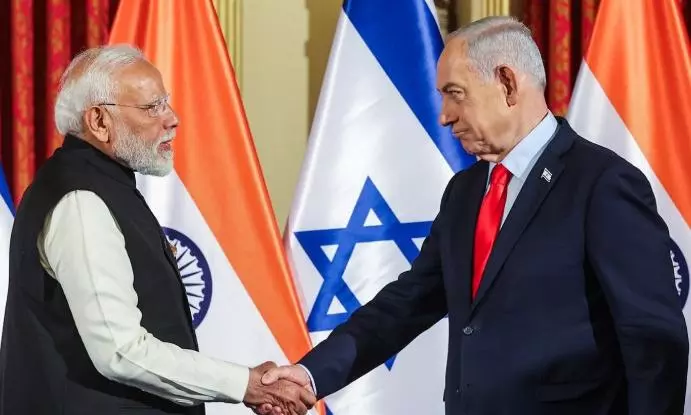
The political setback comes at a particularly embarrassing moment for Modi, given the warmth of his personal and diplomatic relationship with Netanyahu.
Only last month, Netanyahu invited Modi to attend Israel’s Independence Day celebrations in 2027. Two days before launching the illegal war against Iran on February 28, the Israeli Knesset awarded Modi recognition for his “significant contributions to the State of Israel and the Jewish people.”
It is now unclear whether that invitation still stands.
A blow to Netanyahu
On Saturday (November 7), Israel’s President Isaac Herzog invited the leader of a broad coalition led by Gadi Eisenkot to form the next government, delivering a potentially decisive blow to Netanyahu, who had tried desperately to cling to power by hook or by crook despite losing his majority in the newly elected Knesset, Israel’s equivalent of the Lok Sabha.
The inconclusive election last month produced no clear winner, with no party securing a simple majority of 60 seats. However, the opposition, led by Eisenkot, managed to assemble a broad political front, with external support from Israeli-Palestinian parties holding 19 seats.
Following consultations with both Netanyahu’s alliance and Eisenkot’s coalition, President Herzog appears to have given the latter the opportunity to form the next government.
The coalition assembled by Eisenkot is politically and ethnically diverse, bringing together left-wing, right-wing and centrist factions, alongside predominantly Israeli-Palestinian members. Its formation required the participating factions to set aside several of their campaign promises and ideological differences to unite behind Eisenkot.
Eisenkot's principal objective
For Netanyahu, Israel’s political Machiavelli and a dominant figure in the country’s politics for many years, the prospect of losing power represents a major political defeat. He reportedly tried to obstruct the presidential decision-making process until the last moment.
Hours before Herzog's decision to allow Eisenkot to form the government, Netanyahu offered to establish a unity government with his political rival. He also warned that a coalition between the opposition and Israeli-Palestinian parties would lead to the collapse of the country.
Eisenkot rejected the offer, declaring that his principal objective was to ensure Netanyahu’s departure because of his failure to defend the country on October 7, 2023.
Netanyahu's response to the electoral setback has also exposed his unwillingness to accept political accountability. After losing the election, he alleged that foreign countries, particularly Qatar, had contributed to the electoral success of Israeli-Palestinian parties, apparently seeking to delegitimise the verdict.
Trump's unexpected announcement
Meanwhile, Israel’s president said on November 3 that he had been blindsided on election day when US President Donald Trump announced that Washington would halt roughly $4 billion in annual military aid to Israel by the end of the year. The proposed move would cut off American support two years before the existing bilateral agreement is due to expire.
Netanyahu's political predicament cannot be separated from his disastrous regional policies. For years, he has perpetuated the claim that Iran possesses nuclear weapons, eventually dragging President Trump into a war against Iran in June 2025. The two leaders subsequently intensified the conflict from 28 February, eliminating Iran’s top leadership.
The continuing war, accompanied by the closure of the strategically important Strait of Hormuz, has precipitated unprecedented economic and existential crisis across countries, exposing the far-reaching consequences of Netanyahu's regional adventurism.
Little wonder, when he entered the sanctum sanctorum of the United Nations General Assembly in September, a large majority of countries chose to walk out from the proceedings.
The risk remains
“Israel is already in the midst of a dangerous diplomatic tsunami,” Eisenkot said on Friday. He expressed concern that a situation in which Netanyahu “continues to exercise authority over Israel’s security system and law enforcement agencies is dangerous and must not be allowed to continue for even one more day.”
Eisenkot has already announced that he would consider establishing a committee to investigate Netanyahu’s failures in handling the October 7 events. Netanyahu also faces serious corruption charges and could ultimately go to prison.
Nevertheless, Netanyahu remains caretaker prime minister, and his departure is not yet a certainty. The swearing-in of the new lawmakers on Tuesday could still encounter obstacles, as Eisenkot works to arrange the election of a new parliamentary speaker to replace the Netanyahu loyalist currently holding the position.
The possible end of Netanyahu's political dominance would therefore represent more than a change of government. It could mark a repudiation of the politics of permanent war, impunity and the systematic ethnic cleansing of Palestinians from their own land.
India’s selective outrage
For Indian Prime Minister Narendra Modi, whose “dear friend” Bibi Netanyahu has presided over an exceptionally close diplomatic and defence relationship with India, the political developments in Israel present an uncomfortable contrast.
Modi was quick to condemn the killing of seven Israeli citizens in Tel Aviv as “heinous.” Yet he has remained conspicuously silent about the indiscriminate killing of Palestinian mothers, children, doctors and aid workers, as well as the continuing destruction of Gaza’s hospitals, schools and refugee camps.
Recently, the RSS, which silently shares the ideological goals of Zionists, invited the Israeli envoy to its 100th anniversary celebrations in Nagpur.
This selective expression of outrage raises serious questions about the moral foundations of India's political and foreign policy.
New Delhi's contradictions
India is a signatory to the 1948 Genocide Convention. Yet the Modi government continues to deepen its economic and military relationship with Israel even as the International Court of Justice examines allegations of genocide against the country. Earlier, New Delhi signed a new bilateral investment treaty with Tel Aviv, a development that, under international law, may constitute complicity.
The contradiction is difficult to reconcile with India's longstanding claims of support for international law, human rights and the Palestinian people's legitimate aspirations.
India's relationship with Israel is, of course, not new. But the Modi government's increasingly close political, military, and economic embrace of Netanyahu has taken that relationship to another level, at a time when Israel's conduct in Gaza, Lebanon, and Iran has attracted unprecedented international condemnation.